
 ***** “Hokusai & Ukiyo-E: The Floating World” is an incredible exhibition of Japanese artwork from the Edoardo Chiossone Collection. Focused on the Edo period between 1603 and 1868, these drawings, paintings, woodcuts, and handcrafted objects have been meticulously assembled for the first-time in the United States at the Cleve Carney Museum of Art. Much of the exhibition is dedicated to the renowned artist Katsushika Hokusai (1760-1849), best known for his depiction of “Under the Wave off Kanagawa”, commonly known as “The Great Wave,” from his series “Thirty-Six Views of Mount Fuji.” The larger theme of the show has to do with “The Floating World”, or ukiyo-e, which is the combination of theatre, art, music, fabric, and philosophy: basically, the finer things that life has to offer. Ukiyo-e implies that since life is transient, one ought to spend time seeking pleasure and be “buoyantly floating.” The thought is that the arts portend a higher realm and give people a glimpse of Paradise.
When we first enter the galleries, we learn about Hokusai’s biography and that of other artists of the era as well as about the history of Japan. One of the more fascinating things we discover is that Hokusai was instrumental in the design of banknotes, with the nation’s standardization of Japanese currency. In addition, we come to understand something about Hokusai’s contemporaries, predecessors, students, and followers and where all of these famed artists studied and taught. Once we leave from the gallery that explains all of this historical background, we enter the main gallery to see the art collection itself, upfront and personal.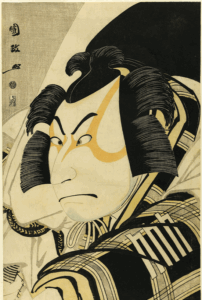
What is fascinating is the number of developments during the Edo period that revolutionized Japanese printing and painting. For starters, the methodology of printmaking advanced. The use of woodblock printing meant that multiple prints could be made, so that owning artwork was no longer limited to elite patrons but could become accessible to the public. But it was the use of color that made prints even more highly desirable. As traditional black ink gave way to colored inks (which artists would layer on their blocks), artists of the time began to experiment with differing pigments. For example, when Hokusai created his iconic woodblock prints in the early 1830s, he used a deep Prussian blue: a relatively new pigment at the time which gave his artwork its vibrance and striking contrast. But when we walk up to the final piece of art in the exhibition, that is, “The Great Wave”, we see no such contrast. Heat and humidity have apparently faded and darkened the image. As a consequence, we are treated to the highlight of the collection in the lowlight of a semi-darkened room—to prevent this original masterwork from deteriorating any more than it already has.
The Edo period also marks an important transition having to do with the way that Japanese landscape artists captured a three-dimensional world using a two-dimensional medium. This has to do some shifting away from a traditional Japanese perspective regarding the illusion of depth and the adoption of a more Western perspective (most likely from the Dutch Masters). This “modern” use of perspective can be found in Hokusai’s art as well as Utagawa Hiroshage’s triptychs, which incorporate the idea of foreground, middle ground, and background. In addition, artists of that era often added to their choices of subject matter, choosing to depict the activities of average people in addition to portraying the interests and pastimes of the elite. For example, in Hokusai’s masterwork, we see fishing boats, which (depending on one’s interpretation) are either moving towards or away from shore. He captures a feeling of motion and activity in contrast to offering stillness by freezing a moment in time.
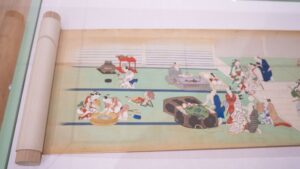
Other highlights of the collection include Utagawa Kunimasa’s colored wood block prints of highly dramatic expressions of actors’ faces, Kuwagata Keisai’s simplified drawings of animals and plants, Utagawa Toyoharu’s calm portrayals of people, Kitagawa Utamaro’s depictions of geishas and definitions of what makes them beautiful, and Utagawa Kuniyoshi’s cleverly designed series of faces comprised of nudes (called his “together pictures”), plus painted scrolls by various artists.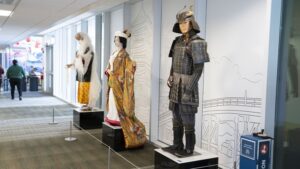
After leaving the Chiossone Collection, it’s on to Rich Lo’s modern artwork with a Japanese theme, followed by “Hokusai’s World: Step into Edo.” Here the stage in the theatre section has been nicely recreated as a street in Tokyo (Edo) (circa 1830): one that Hokusai might have frequented, complete with wax figures of Japanese residents and little shops, such as a teahouse and market stall. Inside the printmaking shop, the artist and his daughter are portrayed as lifelike figures who are creating art. Visitors can walk down the street or take advantage of a respite in a theater seat.
Next we are confronted with a very different type of immersive experience: This time we become the subject of artwork in a two-dimensional world. The room is entitled “Immersive History of Manga & Anime”, and we enter the pages of a graphic novel or comic book. I loved it! A collaboration between the Cleve Carney Museum and Chicago’s 2d Restaurant (which opened in February 2022), this exhibit is very innovative! Here 2D is changed into 3D and we can walk around in a display that’s completely in black and white (with no shades of gray). Posted throughout is a detailed history of these visual artforms for children, teens, and adults. Across the hall is a Hokusai Kids Area, where children are encouraged to do arts and crafts in the Japanese style, and also a Samurai & Silk Selfie Photo Station where you can stand next to manikins dressed in the Japanese fashions, with women dressed in kimonos and men as warriors.
Japan is known for its pilgrimage routes which afford tourists an opportunity to think about how to live with a vibrant heart. Akin to this journey, each visitor is provided with an Eki Stamp Book when they receive their admission ticket, so that visiting each site in the Museum might be commemorated by a unique stamp. And by diligently traveling throughout the Museum from one exhibit to another—and following our own spiritual path—we are ostensibly replicating the idea that we can spend a fulfilling life viewing the representations of Paradise on earth.
This exhibition is a Must See!
“Hokusai & Ukiyo-E: The Floating World” is at the Cleve Carney Museum of Art, in the McAninch Arts Center, at the College of DuPage, 425 Fawell Blvd., Glen Ellyn, Illinois, through September 21, 2025.
Exhibition hours (subject to change):
 Tuesdays, Wednesdays, and Fridays – 10:00 a.m. to 6:00 p.m.
Thursdays – 10:00 a.m. to 8:30 p.m.
Saturdays – 9:30 a.m. to 6:00 p.m.
Sundays – 9:30 a.m. to 5:00 p.m.
Tickets: Choose the date and time, offered every 15 minutes.
$12 – Tuesday/Wednesday, Thursday and Friday after 2:00 p.m.
$27 – Tuesday/Wednesday/Thursday/Friday
$32 – Saturday/Sunday
$20 – youth (age 12 and under)
$2 discount for senior/student/military (not applicable to $12 ticket)
College of DuPage Student – 50% off adult price. Must purchase in person with COD ID
Eki Stamp Book included with ticket purchase
Audio Tour – $10 additional
For more information and to purchase tickets, go to: https://clevecarney-gallery.squarespace.com/hokusai or call 630-942-4000.
Groups of 20 or more: Call 630-942-3026 or grouptix@cod.edu for reservations.



More Stories
“Fantasticus: Bach and Before” Bach in the City reviewed by Julia W. Rath
“The Carpenters Songbook: A Live Celebration” starring Christina Helene Braa as Karen
“Battle of the Burgers” at Amrican Place Casino-