
 ** The Holocaust, known in Hebrew as the Shoah, was the genocide of European Jews during World War II. From 1939 to 1945, Nazi Germany and its collaborators systematically murdered around six million Jews across German-occupied Europe, approximately two-thirds of Europe’s Jewish population. Concurrent persecutions killed millions of other non-Jewish civilians and prisoners of war, such as the Roma and Sinti, people with disabilities, homosexual men, Jehovah’s Witnesses, black people, and political opponents of the Nazi regime, not to mention the intentional targeting of Slavic peoples, including Soviets, Poles, and other Eastern Europeans. Starting in the year 1933, when Adolf Hitler and his Nazi Party came to power in Germany, State‑organized persecution of Jews and other minority groups began. These policies quickly escalated into imprisonment, violence, and eventually mass murder.
Initially, the murders of the Jews were committed through mass shootings across Eastern Europe. But later, Hitler invoked what was called “The Final Solution.” The plan was to squeeze Jewish populations into ghettos throughout Europe to facilitate their residents’ subsequent transport to concentration camps, some of which were labor camps (often supplying the German war effort) whereas others were extermination camps. While starvation, forced labor, executions, and medical experimentation and extermination programs all contributed to concentration camp deaths, what was subsequently chosen as the most “efficient” means for murdering millions of people was the use of poison gas chambers.
But the Jews did not remain helpless in the face of mass deportations. Among the Jewish ghettos that were created by the Nazis, the largest was the Warsaw Ghetto, in Poland. When formed in 1942, it confined nearly half a million Jews. There, Jewish underground groups formed armed resistance units, and on April 19, 1943, led by Mordecai Anielewicz, the resistance launched the Warsaw Ghetto Uprising, the largest Jewish revolt during World War II and the first significant urban revolt against Nazi occupation in Europe. Despite limited weapons and support, the fighters resisted German forces for nearly a month until the ghetto was fully liquidated on May 16, 1943. Since 1959, the 27th of Nisan on the Hebrew calendar (which usually falls in April or May) has been designated worldwide as Holocaust Remembrance Day so as to mark the resistance of these brave Warsaw Ghetto fighters together with a wider recognition of the darkness of the Holocaust, where hope often seemed futile in the face of evil.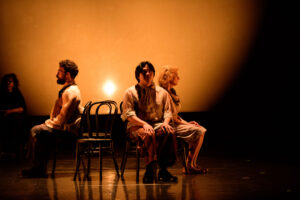
Keeping this in mind, a play called “Concentration” took place at the Ruth Page Center to commemorate Holocaust Remembrance Day. Performed only twice and for one weekend only, this play in one act with music pieced together a series of fifty poems written by Arne Weingart that combined reflections about genocide and human suffering, using material obtained from those who witnessed the horrors of Nazi concentration camps. But it was hard to concentrate on “Concentration.” As a production, it was choppy and disorganized and, at best, avant garde. While the overall story moves forward in time, the narratives are largely “stream-of-consciousness.” This stage adaptation of poems, directed by Anna H. Gelman, was meant to be a “dramatic monologue”, intended to be voiced by one young poet living in a death camp. If that’s supposed to be the case, then it should have been staged very differently. As things currently stand, it feels as if each of the narratives, spoken by four different actors, are the thoughts and impressions of a good number of prisoners. Hence the rest of this review is being written from the point of view of the audience, where we believe that the monologues are not simply the reflections of one individual but are intended to be the voices of many different people in the camps.
This brings me to one of the major faults of the show: that the audience remains at too much of a distance from the characters. This is largely because the four actors—Jack Aschenbach, Lynne Baker, Rich Adrian Lazatin, and Jourdan Lewanda—rotate parts and play so many roles that we cannot keep them straight. The characters don’t have names, and we don’t know how many in total they are meant to represent. We never really learn about their background except for a few snippets, and above all, we don’t know where the individuals came from and what occurred before or after their concentration camp internment. How and why did they wind up in the camp in the first place? Some of this is hinted at, but we don’t really know. With no one particular victim’s or survivor’s account to follow from beginning to end (and with each disjointed narrative immediately following one after the other), I found myself losing whatever depth of feeling I might otherwise have had. Basically, the actors read their lines but don’t inhabit the characters. This trivializes the terrible things that have happened to these prisoners and diminishes the magnitude of their encounters with evil.
Yet the main problem with this play is its lack of context. It is mostly ahistorical. No mention is made of how long the Jews had been living in Germany as a people or what their culture, language, and religion meant to those living in Eastern Europe. No geography is ever mentioned, except a bit towards the end about the location of the camps themselves. Plus, the politics of Hitler’s rise to power are not discussed, not to mention the growing restrictions which the Nazis placed on the Jews from 1933 forward. I understand that “Concentration” is not meant to be all-encompassing of the Holocaust and World War II era. But if you don’t already know something about this time period in advance, you’ll get lost and glean little from watching the show. And if you already know something about the Holocaust, you’ll know how much this production falls short.
As for the staging, the actors are continually moving, shifting, inverting, and stacking chairs. For me, this seemed reminiscent of that famous expression about rearranging chairs on the deck of the Titanic. And while this motion adds some interest to the play (or else the monologues would be completely made up of talking heads), this only adds to the confusion in telling the larger story. To a point, I understand the director’s choice in creatively illustrating how the camps were meant to be chaotic for their inmates. But in a number of spots, so much hubbub takes away from the words that the actors speak.
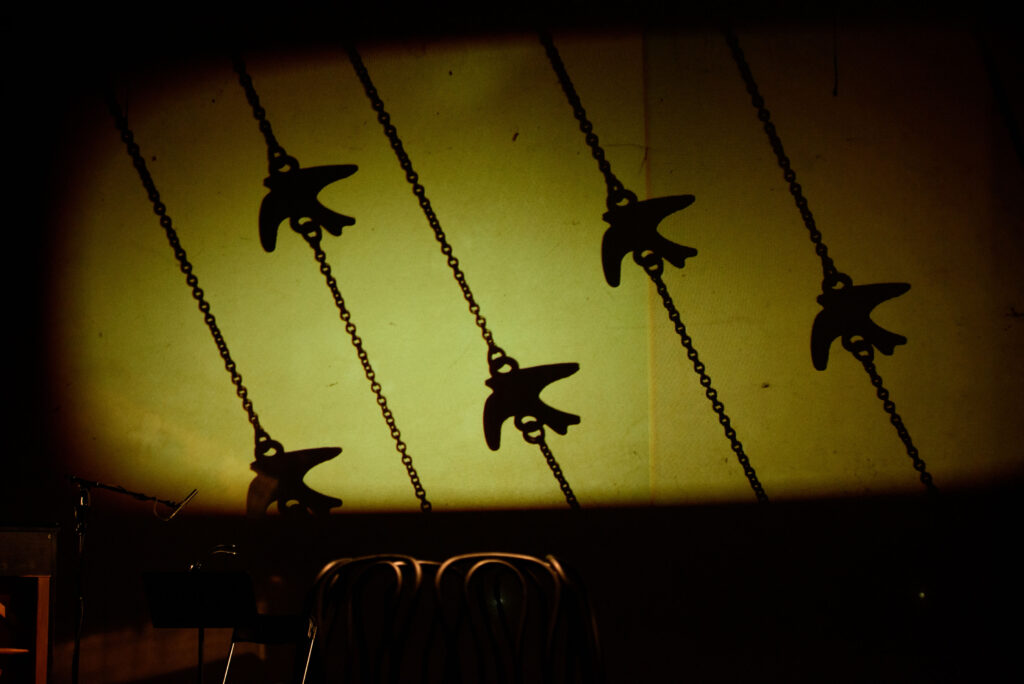
I generally liked the stirring music created by composer Cherise Leiter, which added to the solemn mood. Music director Jordan Olive, Kelly Quesada on cello, Barbara Drapcho on clarinet, and Nathan Urdangen on piano all did a nice job. Sonia Goldberg, the vocalist, was at her best when she sang the high soprano towards the end, and it was appropriate that she sang in Yiddish to match the Yiddish songs that we heard as we entered the theatre before the performance started. The choice of melodies and sound design by Patrick Budde were more than appropriate. Ryn Hardiman’s lighting and projections were good but scenes from the camps and trains could have been more ample. Costumes by Madeline Felauer were suited to the play, with the actors eventually shedding their colorless clothing for army-issued underwear. This nicely pointed up how the Germans tried to make their prisoners appear gray, soulless, and uniform. But I did not care for the house lights coming on when the actors returned to their street clothes before the show ended, although I understand that this was done to demarcate what happened back then to what’s happening now. Allow me to explain…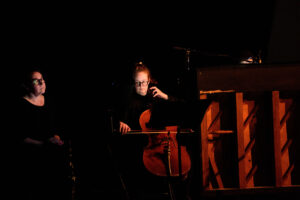
While the play is for the most part nonlinear, it does move forward to the moment when the concentration camps are liberated. Right after that is perhaps the most poignant part of the show: when the camps from the 1940s are likened to ICE facilities throughout the United States today. My question is whether this analogy meant to be a parallel or a foreshadowing. Is there some religious belief (like being anti-Semitic) or some political ideology (like being anti-immigrant) a holdover from the past? Can this play serve as a warning about the persistence of evil from one generation to the next? Presently, we all know who and what ICE is. But creating some monologue linking ICE to the Nazis or to the Far Right would have helped place current events in some context beyond that of our own imagination.
In sum, “Concentration” lacks focus and does not generate enough empathy. Because character development is nonexistent, the heartwrenching accounts of suffering, pain, and incomprehensible grief don’t resonate with the emotion that they should. Of course, it is nearly impossible to grasp the larger reach of fascism and the full extent of the crimes that the Nazis perpetrated against the Jews and others. But rather than listening to a series of sporadic and often unrelated recollections, it would have been better (and much more meaningful) to absorb fuller narratives from victims and survivors. At the very least, their stories would have been much easier to follow. I was disappointed.
“Concentration” had only two performances: Saturday, April 11 at 7:00 p.m. and Sunday, April 12 at 2:30 p.m., at the Ruth Page Center for the Arts, 1016 N. Dearborn Street, Chicago.
Tickets were $18 and $36 and were available at Concentration26.eventbrite.com or https://www.eventbrite.com/e/concentration-tickets-1983139577862?aff=oddtdtcreator.
There were talkbacks after both performances:
On Saturday, Rabbi Steven Philp (Miskan Chicago) was in discussion with Anna H. Gelman and Arne Weingart about Holocaust Memory & Memorialization.
On Sunday, Rabbi Shoshanah Conover (Temple Solom Chicago) was in discussion with Anna H. Gelman, Arne Weingart, and Cherise Leiter.


More Stories
“The Carpenters Songbook: A Live Celebration” starring Christina Helene Braa as Karen
“Battle of the Burgers” at Amrican Place Casino-
Ravinia Musical Festival presents ” Sing Along Grease” reviewed by Frank Meccia