
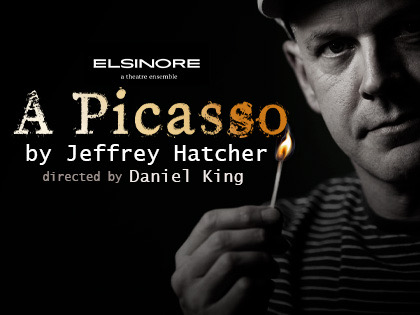
 ***** I can’t say enough good things about “A Picasso”, written by Jeffrey Hatcher, directed by Daniel King, and produced by Elsinore Ensemble. This two-hander is a brilliant psychological drama, combining very complicated personal dynamics with a theme that’s urgent. A brilliant playwright with an incredible understanding of human nature, Hatcher shows us how facts can be twisted to become lies, how lies can be twisted to become facts, how people begin to believe their own lies, and how they carefully pick and choose to remember or forget details from their life—and then frame these details in ways most favorable to themselves. He asks all the right questions about what it means to compromise oneself and one’s principles, as he points up the circumstances where this could easily come about, that is, under the aegis of an authoritarian regime.
The story takes place in Occupied Paris in the year 1941. Picasso (Jamie Ewing) has been seized by the Nazis and has been brought to an art storage vault with the intent of having him questioned by a German “cultural attaché” named Miss Fischer (Lori Rohr). Since she has specifically been tasked with getting “A Picasso”, her interrogation is framed by one burning question: Which one of his confiscated works will the master artist agree to contribute to a major art exhibition soon to take place at the Tuileries? Suffice it to say that other famed artists of the era will have their works on display as well, under the title “Degenerate Art.” However, since Picasso’s work is intended to be the highlight of the exhibition, the Nazis are giving him a choice in the matter.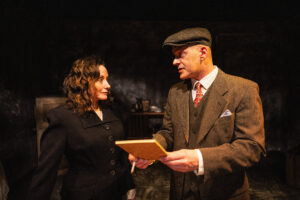
As the discussions between Picasso and Miss Fischer turn to the nature of his oeuvre, or body of work, we learn about the artist’s family history, his romantic interludes, and his feelings about his contemporaries—and also how strongly he feels about the fruits of his labor, which he describes as akin to his children. We discover his feelings about the innate sexuality of the women who once posed for him. We also contend with the idea that his works might have some type of political significance or hidden agenda associated with them. A good portion of the play is thus devoted to one of Picasso’s most famous paintings “Guernica”, which he executed at his home in Paris in response to Nazi Germany’s 1937 bombing of Guernica, a town in the Basque Country in northern Spain. This black and white painting in the Cubist style helped bring worldwide attention to the Spanish Civil War. Yet in response to Miss Fischer’s questions, Picasso insists that his job as an artist is not to comment on politics, but she is not taken in.
In fact, we witness how Picasso selectively rewrites his biography with expediency being first and foremost, paramount to his own survival and that of his art. We learn how he climbed the ladder of success: telling us how, as a child, he could draw like Raphael, but he had to unlearn all this as an adult in order to draw and paint like himself, that is, to be true to his perceptions. At the same time, Miss Fischer reveals parts of her personal history and admits how much she enjoys modern art; yet she intentionally chose to mold herself under the watchful eye of those around her and mimic their opinions, even when she disagreed with them. In other words, she learned to say all the right things to all the right people in just the right way and at just the right time in order to advance her career. She tells us how, over time, it became easier and easier to convince herself that someone else’s opinion mattered more than her own. Basically, she learned how to navigate the current Nazi regime by subsuming her own thoughts and beliefs and by placing her self-preservation over good will.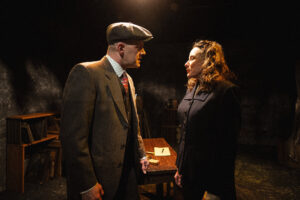
In spite of their differences in politics and morals, Picasso and Miss Fischer actually do understand each other. As both grapple with each other’s viewpoint, they start to see themselves to a greater or lesser extent in each other, which draws them together. Above all, both know what it means to have a private face as well as a public one. And both are forced to confront the magic question regarding which individuals ought to pass judgment on one’s work. Who do we trust? Who would be dead honest about its quality? And what does it mean to be of critical mind? But additionally, what does it mean to become tightly invested with a crew of so-called tastemakers? Who are they? And to what extent might one’s judgment be compromised by individuals who have a preconceived agenda?
Marquecia Jordan’s costume design using 1940s patterns works well for this show. Picasso is nicely dressed in a suit and vibrant tie. Miss Fischer is dressed in a navy blue suit, reflecting her professional status in the Nazi party. Randy Rozler’s props and set dressing are very good in its representation of a storage vault with artwork. I liked the robe over the mannikin and the wooden table in the middle with two metal-framed chairs from the time period, together with lots of canvases leaning against a wall, plus a wooden bookshelf with art books and smaller pieces of artwork. Quinn Chisenhall’s lighting design is more than appropriate to amplify the characters’ basic sentiments. Sound design by Kate Schnetzer is good. I especially liked the BBC radio broadcast before the show started, with the announcers talking in English with British accents and the Germans talking in English with German accents.
No commentary about a master 20th century artist like Picasso would be complete without an examination of what beauty is, especially in relation to truth. But what is truth, and what is beauty? Is there some kind of objective standard? The Nazis excelled at disparaging those works that didn’t fit the narrow mold of what they considered to be high culture, and, in so doing, they dehumanized the people who created these things (and obviously, these people would have to be degenerates themselves). Hence, the production opens up ideas regarding what criteria the Nazis used to determine which items of art they considered to be degenerate.
Except for learning the names of the various fine artists whose works have been censured, we learn remarkably little about the type of artistic detail which the Nazis had a problem with. Nonetheless, we are told that the German population acquired a growing interest in artwork having to do puppies and kittens. This choice of subject matter was considered safe, as it lacked any sort of political meaning. Now flash-forward to a politically and culturally divided country like the United States today. What apparently gets the most hits or likes on social media happens to be the very same thing: photos and videos featuring puppies and kittens.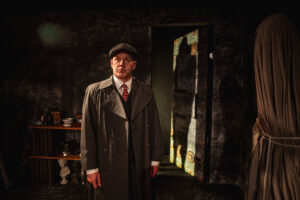
Finally, as Jamie Ewing writes, “This is a real time interrogation piece… with life and death circumstances cut through with levity. Both characters are compelling, complex, and relatable in their own ways – sometimes uncomfortably so. What’s more, it’s been hard to escape the uncomfortable echoes in present-day Chicago. In the show, Picasso is literally taken by Nazi agents from the streets of Occupied Paris in broad daylight. Sadly, this parallel has become even more pertinent throughout our rehearsal process – seemingly by the day.”
This show is a MUST SEE!
“A Picasso” is playing through December 21, 2025, at the Greenhouse Theater Center, 2257 N. Lincoln Avenue, Chicago.
 Tickets: $32 for Adults + $4 convenience fee
$22 for Seniors (age 65+) /Students/Military + $4 convenience fee
Performance schedule:
Thursdays, Fridays, and Saturdays at 7:30 p.m.
Sundays at 2:30 p.m.
For more information about this show, go to: https://www.broadwayworld.com/chicago/regional/A-Picasso or visit Facebook at https://www.facebook.com/ElsinorePlayers/.
( the theatre company https://elsinoreensemble.com ).
To purchase tickets, see: https://ci.ovationtix.com/36644/production/1255700 or call the Greenhouse Theater Box Office at 773-404-7336.
To see what others are saying, visit www.theatreinchicago.com, go to Review Round-Up and click at ” A Picasso”.




More Stories
“Dead Girl’s Quinceanera”
“Dial M For Murder”
“A Midsummer Night Scream” reviewed by Frank Meccia