

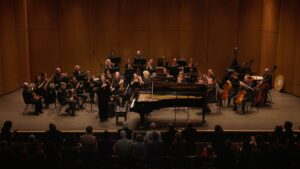
 ***** “Mozart’s Summit” is the peak of perfection! To open its 56th season, Music of the Baroque featured an all-Mozart program by celebrating three of his last works, written in just a few short weeks before his premature death. At the time of Mozart’s writing, he was at the height of his powers and his productivity—and now on Sunday, September 27th, his compositions were being performed magnificently by the Music of the Baroque Orchestra, conducted by Dame Jane Glover, at the North Shore Center for the Performing Arts, in Skokie. Every seat in the house was taken, and all of us got to witness one of the best concerts ever.
 After the intermission, we heard Symphony No 41 in C Major (Jupiter), K551, the last symphony that Mozart would write. Known for its triumphant use of brass and violins to indicate the Roman god’s fury, both Allegro movements were stunning and stirring. The famous Andante cantabile section features unusual dynamics and arpeggios that move in waves. The Menuetto movement features a dance that descends and dissolves, only to be supplanted by the Finale: Molto allegro movement, where the thundering music gave all the instrumentalists quite the workout and provided a bold and triumphant conclusion to the evening.
Maestro Glover superbly conducted all of the scores from memory, with the slower sections by hand alone rather than by using the baton. What an incredible job! I was also very impressed with how completely she recognized every one of the musicians at the very end.
It was an honor to be in attendance at this perfectly executed concert, being performed by such a talented ensemble. A special mention needs to be made of violinist Paul Vanderwerf, who also serves as the orchestra’s music librarian. If there was any one similarity between all three of Mozart’s works on the program, it was the wide use of theme and variation. I loved listening to how the melodies gravitated from one section of the orchestra to another, with echoes that permeated throughout. The concert also got me thinking about how music during the late Baroque Period has evolved into what we consider to be modern music, that is, with the abandonment of the basso continuo and with the evolution of the full sound of the modern orchestra.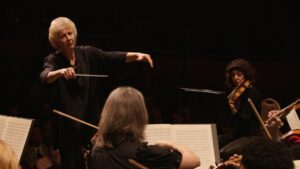
Above all, the concert was well received by a delighted audience! The event provided me with a stellar example of how envious I can be of those who play Mozart’s compositions on a regular basis and get to know every note, trill, shimmer, and nuance.
“Mozart’s Summit”, Music of the Baroque took place on Sunday, September 27, 2026, at the North Shore Center for the Performing Arts, 9501 Skokie Boulevard, in Skokie. This was followed on Monday, September 28 by a performance at the Harris Theater, in Millennium Park, 205 W. Randolph Drive, in Chicago. Both concerts began at 7:30 p.m.
For more information about this and future performances of Music of the Baroque, including times, dates, and locations, please go to: https://www.baroque.org/.
The On-Demand pass is available from October 2 through November 2. The purchase price is $18. Go to: https://www.baroque.org/Seasons/2026-2027/mozart-s-summit/. Terms and conditions apply.
Music of the Baroque is a resident company of the North Shore Center for the Performing Arts. To learn more about the venue, its future offerings, and ticket prices, visit: https://northshorecenter.org/.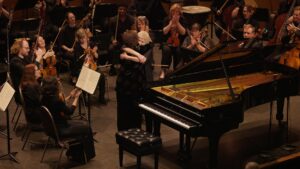
To learn more about the Harris Theater, their future offerings, and ticket prices, go to: https://www.harristheaterchicago.org/.



More Stories
“The Carpenters Songbook: A Live Celebration” in Milwaukee
“The Last Word” IO THEATER
The Generations visit McHenry