
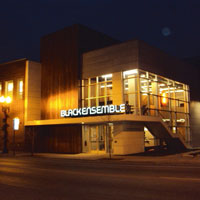
 ***** Vibrant, energetic, and highly entertaining, “You Can’t Fake the Funk: A Journey Through Funk Music” is a spectacular musical revue in conjunction with the 50th anniversary of Black Ensemble Theater. Presented from the perspective of the “mothership” blasting off from Earth, this musical revue makes people like me remember how old we really are! Written and directed by artistic director Daryl D. Brooks together with associate director Qiana McNary, the show is narrated by Dwight Neal as Dr. Funk. He traces the golden age of funk from its origins during the Civil Rights Movement and then through the 1960s, 70s, and 80s. We learn about its major recording artists via a psychedelic journey where we hear their music and watch their performances as well as through a deep dive into the artists’ back stories. We not only see vignettes from some portion of their lives, but we also discover how some of their songs became crossover hits that appealed to audiences both black and white.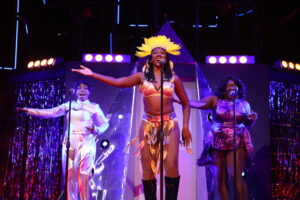
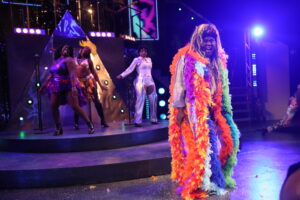 Denise Karchewski does double-duty with her set design and lighting design, both of which are fascinating (as in the way that Mr. Spock might say the word). We see a “mothership” somewhat resembling a 1960s’ flying saucer or some similar space vehicle, featuring a triangular main doorway. In addition, metallic streamers hang from two other doors at the back of the set, and mock windows are featured above the stage. The floor also turns clockwise to introduce each new musical group to the venue and turns once again when each group makes its exit. The lighting creates a mood in keeping with the associated songs and artists, with each scene separated out from the rest by flashes of brightness and splashes of color. (I should add that there are moments, however, especially towards the beginning where the brightness can be too overwhelming.) DJ Douglass’s projection design is amazing, with vintage photos of the original artists and their bands plus psychedelic artwork, projected onto the stage windows and all throughout.
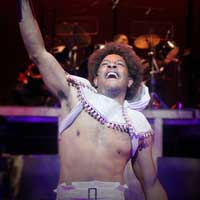
Makeup and hair and wig design, notably the large Afros of the day (and Rick James’s below-the-shoulder-length hair), make the remembrance of this era poignant but also fun. Thanks to costume design by Robert Kunh, the re-creation of times past is beautifully accomplished through the wealth of outfits. The clothes could not have been created any better, such as the tight-fitting metallic outfits, the pastel-colored garments, and, of course, the bell-bottoms. After all, this was the hippie era! While some patterns are taken directly from that time period, men’s trousers are sometimes women’s wear in disguise. And some of the costumes are just plain funky, such as Dr. Funk’s white suit with fringe, which morphs in the second half to a more outlandish outfit. The scope of the collective wardrobe is impressive as are the extensive number of costume changes by all the performers during the course of the show.
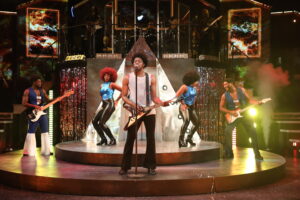
The incredibly invigorating and perfectly timed choreography is a treat! The performers dance with heart, speed, and precision: a credit to choreographer Christopher Chase Carter, who has schooled the cast in every slide, spin, leap, shake, and split. Their dynamism is infectious and makes the audience want to pick up where the performers have left off. Robin DaSilva, the vocal arranger, has done a marvelous job reworking the original songs so that they sound fresh and lively in keeping with the amazing talents of all the vocalists. And the musicians who back up the singers and dancers do a sublime job! The band consists of music director Robert Reddrick (drums), Adam Sherod (keys), Oscar Brown (guitar), Charles “Chip” DuBose (guitar), Walter Harrington (bass), Mark Allen Felton (sax), Corey Wilkes (trumpet), Bill McFarland (trombone), and Myron Cherry (drum understudy). Reddrick is located closest to the rafters, and with the band situated in three different levels within the set, it becomes apparent that the other musicians look to him for their cues. We see both Dr. Funk and the occasional band member ascend and descend the stairs that connect the various levels of the stage. The director has done a wise thing, that is, to have the narrator constantly moving around in order to create interest as well as to have guitarists and other musicians in the aisles, depending on the vignette being featured. Last but not least, sound design by Sean Alvarez is nicely balanced, although it is handy to carry a set of earplugs.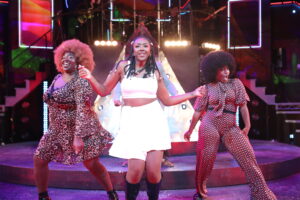
Funk is a “sound that defined a generation.” A lot is packed into the first half of the show, and on opening night, the audience was left astounded by its pure electricity. The second half is remarkably shorter and, to my mind, doesn’t build up to its gusto in the same way. That being said, what makes “You Can’t Fake the Funk” truly special is how much heart it has. It feels like a genuine love letter to the artists who originally created these timeless songs. It demonstrates how funk music is still relevant all these years after its creation. The performers at Black Ensemble don’t just mimic the famous stars of the past, but they bring their own unique styles to the stage. They do a phenomenal job of breathing life into these timeless songs as they use their musical talents to create the perfect mix of deeply felt emotion, high voltage, and high volume. This creates a profound connection with the audience while setting up a groovy vibe among those of us clapping our hands, dancing in the aisles, and enjoying ourselves immensely.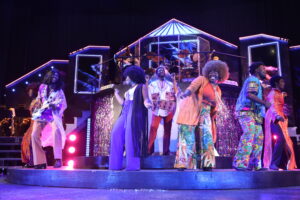
“You Can’t Fake the Funk” is playing through October 25, 2026, at Black Ensemble Theater, 4450 N. Clark Street, Chicago.
Tickets: $65 + $4 convenience fee = $69
17 or younger (proof of age required): $55 + $4 convenience fee = $59
Seniors 65+ proof of age required): $55 + $4 convenience fee = $59
Performance schedule:
 Fridays – 7:00 p.m.
Saturdays – 2:00 p.m. and 7:00 p.m.
Sundays – 2:00 p.m. and 7:00 p.m.
No performances: Sunday, October 4th at 7:00 p.m., Friday, October 16th at 7:00 p.m., and Sunday, October 18th at 7:00 p.m.
For further information and to purchase tickets, visit: https://www.blackensembletheater.org/youcantfakethefunk.
For general information about Black Ensemble Theater and for a list of their other offerings, go to: https://www.blackensembletheater.org/ or call the box office at (773) 769-4451.
To see what others are saying, visit www.theatreinchicago.com, go to Review Round-Up and click on “You Can’t Fake the Funk: a Journey Through Funk Music”.
Photos by Alan Davis


More Stories
“Dead Girl’s Quinceanera”
“Dial M For Murder”
“A Midsummer Night Scream” reviewed by Frank Meccia