

*** Thornton Wilder’s “The Long Christmas Dinner”, directed by Jacqueline Stone, offers a sobering counterpoint to the usual cheer of the season. This is a play that telescopes ninety years of Christmas gatherings at the Bayard family house, using one long dining room table to chart births, marriages, and deaths. We see how loved ones fade—physically, mentally, and emotionally—and we see how children grow up and are incorporated into the family. And as people grow older, so does the house. Akin to the generations of people it has held, the house itself gradually fades from its newness to being in need of refurbishment and repair. Once on Indian land, the structure finds itself located in an undesirable factory district, with its newest generation of owners feeling the need to move on.
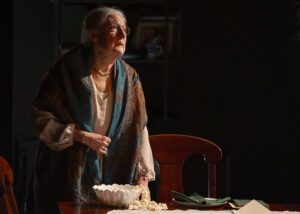
The basic Thornton Wilder story features Mother Bayard (Joan Merlo) presiding over her son Roderick (Clifton Frei), his wife Lucia (Alexis Primus), and Uncle Branden (Bide Akande) at the initial Christmas dinner. Their joy expands with the arrival of children Charles (Huy Nguyen) and Genevieve (Charlie Irving). Charles subsequently marries Leonora (Aziza Macklin), and the family line continues with Sam (Akande), Roderick II (Frei), and Lucia II (Primus). But over time, the house no longer feels like a home. Genevieve now wants to travel around the world and Roderick II chooses to live to California, and Lucia II chooses to live in a new house nearby. At the end, the matriarch who remains in the original house is cousin Ermengarde (Merlo), who lives alone.
Thanks to the work of Keith Parham, the set design is nicely done in conjunction with Helen Lattyak’s prop design. I especially adored the huge, long chandelier hanging from the ceiling over the old-fashioned elegant dining room table. The light fixture in the shape of grapes hanging from an arbor feels like one-of-a-kind, with its detail of branches and twigs at the top and glass pendants forming the individual grapes. Parham’s fine efforts also extend to lighting design, where the brightening and dimming of the lights and their color temperature shifts allow us to differentiate among the many years when Christmas Day takes place. This, in conjunction with commentaries about the weather (snowy, sunny, cloudy, and the like), provides the background by which we can witness the evolution of the characters through time. We see who is present at the table, who is now absent, who is new to the table, and who is aging or beginning to lose their faculties. I loved how the actors provided the illusion of time in the way they portrayed all the characters! We witness joys and arguments, and, in one of the most stirring scenes in the play, we witness Leonora’s grief for her stillborn baby. Stone’s staging is particularly striking in its treatment of death and absence. Characters who pass away slip quietly into a black-draped hallway stage right.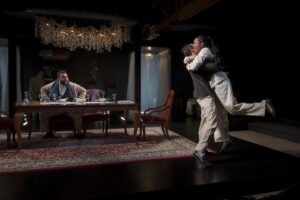
If there’s any real fault in the play, this has to do with Wilder’s original writing. Dinner table conversations in this show rarely touch on food, humor, or gossip. External events, such as politics, war, and religion, are only lightly acknowledged, and we see Roderick and Charles apparently more concerned with keeping up the family business (although we’re not entirely sure what it is). Nonetheless, adding a nod to often trivial discussions (if only for a line or two) would only add to the story’s authenticity.
I loved the costume design by Rachel Sypniewski, where all the actors are dressed in white, but then they put on vests and jackets and ties and robes and the like throughout the performance as they play different (living) characters. They often dress in front of the audience, but occasionally we see them change clothes as they retreat to the back and sides of the stage. But when they become angels or spirits or imaginary midwives (or when the actors serve as crew members and assemble and reassemble the furniture), then they are dressed entirely in white. One can easily observe the change in the house’s ownership from one generation to the next with the passing along of a lovely turquoise shawl, initially worn by Mother Bayard but which eventually finds itself astride the neck of Ermengarde—with both roles being played by the same actor. This serves as bookends to the performance.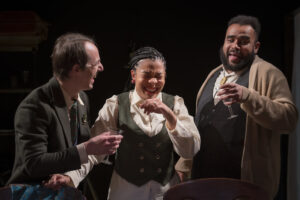
For those who have seen the show before, a number of changes have been made this year, not just in the casting but also in the script. While these changes keep things fresh, they are not necessarily for the better. Some amount of comedy has now been inserted into parts of the story where it is unneeded. For example, when one of the characters yells to the midwife not to drop the baby, I felt this was going for the cheap laugh. And suddenly the mystique of birth—as well as the mystique of death—was not as poignant anymore. From my perspective, this is a rather profound tale; and while adding some humor has its place, I found last year’s conventional version to be more compelling.
Another area of change is that some amount of music has been added to the production. Before the narrative starts, we see Macklin as a dancing vocalist who sings the blues, accompanied by Akande on guitar. Later we hear the hip version of “Santa Claus Is Coming to Town”, plus several other familiar melodies (including “Ain’t No Mountain High Enough”), which are incorporated within the story. While I happen to like these songs as stand-alone pieces and while they are performed very well, these selections are unfortunately not the right ones for this show. If music is to be added, the play would be better served with songs and arrangements from the eras that straddle the different Christmases, namely, songs contemporaneous with the years 1865 through 1955. This music would not only add a nice touch but would better allow us to pinpoint the various time periods that the play spans and enable us to differentiate among them. For example, inserting the original version of “Santa Claus Is Coming to Town”, circa 1934, into the appropriate scene could transport the audience back to that year and would help ground the storyline. Other “old-fashioned” Christmas songs could work well too, perhaps starting with “Deck the Halls”, written in 1862, followed by “Away in a Manger”, written in 1885, and perhaps end with Frank Sinatra singing Christmas melodies from 1948. Now having said that, I also felt that the existing songs could close the show; because once the narrative ends, the actors could break character, making the anachronism not so important.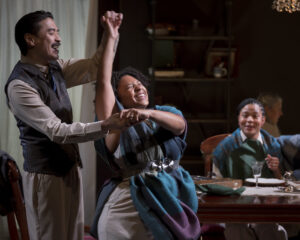
Related to this, the ending is somewhat different too. Ermengarde still threads popcorn into a garland, but the last scene is sadder: It lacks 2024’s joyous streams of garlands, accompanied by singing and interactivity with the audience. Of course, maybe today’s ending is more realistic, since the show is largely about how there always is someone absent at our holiday table but ever-present in our minds. Over the years, it’s reminiscences that become first and foremost, and we learn that festiveness doesn’t necessarily accompany the holidays as much as we think it should. Yet I would still prefer ending things on a lighter, more hopeful note, where celebration ultimately endures and adds to the spirit of the season.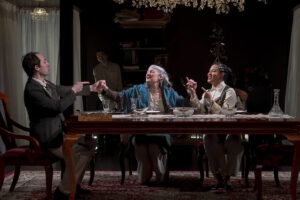
“The Long Christmas Dinner” is playing at Bramble Arts Loft, The Beatrice Theatre, 5545 N. Clark Street, 2nd floor, Chicago, through December 28, 2025.
Ticket prices $20, $45, $60, $100 (plus a $3.00 ticket fee)
 Performance schedule:
Thursdays, Fridays, and Saturdays at 7:30 p.m.
with Saturday matinees at 3:00 p.m. on December 20 and 27
Sundays at 3:00 p.m.
Additional performances on Monday, December 22 and Tuesday December 23 at 7:30 p.m
No performance on Christmas Day, December 25.
For further information and to purchase tickets, visit https://www.tutatheatre.org/the-long-christmas-dinner-tickets or email boxoffice@tutatheatre.org.
To see what others are saying, visit www.theatreinchicago.com, go to Review Round-Up and click at “The Long Christmas Dinner”.




More Stories
“Escape to Margaritaville” reviewed by Julia W. Rath
“Instructions for a Seance” (Milwaukee) reviewed by Amy Menzel
“Vladimir” reviewed by Frank Meccia