
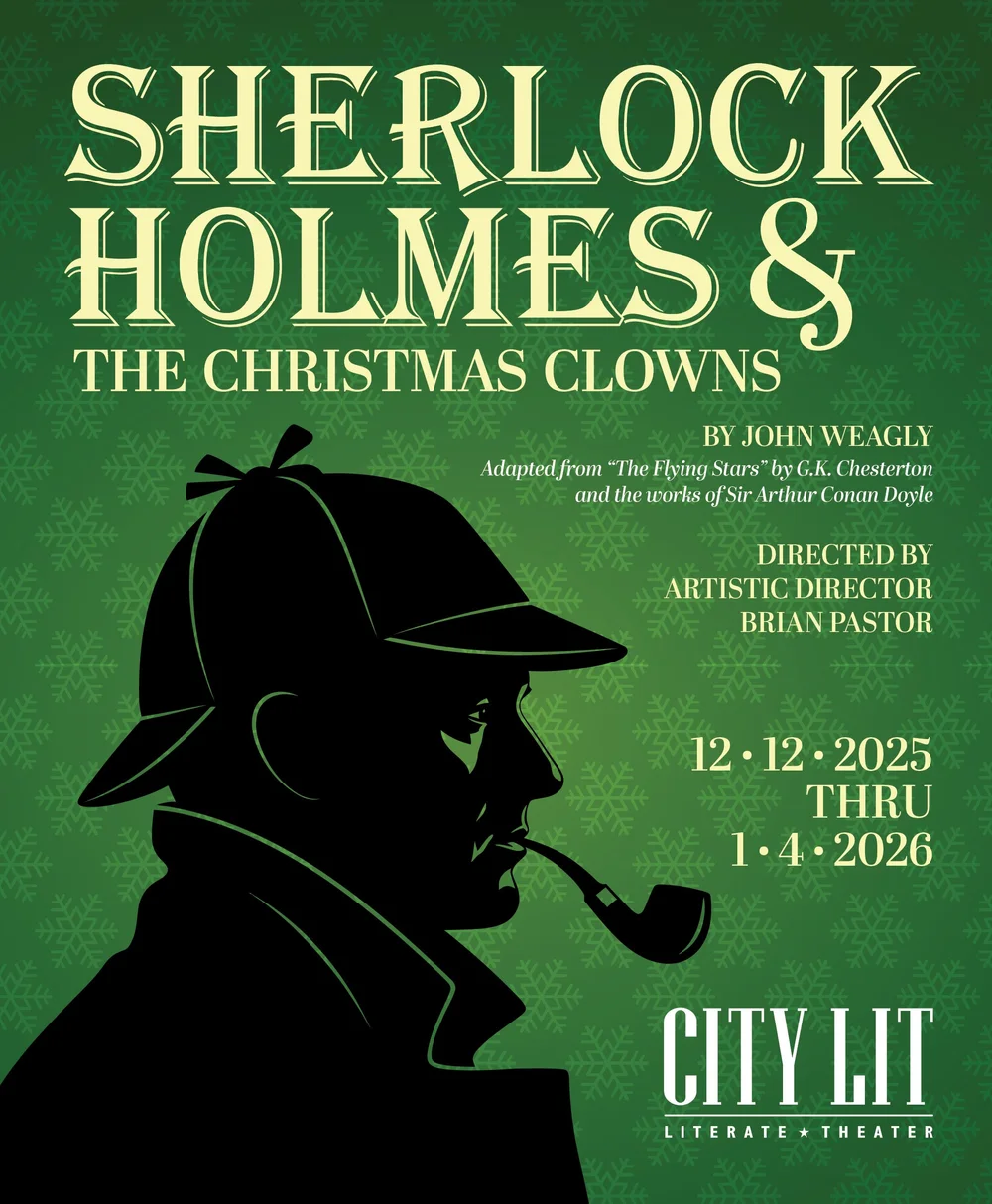
 ** Delightful, fun, but underdeveloped, “Sherlock Holmes and the Christmas Clowns” is a good play with music that could have been truly great. Written by John Weagly, this tale of mystery starts out like gangbusters, with its focus on its two main characters Sherlock Holmes (James Sparling) and Dr. Watson (Adam Bitterman). Sparling and Bitterman are expertly cast and play their parts brilliantly. It is thoroughly enjoyable to watch Holmes’s obsessive nerdiness and exactitude and Watson’s need to break down the fourth wall and narrate the story for the benefit of the audience. Of course, we can rightly assume that the stage is being set for Holmes to be the super sleuth who will solve some major crime.
The whodunnit takes place during a family gathering in the home of Colonel Horatio Adams (Mark Mendelsohn), a former army comrade of Watson’s. In addition to the colonel, we are introduced to his daughter Ruby (Sophia Vitello), her love interest and next-door neighbor John Crook (Manny Sevilla), Horatio’s sister-in-law from Canada Jemma Blount (Courtney Abbott), and Ruby’s godmother Lady Gabriella (Betsy Pennington-Taylor), as well as their housemaid (Alex George) and chauffeur (Bruce Holtman)—plus a messenger (Maggie Cain) and a policeman (David Fink). In addition, the minor characters double as an ensemble of singers and dancers, who add a buoyant touch to the narrative. It goes without saying that when the ensemble reveals Lady G’s stunning sets of three large diamonds to the audience, we can put two and two together and figure out that these would somehow become central to the overall plot. And sure enough (and I’m not ruining it for you), it appears that these diamonds have suddenly gone missing during a Christmas pantomime at the Adams’ house.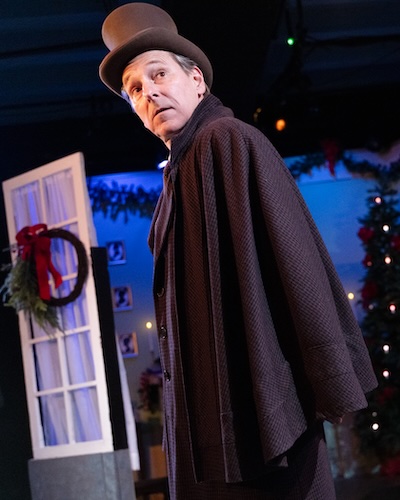
The so-called Christmas Clowns are a great component of the story, turning the show into more of a burlesque and a British pantomime within a pantomime. The production simultaneously makes light of this genre while holding it under a magnifying glass and expanding on it. The inclusion of music and dance thus turns an ordinary whodunnit into a burlesque with a plot behind it and serves to amplify the characters’ emotions while lightening the mood. The ensemble of singers and dancers not only promote the joyousness of the Christmas season but expose the economic divide and political atmosphere in 1896 London. They point up the reality of the day: that there are wealthy people who have the finances to own diamonds and to create their own entertainment at Christmastime and there are poor people in dire need of food and housing.
Now, having said that, the show suffers from a number of deficiencies. At 53 minutes long (or a full hour if you count the appended song plus the curtain call), the play is much too short to accomplish all that it has set out to do, that is, to combine a proper mystery with music and entertainment. For starters, the characters need to be developed better. With the exception of Holmes and Watson, each of the characters ought to be more complicated in order to draw more suspicion to them for this play to be successful. We need to understand somewhat more about each character’s background and possible motives for committing a crime so that we can look upon them as potential criminals. Since the show never fully builds up its characters, the result is that audience is not invested enough in caring about them or what happens to them.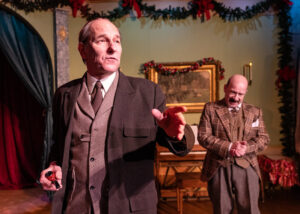
This feeds into multiple issues with the plot, which is woefully inadequate, as it lacks enough twists and turns to make the story satisfying. There needs more time to develop a successful story arc which doesn’t end prematurely. If the intent is to explore the possible means, motives, and opportunities for committing one or more crimes, then Holmes has to be somewhat more proactive in talking with each of the possible suspects. Since he is bound to notice some piece of evidence or some unusual situation that helps him to solve the mystery, the narrative needs to be made more gripping by having him either make a mistake at first (to show that he’s human) or by having him provide some sort of misdirection so as to lay a trap for the guilty party… or something of the sort. The play unfortunately contains none of these things and thus feels incomplete. I wanted to say to myself at the very end of the performance, “Damn! With all those hints being dropped—and all those questions being raised—why didn’t I see that coming?” But this never happened. And as a result, we don’t really care who the culprit is… or why they committed the crime. Among other things, we don’t know enough about why Horatio’s wife was no longer in the house or why John was a socialist or even why Ruby was so enamored of him—although the lesbian interest between Ruby and Jenna adds an interesting dimension to the tale at a time period when lesbianism and talk of lesbianism was taboo.
Costume design by kClare McKellaston is great! The period costumes from the late 1890s could not be any better! The men wear their customary waistcoats, with Holmes in his traditional Inverness cape and Watson in his trademark tailored tan woolen vest. Plus, Jena’s green and red harlequin teddy with sparkles looks like the epitome of a sexy Christmas outfit from that era. Scenic design by Jeremiah Barr works well. The living room walls are painted light green with accents in red for the season. We see a decorated Christmas tree by the fireplace and vintage furniture plus garlands and red bows hanging along the ceiling. I especially liked the sliding doors and ledges to simulate outdoor scenes on such a small stage. The lighting by Liz Cooper is nicely done throughout and especially at the beginning when the tree is being lit by the cast via electronic/battery-operated candles. Carrie Hardin has nicely imparted the appropriate accents to all the characters, while music director Mary McCormack has done a fine job with the variety of songs. Directing by Brian Pastor places all of the actors exactly where they need to be, especially when it comes to the sidestep and cross-step movements of the Christmas Clowns as they inch their way across the stage at various points in the story.
Adapted from “The Flying Stars” by G.K. Chesterton and the works of Sir Arthur Conan Doyle, Weagly has created fine outlines for each of the characters and a nice sketch for the plot. But while the parts are acted well and the singing and choreography are great throughout, this world premiere production could have been made more robust and substantial. While the combination of music and mystery makes the tale enjoyable, the script needs to be rewritten and the show lengthened to 90 or 100 minutes to better develop the characters and to properly build up to the climax and denouement. As things stand now, there are not enough plot twists to make this play memorable and exciting, and I am still confused about why there is suddenly a dead body on stage at one moment and then suddenly it is no more! When things are apparently “resolved” much too quickly, we leave the theatre feeling empty despite all the cheery holiday songs. Even though the play contains many excellent elements, the story as a whole needs to baffle and endear the audience. And for this to be a compelling whodunnit, the audience must be given the time and space to wonder what will happen next.
“Sherlock Holmes and the Christmas Clowns” is playing through January 4, 2026, at City Lit Theater, 1020 W. Bryn Mawr Avenue, on the second floor (accessible via elevator) of the Edgewater Presbyterian Church.
 General Admission Tickets: $28
City Lit subscribers: $20
Seniors: $23
Students and Military: $15
Performance schedule:
Fridays and Saturdays at 7:30 p.m.- Sundays at 3 :00 p.m.
Tickets available online at https://www.citylit.org/ or by phone at 773-293-3682
To see what others are saying, visit www.theatreinchicago.com, go to Review Round-Up and click at “Sherlock Holmes and the Christmas Clowns”.



More Stories
“Dead Girl’s Quinceanera”
“Dial M For Murder”
“A Midsummer Night Scream” reviewed by Frank Meccia