

*****City Lit Theater’s world premiere of the musical “Scaramouche” is one of the most promising shows this year. Smoothly directed by Beth Wolf and centered on the French Revolution era, this fictional story rivals that of the beloved musical “Les Miserables” with its similar basis in class distinctions and the turn to political violence on the part of both the left and the right. Another point of comparison has to do with the structure of the plot and its scope: with its overlay of external political forces on top of a story about moral choices given the cultural and historical circumstances of the time. And then, of course, there’s the singing and dancing and swordplay. Based on the novel “Scaramouche: A Romance of the French Revolution” by Rafael Sabatini, this production can boast of remarkable music and meaningful lyrics by Kingsley Day and a wonderful adaptation/book by Day and James Glossman. Drawing you into the plot at the beginning is the implicit and frightful analogy of 1790s Revolutionary France to the growing climate of political and economic division in the United States today.
Ethan Smith does a sensational job holding the entire show together as André-Louis Moreau, a provincial lawyer from Brittany. He is anxious to avenge the death of his best friend Philippe de Vilmorin (Connor Ripperger) at the hands of the Marquis de la Tour (Kent Joseph), a powerful nobleman and master swordsman. Their duel could be considered a microcosm of the larger class divisions in France, where rifts have formed between those supporting the growingly impoverished and dispossessed French peasantry and those dedicated to sustaining the wealthy elite and the status quo.
André is the adopted son of his godfather Quintin de Gavrillac (Henry Michael Odum) and has been raised in an upper-class household. But having been adopted and with no knowledge of who his parents are, he can never attain the true wealth and status of those of noble birth who can trace their lineage. And André is fully aware of his lack of social standing, despite being a lawyer. Because he understands first-hand that people are people regardless of the circumstances of their birth, ideas about the rigidity of the social order are not as fixed within his mind as compared to others. Hence, the reality of André’s situation allows him to become an individual with his foot in more than one world. Specifically, he can see the larger nexus of class relations, economics, and politics from more than one perspective. He has been given a rare gift: that is, the freedom if not the duty to invent and reinvent himself in accordance with (what he perceives of as) his larger sense of values. Needless to say, when he publicly advocates for democratic action and points out how hateful, arrogant, and self-serving the elite has become, this only gets him into trouble.
At the same time, André is the confidante of Aline de Gavrillac (Laura Michele Erle), the orphaned niece of André’s godfather Quintin. She is desirous of marrying the Marquis de la Tour, in part to retain her social status in a society where women are largely treated as appendages of men. Since André looks out for Aline’s best interest, he cannot believe that she would want to marry someone so despicable, who only cares about himself and, by extension, those in the upper classes. Yet his own affections for Climène (India Huy) are equally misguided, since the two of them are not on the same page regarding ideas about romance. While André is serious about the prospect of marriage, she is more interested in having a series of flings, preferably with men of wealth and high status. She might as well take advantage of a rich man’s generosity, since she can never aspire to become any greater than her low social class. Her attitude is also in keeping with the traditional stereotype of “loose women” being a part of theatre companies in the 18th century.
If there is a main fault with this show, it is that too few actors play too many characters. However, if the audience can suspend judgment and recognize that these actors are all meant to be different people, then the illusion works nicely. So in addition to being Andre’s godfather, Henry Michael Odum plays Pierre Binet, the leader of a traveling commedia dell’arte troupe (as well as Bertrand des Amis, a fencing master). Other actors with multiple roles (and who make up the Binet theatrical troupe) include: Connor Ripperger, Shea Lee, Kent Joseph, Rushil Byatnal, Ed Rutherford, India Huy, and Alicia Berneche. “But who is Scaramouche?” you might ask. If you come to see this production—and I hope you will—you will learn how and why André takes on this name to establish his own secret identity.
Particularly exciting are the swashbuckling scenes! The swordplay among the principals is realistically constructed and a major plus! Violence and intimacy director Jamie Macpherson has done a superior job coaching the cast with respect to fight design. Additionally, there are the inventive dances, especially the one when the ensemble moves through their paces with their foils. Choreography by Beth Wolf, Ray Post, and Maureen Yasko could not have been better, making the musical wonderfully refreshing and fun throughout!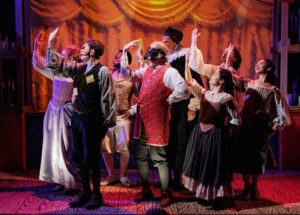
Kevin Zhou’s music direction and orchestration have been skillfully done. I loved the live orchestra playing a score of 25 numbers and 6 reprises. But there was a problem with the balance between the orchestra and the vocalists on the day I watched the performance. Whenever the full orchestra played, the instruments were much too loud relative the voices. That said, I caught all the words, except for those of one singer, who didn’t project well enough.
Scenic design by Trevor Dotson is relatively minimal and multi-purpose. The show starts out with a projection of a stage, which foreshadows a play within a play. Prop design by Meg X. McGrath is largely suggestive, initially consisting of a large wooden trunk front row-center (and ultimately filled with costumes), plus wooden planks, barrels, and similar accoutrements. Lighting design by Jackson Mikkelsen perfectly indicates scene changes and the movement of time and place. While DJ Douglass’s projections are presented well, the artwork, in my opinion, is too poetic for this story and not faithful to the time period. The paintings neither fit the rococo style of the aristocrats nor the neo-classical style, which the French revolutionaries espoused and which promoted ideals of reason, order, and virtue over hedonism and decorative excess. Instead, the paintings are more indicative of the romantic period, which came once the revolution ended.
Jennifer Mohr’s costume design is mostly authentic. The waistcoats worn by the men and the dresses worn by the women are all true to their respective statuses as peasants and nobility… and commedia dell’arte players. The tricolor cockade worn by Monsieur de Chapelier (Ed Rutherford) is the ideal symbol of the radical cause, not to mention his torn and patched clothing to depict his lower-class roots. I especially loved the various types of hats from that era. But while the wearing of red scarves neatly works to identify characters with populist/radical affiliations on stage, this is not historically accurate. In essence, this article of red clothing was not being worn at this point in time. (Note that sometime after the revolution, French fashion history sported a trend called “victim chic”, where pro-royalists wore red scarves and ribbons to represent the guillotine in a mocking way, but I digress.)
Captivating and compelling, “Scaramouche” encapsulates the turmoil and hardship of the French revolutionary era with comedy and tragedy rolled into one. The charm of this show is in observing just how chameleon-like André can be, not to mention how capable he is with the sword. He is always on the move, reinventing who he is in accordance with his beliefs and values—and constantly figuring out where the journey might take him next. Hopefully, the show wins major awards and is Broadway bound.
“Scaramouche” is playing through June 14, 2026, at City Lit Theater, 1020 W. Bryn Mawr on the second floor (accessible via elevator) of the Edgewater Presbyterian Church.
Tickets $45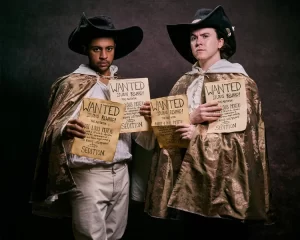
Seniors $40
Students and military $22
Performance schedule:
 Fridays and Saturdays at 7:30 p.m.
Sundays at 3:00 p.m.
Monday, June 1 at 7:30 p.m.
Understudy performance Monday, June 8 at 7:30 p.m.

For more information and to purchase tickets, visit: https://www.citylit.org/shows/45-scarm or by phone at 773-293-3682.
For general information and to learn about City Lit Theater’s other offerings, go to: https://www.citylit.org/.
To see what others are saying, visit www.theatreinchicago.com, go to Review Round-Up and click at “Scaramouche”. photos: Steven Townshend/Distant Eras



More Stories
“Dead Girl’s Quinceanera”
“Dial M For Murder”
“A Midsummer Night Scream” reviewed by Frank Meccia