

*** Steppenwolf Theatre’s 50th anniversary season opens with “Mr. Wolf” by ensemble member Rajiv Joseph. A gorgeously crafted production, featuring incredible sets, fine acting, and phenomenal directing by K. Todd Freeman, the show holds our attention with all its twists and turns. When a kidnapped girl is suddenly found twelve years after her disappearance, this raises all sorts of questions regarding who her kidnapper was and why he did this. It also opens up issues about how deeply the now-fifteen-year-old carries the possible imprint of trauma. While the story initially appears to be in the realm of science fiction, it is actually more of a psychological drama, hinging on crime, family dynamics, and an overarching religious philosophy that is unusual to say the least.
Living in a typical clapboard house and unbeknownst to neighbors, Theresa (Emilie Maureen Hanson) has been isolated from the bulk of humanity since the time she was kidnapped from her family at age three. Raised and homeschooled by an astronomer aptly named Mr. Wolf (Tim Hopper), she has been taught that one can find God if one searches for Him in the far reaches of the universe. Among other things that Mr. Wolf imparts to Theresa is his belief that she is a prophet whose mission is to save humanity: an idea which she has internalized as well. Theresa is quite the artist and can draw the stars and planets and can provide detailed explanations for them. She also proposes that there are numerous other worlds, existing simultaneously with our own—and in some of them, people we know and love don’t die. But once Theresa’s mentor is out of the picture and once her isolated bubble suddenly collapses around her, she is reintroduced to the family of her birth, consisting of her father Michael (Namir Smallwood), her mother Hana (Kate Arrington), and her stepmother Julie (Caroline Neff).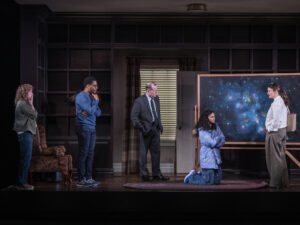
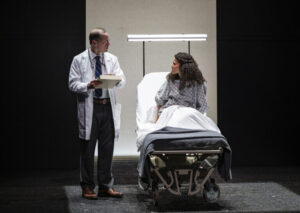
Since Theresa has never been socialized to interact with anyone else but Mr. Wolf, she treats other people abominably, and we witness her self-absorbed, abrasive, and disdainful personality. So while her family members are happy to have found her after all these years, she has no clue how to deal with them. She has more respect, however, for the male professionals whom she comes into contact with, like the medical doctor and the detective. And since Mr. Wolf was the only person she ever knew, she begins to see his face in all men in positions of authority. Having the same actor (Hopper) play these varied roles is very clever, because the audience knows that they are supposed to be different people, while Theresa sees them as being one and the same.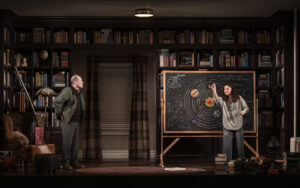
It is during one of the major turning points when Theresa realizes that what she has said is hurtful and finally takes notice of how a series of repressed memories has limited her self-awareness. One of the things I liked best about this show is how she starts to reveal these memories at the same time that she discovers empathy and starts to realize something about the trauma that her parents were put through after her kidnapping. Subsequently, she learns more about the truth about the type of person who Mr. Wolf really was. Did he really think he was saving humanity by kidnapping Theresa? Was he the master of some religious cult, and did he convince himself as such, or was he mentally ill and making excuses for his criminal behavior? The complexity of this theme only adds to the story’s intrigue.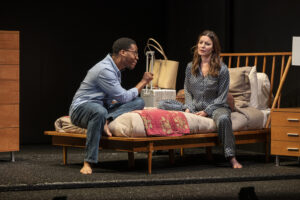
But what is most extraordinary about this production is the incredible scenic design by Walt Spangler, which should win lots of awards. Not only are the sets in and of themselves beautiful and meticulously crafted, but they resemble a 3-D interlocking puzzle in the way that the pieces separate out and come together and glide up and down from top to bottom and from side to side, together with accompanying props (like couches, beds, and the like), which smoothly and elegantly slide in unexpected ways or descend below the stage. Freeman’s superb direction makes the scenes seamlessly shift, with actors frequently moving with the sets or having to climb them. One of my favorite set designs is that of Theresa’s room in Mr. Wolf’s house, where the multitude of books and bookshelves, a blackboard, and an oval rug are not just part of the background but serve as integral components of the story. With the transitions so fantastic from the original house to the hospital room to the house owned by Julie and Michael—together with the changes in lighting that accentuate these elements (thanks to the brilliance of Keith Parham)—you should go and see “Mr. Wolf” if only for this! The sets are also bolstered by Rasean Davonté Johnson’s projections, where we initially see the exterior of a white clapboard house projected on a scrim: What a relatively normal-looking house, with turquoise handrails, red-orange trim, and evergreen trees in front. Who could have possibly imagined that a kidnapped girl was being held there for so many years, sight unseen? Later on, a schema of gray clouds gives way to the close-up face of a horse, neatly replicated, and once again, what a well-done projection!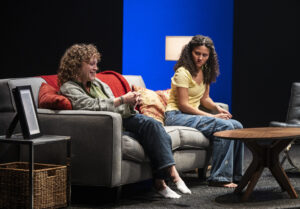
My guest absolutely raved about the show and loved practically every moment of it. We both liked the plot points and how the family members internalized the loss of their daughter in very different ways. She thought that the ending was great, where not every loose end is tied up in a bow. “It was just enough,” she said to me afterwards and was content with the last scene—with its suggestion that when the parents acknowledged Theresa’s talents, this would imply a step forward in her life and some amount of rebirth within her. But I had a major issue with the ending: The story cut off prematurely, with too many important issues brought up earlier that are not only left unresolved but dropped entirely.
To my mind, Theresa’s character remains somewhat too stagnant at the conclusion. Having her family smile upon her admiringly is not sufficient to indicate an important shift in her personality or her self-concept. I wanted to see a scene appended where she struggles with her identity and her place in the household. Maybe Theresa could sit on her favorite rug with her books surrounding her plus some of her creative artwork, and we could finally get a glimpse into how well adjusted or maladjusted she has become. Perhaps she could evolve into a more sympathetic character: a kinder or more vulnerable human being, possibly content with her situation—or perhaps not. Maybe she needs to lash out at others or become destructive as a means of reifying the struggle within herself.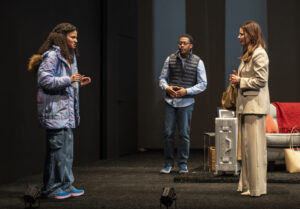
Theresa’s relative contentment or distress could thus serve as the backdrop for the further development of the other characters. Considering that Julie, Michael, and Hana are all warm and welcoming parents, perhaps some necessary conversations could be held among the three about sharing custody. Maybe Michael’s first wife and second wife might be required to get along, because they need to co-parent in the best interests of the child. Finally, while issues surrounding divorce are usually very challenging for most families, especially with regard to their minor children, this becomes all the more magnified when a teenager already faces serious psychological challenges. Hence, there ought to be some tacit acknowledgment of Theresa needing to visit a therapist or counselor to help make her whole. So while we’ll never see exactly how Theresa moves on with the next chapter of her life, a stronger ending would help us better understand the new family dynamics and thus provide a better sense of closure for the audience.
“Mr. Wolf” runs through November 2, 2025, at Steppenwolf Theatre, 1650 N. Halsted Street, in Chicago, in their downstairs theatre.
Single tickets range from $20– $128.50*.
(*Pricing includes an $8.50 handling fee.)
 Performance schedule:
Tuesdays, Wednesdays, Thursdays and Fridays at 7:30 pm
Saturdays at 3 pm & 7:30 pm
Sundays at 3 pm.
Please note: there will not be 7:30 pm performances on Tuesday, September 30, Thursday, October 2, Wednesday,October 8, Thursday, October 9, Tuesday, October 14 and Tuesday, October 28(Veteran’s Night); there will be an added 2 pm matinee on Wednesday, October 22.
Accessible Performance Dates:
Audio-Described and Touch Tour: Sunday, October 12 at 3 pm (1:30pm touch tour)
Open-Captioned: Saturday, October 4 at 3 pm and Thursday, October 23 at 7:30 pm
ASL-Interpreted: Friday, October 17 at 7:30 pm
For more information and to purchase tickets and learn about Steppenwolf’s other offerings, visit https://www.steppenwolf.org/ or call the Box Office at (312) 335-1650.
To see what others are saying, visit www.theatreinchicago.com, go to Review Round-Up and click at “Mr. Wolf”.





More Stories
“Dead Girl’s Quinceanera”
“Dial M For Murder”
“A Midsummer Night Scream” reviewed by Frank Meccia