
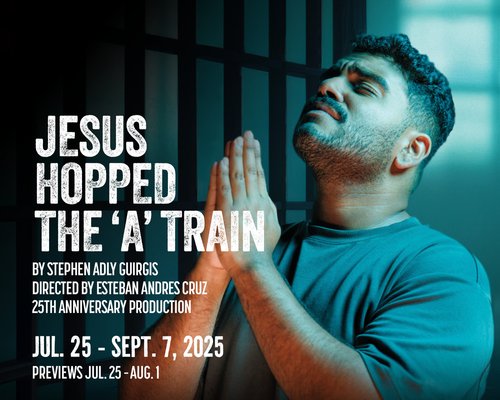
 ***** “Jesus Hopped the ‘A’ Train” is one of the best shows I’ve seen all year! In the skilled hands of director Esteban Andres Cruz, this powerful and profound tragedy written by Stephen Adly Guirgis comes alive on the City Lit stage. This is an intimate and tough drama to watch: with its emphasis on prisoners and violent crime, combined with scenes spotlighting self-imposed and sadistic psychological torture.
The drama focuses on the life of Angel Cruz (Lenin Izquierdo), who has been incarcerated at Rikers Island, New York, awaiting trial for murder. The young Puerto Rican man, is unrepentant and doesn’t believe he’s a murderer even when he admits as much: that he intentionally shot the Reverend Kim “in the ass”, because “he deserved it.” This was after his best friend Joey was lost to Kim’s manipulative and deceptive religious cult. The audience is left wondering if the character, deliberately named Angel, is really guilty of murder. Did the Reverend Kim receive “his just desserts” by being killed at Angel’s hand—and was this possibly a punishment from God? If so or if not, then who or what is God? And what role does He play in today’s world? And what role does Angel play in fulfilling God’s directive?
Angel has a public defender named Mary Jane Hanrahan (Maria Stephens), who has taken on his case and comes to visit him in prison. From her perspective, Angel’s crime reminds her of something that her father did years ago, that is, perpetrating a physically violent act where he didn’t believe he was at fault—even though he admitted to doing the deed. Both would have considered these to be crimes of retribution.
During his once a week exercise in the prison yard, Angel meets hardened criminal Lucius Jenkins (Bradford Stevens) a charismatic black man, who murdered eight people and self-confessed to his crime. Though Lucius committed all of his killings with intent, he has become a very caring sort of person while in prison, where he claims to have found God as a born-again Christian. Whereas Angel believes that he has never lost God (but is unsure of exactly what God wants of him), Lucius lives from day to day with more certainty and offers Angel kindness, advice, and somebody to talk to.
Prison guard Charles D’Amico (Michael Daley) is a kind and decent man, who treats Lucius like a human being and even provides him with his favorite Oreo cookies. (Of course, the symbolism of the vanilla-coated Oreos is rather obvious.) However, D’Amico is soon replaced in his job by the sadistic and bloodthirsty Valdez (Manny Tamayo). Full of bluster, he preys upon Angel and Lucius and treats them with distain. He is the force of evil within the prison gates. He enjoys imposing harsh punishments on his charges and makes sport of their physical and mental torture. He’s constantly states (and I’m paraphrasing) “Where is God for you now?” as he constantly beats down his prisoners and alludes that they are not safe from his brand of vigil ante justice.
This show basically focuses on Angel’s, Lucius’s, and Mary Jane’s particular grief, based in part on their personal histories and what they bring to the present moment. Yet it is Mary Jane who often addresses the audience directly. As she says in Act II, scene 1 (and which is stated in our program), “The law is fallible, the truth will not set you free, and, in a courtroom ‘legal justice’ is an oxymoron because the two rarely coexist, and when they do, it is the product of design, not an inevitable coming together.” But ultimately, this is a story about the rationalization of crime, punishment, and retribution, however convoluted any such explanations might be.
This leads us to the show’s title “Jesus Hopped the ‘A’ Train.” Angel believes that he has been saved at least once before, that is, when he and his friend Joey had once climbed onto the tracks while a moving subway car plowed towards them—and its headlights shone into their faces. Jesus apparently saved Angel to live through the present moment. Does this mean that he was predestined to be saved from future harm or was destined for bigger and better things? Or not? And would He save Angel again? Could this have been a meaningless illusion and a cruel trick? Is Angel now like all the rest: being spat out by an uncaring and unburdened criminal justice system and dying well before his time? Or is he the Hand of God in human form, being sacrificed in order to further God’s purpose? The implication in his show is that much of Angel’s life has had to do with the intersection of predestination versus free will.
Tianxuan Chen’s scenic design is a marvel in its simplicity. A set made up of a series of plain white tarps allows us to imagine prison cells, with vandal-resistant red lamps hanging on the walls behind. Thanks to scenic stitcher Gillian Adkins, there are openings within the tarps that reveal imaginary prison doors. This is all very creative! Lighting design by Josiah Croegaert adds to the effect, largely by using gobos to create parallel line patterns, resembling prison bars or stripes. Sound design by Warren Levon is right on target. Costuming by Jazmin Aurora Medina is done with authentic touches and features contemporary orange jumpsuits, prison guard uniforms, and the like. Projection design by Andres Fiz at the beginning of the first and second act presents us with a meat market, analogizing the reality of prisoners being shipped off to Death Row, almost like cows being herded and sent off to slaughter… without a thought being given about them as individuals or about the circumstances which brought them to this point in their lives.
This play is alternately scary and fascinating. We get to see the characters’ flaws and virtues close up and personal. We begin to examine the presumed motives of those accused of committing one or more acts of murder. We get to understand something about the moral ambivalence of the law, the limitations of our courts, and the failings of law enforcement. And we start to wonder how and when and under what conditions such horrific crimes are eventually discovered and prosecuted—and why. And finally, we must consider whether these criminal defendants consider themselves guilty or not in their own eyes as well as in the eyes of the law and in conjunction with their own religious beliefs.
So if you want to do the deep dive and explore the profundity of the soul—and watch Esteban Andres Cruz’s excellent directing plus fabulous acting by all—then this show is for you. It is an amazing production, and you should see it now!
“Jesus Hopped the ‘A’ Train” is playing through September 7, 2025, at City Lit Theatre, 1020 W. Bryn Mawr Avenue, in Chicago, on the second floor (accessible via elevator) of the Edgewater Presbyterian Church.
Tickets: $38.00 plus a $2.00 convenience fee.
Seniors: $33.00 plus a $2.00 convenience fee.
Students and military $15.00 plus a $2.00 convenience fee.
 Performance schedule:
Fridays and Saturdays at 7:30 p.m.
Sundays at 3:00 p.m.
Monday, August 25, at 7:30 p.m.
For more information and to purchase tickets, visit https://www.citylit.org/ or phone at 773-293-3682.
To see what others are saying, visit www.theatreinchicago.com, go to Review Round-Up and click at “Jesus Hopped the ‘A’ Train”




More Stories
“Dead Girl’s Quinceanera”
“Dial M For Murder”
“A Midsummer Night Scream” reviewed by Frank Meccia