
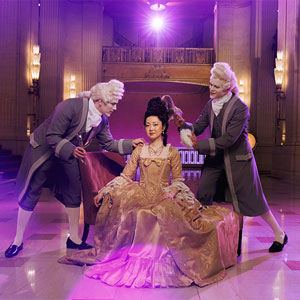
 ***** If you’re looking for an elegant comedy to enjoy for a few hours, you could hardly do better than the production of Don Pasquale now at the Lyric Opera of Chicago. Written by the prolific composer Gaetano Donizetti in 1843, when he was at the pinnacle of his powers, Don Pasquale uses commedia dell’arte characters scheming for sex and money to deliver a beautiful score along with hilarious hijinks. This production, directed by Mariame Clément, with Lyric Music Director Enrique Mazzola conducting, features singing actors who know exactly how to delight an audience who want to see characters in a costume drama behaving badly and learning a lesson.The title character, Don Pasquale (baritone Misha Kiria) is an elderly bachelor of the landed gentry who lives with his directionless young nephew, Ernesto (tenor Alberto Robert). Don Pasquale is frustrated because Ernesto refused to agree to an advantageous arranged marriage, being in love, instead, with a penniless young woman, Norina (soprano Ying Fang, Sydney Mancasola on November 27), whom Don Pasquale has never even met. Partly as a desperate attempt to produce an heir, but also because marriage and fatherhood are things that Don Pasquale never experienced and has long yearned for, but also because he’s horny, Don Pasquale has decided to get married himself and throw Ernesto out once the contract is sealed. Family friend Dr. Malatesta (baritone Ian Rucker) has arranged for Don Pasquale to marry his sister, Sofronia, who has been living in a convent. However, Dr. Malatesta is a schemer, and Sofronia is not his sister, but Norina in disguise, and the notary he has arranged to conduct the marriage is a fraud. Don Pasquale quickly gets more than he bargained for, as what he took to be a demure bride turns out to be an abrasive spendthrift who makes his life hell until he agrees to pass her off to Ernesto, instead.
A key choice in Clément’s production is that Malatesta is a con artist, not an ally to Ernesto, and there is good reason to think Norina is, as well. An early scene that significantly recontextualizes the libretto for the rest of the opera establishes that she is actually Malatesta’s lover. Granted, Ernesto isn’t a particularly sympathetic or dynamic character, being a feckless youth with no plan for what happens once his rich uncle cuts him off, but it gives the whole play an even more satirical vibe. Rucker and Fang, as Malatesta and Norina, are both charmers, with Norina introducing herself in grand fashion through the spirited aria “So anch’io la virtù magica,” which is all about her unending zest for life. The doctor has a calmer but equally commanding energy; during the overture, he slithers between secret passages throughout the house, scoping out each of the other characters while they sleep. His singing is a calm middle ground between Ernesto’s dulcet longing and Don Pasquale’s staccato irascibility, but he’s also a quick thinker and can make his manipulations sound like straightforward logic.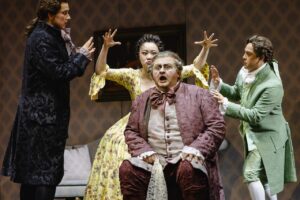
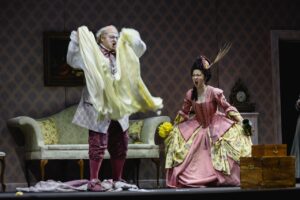
Alberto Robert’s Ernesto is handsome and nice to listen to, even if he is an airhead. He cuts a romantic figure laying about with his guitar in the garden, and it is understandable why Norina would rather marry him even if she is mainly after money. However, the star must be Misha Kiria’s Don Pasquale. He is not a cruel man, exactly, but he is sure he knows what is best for everyone and is far too excited at the prospect of a bride fifty years his junior. (He also seems to have complicated feelings about being humiliated by her.) But however decrepit Don Pasquale may be physically, he leaps to life during his Act III duet with Malatesta, “Cheti, cheti, immantinente/Aspetta, aspetta, cara sposina.” This patter song is one of the best of opera buffa, and earned Kiria and Rucker an encore at the performance I attended. The pink silk that costume and set designer Julian Hansen put him in ties it all together into something truly hilarious. Speaking of which, another interesting aspect of this production is that it is set in the eighteenth century, instead of being contemporary to when Donizetti wrote it. In her director’s note, Clément says she did that because audiences would more readily accept Figaro-era visuals as both heightened and diabolical. I’m inclined to agree, particularly considering the added layer of scheming. Don Pasquale the man may be clinging to dying traditions, but Don Pasquale the opera is still full of life.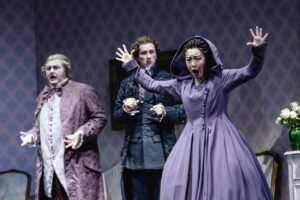
Don Pasquale will continue at the Lyric Opera House, 20 N Upper Wacker Drive, Chicago, through November 27 with the following showtimes:
 November 21: 7:30 pm
November 24: 7:00 pm
November 27: 7:00 pm
Running time is two hours and forty minutes with one intermission. There is also a thirty-minute preview talk an hour before the show.
Performances are in Italian with English supertitles.
The Lyric offers parking deals with Poetry Garage at 201 W Madison St. if inquired about in advance. Tickets start at $40; to order, visit LyricOpera.org or call 321-827-5600.
To see what others are saying, visit www.theatreinchicago.com, go to Review Round-Up and click on “Don Pasquale.”




More Stories
“A Midsummer Night’s Dream” reviewed by Julia W. Rath
“It’s A Wonderful Life” the Live Radio Show ( Citadel)
“Pete The Cat”