
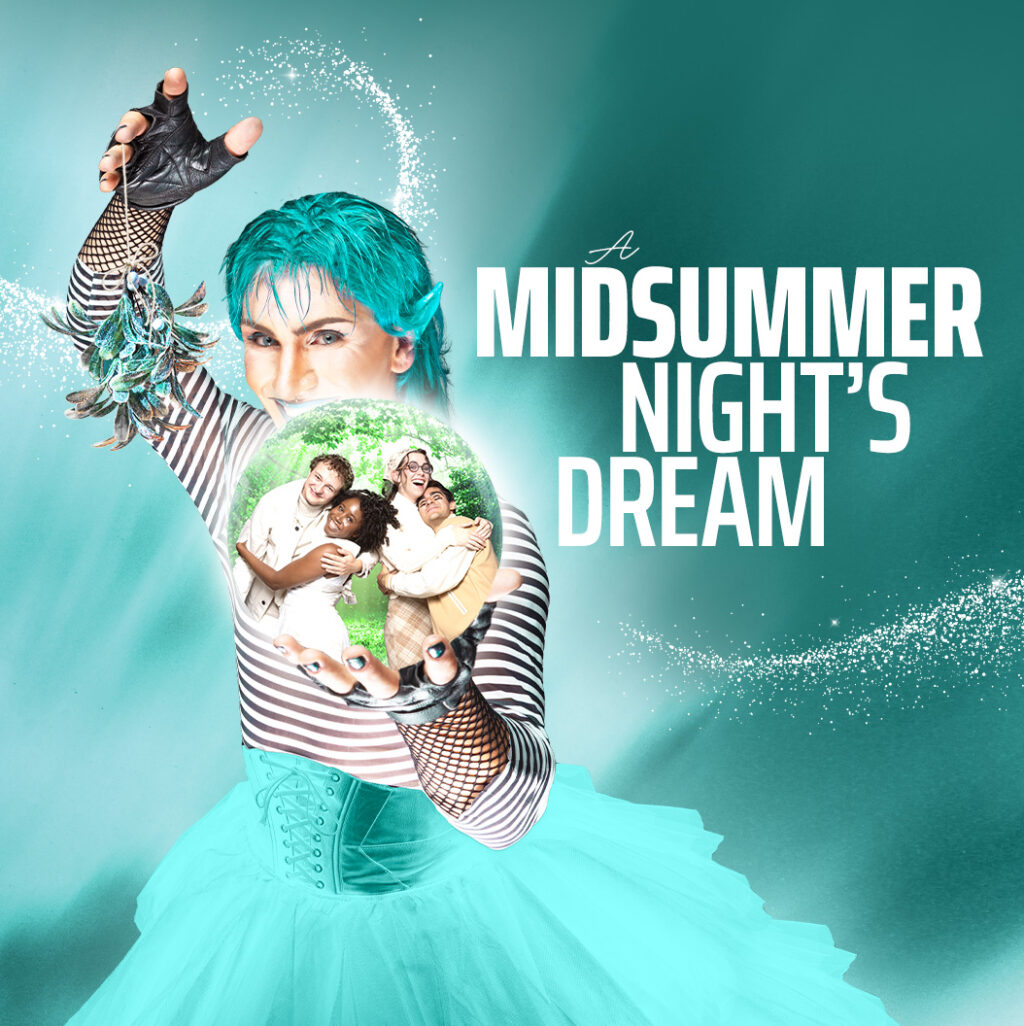
 ***** Featuring outstanding performances, “A Midsummer Night’s Dream” at Chicago’s Shakespeare Theater is an absolute delight! William Shakespeare’s serendipitous comedy rolls reality, imagination, and humor into one, and this is the production that you most definitely need to see. Running approximately two and a half hours, the show is bright, lively, and whimsical, filled with inventive touches that make the centuries-old story feel wonderfully fresh, thanks to artistic director Edward Hall’s sharp direction. He has made this tale about fairies, magical creatures, and unsuspecting human beings come alive in ways that surprise us. Kudos, of course, must go to the entire cast, who have injected new life into classic characters in this myth about love, romance, and fantasy.
The highlights are almost too many to name. But first, the story: The setting is Athens, Greece, where four young people become romantically entangled as their relationships become grist for the meddling of supernatural forces. Their names are Hermia (Felicia Oduh), Helena (Grace Steckler), Lysander (Dan Haller), and Demetrius (Esteban Ortiz-Villacorta). Hermia’s father Egeus (Kevin Gudahl) wants his daughter to wed Demetrius, but she is more interested in pursuing Lysander—while Helena has her eyes set on Demetrius, but he cannot stand the sight of her. All the while, the fairy king Oberon (Sean Fortunato), master of the enchanted forest, wants to play a trick on his wife Queen Titania (Jessica Dan Turner) and elicits his fairy servant Robin Goodfellow, a/k/a Puck (Patty Roache), to use the essence of a magic flower and make her fall in love with the first creature she sees. The story spins out from there when Puck uses the essence to affect romances on the earthly plane… and also gives Nick Bottom (Chiké Johnson) the head of an ass. Plus, Queen Titinia, now bewitched by the flower essence, madly falls in love with this asinine creature.
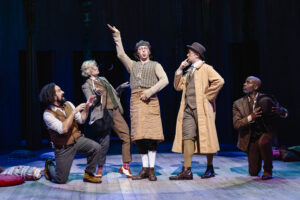
The irrational and often chaotic nature of love is also played up in the dual roles of Theseus and Oberon, performed by Fortunato, and the dual roles of Hippolyta and Titania performed by Turner. We see how Oberon, out of guilt, eventually lifts the curse from Titania and returns Bottom to his original form. Ultimately, Theseus and Hippolyta, the royal couple, are wed at the same time as the young lovers—with “Pyramus and Thisbe”, the play within a play, produced at the wedding for all to see.
Johnson sparkles in his multifaceted role as Bottom, who is not only a weaver by trade but also a stage actor, and he stars as Pyramus towards the end of the show. He also shines in the part of a donkey, in keeping with Shakespeare’s double entendre and the meanings of the word “ass.” Johnson’s slapstick comedy and silly antics heighten the audience’s sense of humor throughout; his power-packed and finessed performance is nothing short of sublime! I can’t remember when I laughed this hard in a long time!
Roache stands out in the role of Puck and is like the proverbial Jack in the classic poem, namely, both nimble and quick. Wondrous athleticism turns Puck into an amazing non-human creature. Most dazzling are the acrobatics on aerial silk!* So whether crawling on the floor or suspended in the air or even while fawning, Puck constantly steals the show with sheer mischievousness, playfulness, and dynamic energy.
Other characters include Peter Quince/Prologue (Erik Hellman), a carpenter who is the head of the acting troupe and brilliantly regrets not having polished actors to put on a stage play. Plus, there is Francis Flute/Thisbe (Kieran McCabe), Robin Starveling/Moonshine (Issy Van Randwyck), Snug/Lion (Demetrios Troy), and Tom Snout/Wall (Ronald L. Conner). It is the minor performance of Wall during the play within a play that creates some of the most hilarity. This character is supposed to be a real wall, personified, that keeps the lovers Pyramus and Thisbe apart from each other, absent one small hole within it, represented by the actor’s first two fingers in the shape of a “V.”-What makes this part especially funny is its modern context. The first thing that enters our collective mind when we see Wall on stage is just how much Donald Trump wanted to build a wall since he’s been President and how today’s comedians have poked fun at it, calling it Wall. Adding in the two-finger gesture makes this part seem all the more ridiculous. To quote Hippolyta (in referring to the play), “This is the silliest stuff that ever I heard.” And I would add, “This is the silliest stuff that ever I’ve seen.”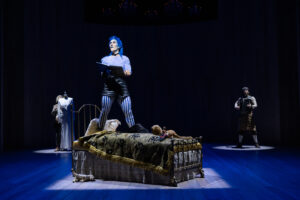
Scenic design by Michael Pavelka is simple with long greige planks along a curvature behind the thrust stage and five chandeliers peeking out from a window above. The scenes are basically demarcated using prop design, which is exemplary! This show excels in the number of times that characters and props rise up from beneath the stage and descend into the floor, adding to the magical quality of the presentation. The bed at the onset recedes, and aerial silks descend from the ceiling, together with throw pillows which fall onto the floor: both functional and decorative. Pavelka is also the costume designer and does an equally splendid job with the wardrobe. We see a concatenation of clothing styles, including modern dress and Athenian wear in white (to indicate the upper class) versus the beiges and browns of the clothing of workmen in the late sixteenth century. Costumes for Oberon in black and for Puck in stripes is perfect! Fight and intimacy choreography is smooth and clever, due to the fine work by Zev Steinrock, not to mention that lighting design by Marcus Doshi and sound design by Emily Hayman work very well for this large courtyard space.
The show would not have been complete without the inclusion of Felix Mendelssohn’s Wedding March, taken from his “A Midsummer Night’s Dream, Overture and Incidental Music to Shakespeare’s Play”, written in 1842. Commissioned by King Frederick William IV of Prussia, this piece of music—then as now—is used to celebrate the resolution of the various romances in anticipation of the final wedding scene.
In all, “A Midsummer Night’s Dream” can be considered one of Shakespeare’s most accessible and fun comedies. Today’s production has been executed perfectly by means of smart acting, gorgeous directing, and a talented crew. The show doesn’t just produce laughter among its audience but earns our wholehearted admiration. It is one of this year’s best plays, and you must go and see it today!
“A Midsummer Night’s Dream” is playing through January 3, 2027, at The Jentes Family Courtyard Theater at the Chicago Shakespeare Theater, on Navy Pier, 800 E. Grand Avenue, in Chicago.
Tickets: Prices vary by performance, depending on date, seat location, and other factors. When on the website, please be sure to include the promotional code for certain performances.
For more information and to purchase tickets, go to: https://www.chicagoshakes.com/current-season/.
Performance schedule:
November 19 – Thursday • 7:00 p.m.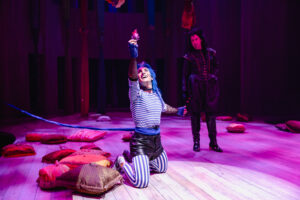
November 20 – Friday • 7:00 p.m.
November 21 – Saturday • 1:00 p.m.
November 24 – Tuesday • 1:00 p.m.
November 27 – Friday • 2:00 p.m. and 7:00 p.m.
November 28 – Saturday • 2:00 p.m. and 7:00 p.m.
November 29 – Sunday • 2:00 p.m.
December 1 – Tuesday • 7:00 p.m.
December 5 – Saturday • 7:00 p.m.
December 6 – Sunday • 2:00 p.m.
December 8 – Tuesday • 7:00 p.m.
December 9 – Wednesday • 1:00 p.m. and 7:00 p.m.
December 13 – Sunday • 2:00 p.m. and 7:00 p.m.
December 16 – Wednesday • 2:00 p.m. and 7:00 p.m.
December 17 – Thursday • 7:00 p.m.
December 18 -Friday • 7:00 p.m.
December 19 – Saturday • 2:00 p.m. and 7:00 p.m.
December 20 – Sunday • 2:00 p.m.
December 22 -Tuesday • 7:00 p.m.
December 23 -Wednesday • 7:00 p.m.
December 24 -Thursday • 1:00 p.m.
December 26 -Saturday • 2:00 p.m. and 7:00 p.m.
December 27 – Sunday • 2:00 p.m. and7:00 p.m.
December 29 – Tuesday • 2:00 p.m. and 7:00 p.m.
December 30 – Wednesday • 1:00 p.m. and 7:00 p.m.
January 2 – Saturday • 2:00 p.m. and 7:00 p.m.
January 3- Sunday • 2:00 p.m.
“A Midsummer Night’s Dream” is in repertory with “The Winter’s Tale” at the Chicago Shakespeare Theater through December 12th. Go online and check those dates too if you plan to see both plays together.
*Note that aerial silk is the long, wide strip of flexible material hanging from ceiling to floor that an acrobat climbs and weaves around their legs.
To see what others are saying, visit www.theatreinchicago.com, go to Review Round-Up and clcik on “A Midsummer’s Night Dream”.





More Stories
“It’s A Wonderful Life” the Live Radio Show ( Citadel)
“Pete The Cat”
“When We Were Young and Unafraid” reviewed by Mark Reinecke