

Reviewed by Mark Reinecke
***** War is hell. Jealousy will eat you up. Violence begets violence. And only the dead will see the end of war. And Timothy Edward Kane as the Poet has the audacity to hope that there will be an end to the “singing of this song” dating back to the days of archaic human history.
When human nature refuses to evolve from our past tragedies, An Iliad (notice it’s not billed as “The Iliad”) is an essential, recurring old song of Troy, bringing spellbinding continuity to today’s battles both big and small with plenty of significance to our nation, culture and to the collective pain we hold as individuals and as a society shaped by these blistering events.
The story of the Trojan War has been told for almost 3,000 years. And the way this story is conveyed – intimate, incisive, and urgent in the written retelling by Lisa Peterson and Denis O’Hare and under the direction of Charles Newell – helps us to better understand how humans are unchanged over the millennia. An Iliad, which returns to the Court stage for its fourth iteration, asks us to consider the physical toll of war and the psychological conditioning needed to transform an everyday individual into a killing machine.
Peterson and O’Hare first adapted this piece from Homer in Robert Fagles’ translation, to “examine war and man’s tendency toward war.” What a formidable task to take Homer’s Iliad, which would require 24 hours of non-stop reading, and consolidate it into a 90-minute tour de force theater production. The production takes key incidents, the mostly iconic and sanguineous ones, from the Greeks’ 10-year battle to conquer the city of Troy. It’s a story of triumph or tragedy (depending on whom you are rooting for) in this epic story of battle and death. Peterson and O’Hare counter the unbearable intensity of the play with welcome humor through the Poet’s observations, his many moods and growing weariness. For all the buckets of blood, lives lost, and bone-crunching martial mayhem, an Iliad’s most powerful moments are its quietest.
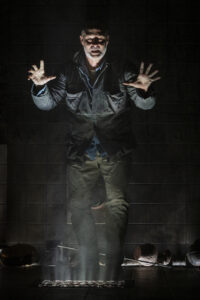
The power in An Iliad lies as much in this epic as in Timothy Edward Kane’s performance as the Poet, which is truly extraordinary and exhausting to experience. There is no denying the enormous effort this performance requires. What makes this role so noteworthy is Kane’s expert articulation and careful enunciation and his story-telling ability to describe each character as if painting a colorful portraiture. Kane’s Poet holds us rapt in his story until he is ready to release us. This play moved at record pace. Kane creates and projects multiple personalities, including Agamemnon, Achilles, Patroclus, Hector and Paris. He shifts from character to character, exposing their vulnerabilities and vanities through their musings and bitter exchanges. It’s an emotional and physical performance that, at times, is a spectacle to watch. Every movement and scene are brilliantly accommodated – and at key moments accentuated – by a visually and auditorily stunning effect by its production team (Todd Rosenthal, scenic designer; Lauren M. Nichols, assoc. scenic designer; Rachel Anne Healy, costume designer; Keith Parham, lighting designer, with Josiah Croegaert, assoc. lighting designer; Andre Pluess, sound designer, with Josh McCammon, assoc. sound designer; and the original production dramaturgy by Drew Dir).
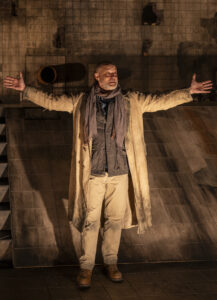
Kane’s larger-than-life, non-stop performance and the creative team’s artistic choices give us an immersive experience, where all of the elements come together to transport the audience to a specific time and place with depth and power. The extraordinary set, the clothing and color palettes, lighting and the spot-on sound effects help develop Kane’s multiple characters, sets a tone throughout, and creates a feeling of place and underscores the raw universal emotions. Here you have a confluence of an actor who understands the story-telling process and a creative team that can infuse the experience with a brooding intensity. The end result is one of those indelible, unforgettable moments in theater.
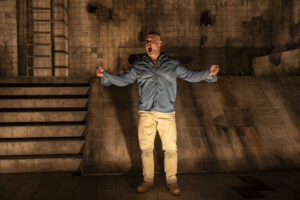
Writers Peterson and O’Hare have brought added clarity to the script by modernizing and re-contextualizing the words of Homer. We get a sense that the violence and lives destroyed thousands of years ago, gives tragic immediacy and meaning to wars now being fought and, likely, in the future. There’s even a part where the Poet lists off seemingly every recorded war in history – up to and including Gaza – in an exasperated cry to humanity. I struggle to explain the ear-piercing primal scream we heard and witnessed on that stage that night. I do not know if the loud cries were due to the violence that is hard baked into our human DNA or that the glory of war is one of our great achievements. I believe the play is not so much about politics but more urgently about our shared humanity and a tendency to create conflict.
Kane walks us away from the battle fields to find whatever humanity is left amid the violence. He helps us reflect on a mother’s worry, a widow’s loss and a father’s heartache. Given the cool, collected control Kane shows throughout, it is all the more disturbing when he, as the Poet, gives over to rage and bloodlust that drives An Iliad.
This is a captivating and chilling piece of theater, unlike anything I’ve seen before. The very things which drew the Greek heroes to war – greed, anger, power, sex, xenophobia, revenge, classism – are what still drives our demise so many thousands of years later. This Iliad is being presented at this moment in time for a particular reason. It is the horror story of our world today; a tragedy that belongs to all of us.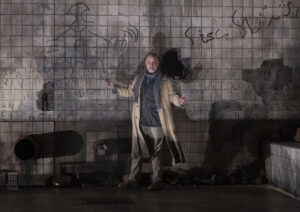
Location: Court Theater, 5535 S. Ellis Ave, University of Chicago Campus
 Regular Run: June 15 – June 29, 2025
Wed/Thurs/Fri: 7:30 pm
Sat/Sun: 2:00 pm & 7:30 pm
Tickets: Performances featuring Timothy Edward Kane:
$100.00 (Evenings), $125.00 (Matinees)
Performances on June 15 and 22 featuring Jason Huysman: $75.00
Subscriber, student, group and military discounts available
Box Office: Located at 5535 S. Ellis Avenue, Chicago; (773) 753-4472 or
www.CourtTheatre.org
Frank Meccia Review: An Iliad at Court Theatre – A Timeless Tale Powerfully Reimagined
The Court Theatre closes out its season with a riveting and visceral production of An Iliad, a modern adaptation by Lisa Peterson and Denis O’Hare based on Homer’s epic poem. Under the masterful direction of Charles Newell, this one-man play becomes a tour de force that resonates deeply with today’s world, bringing the ancient text to urgent, heartbreaking life.
Set in what appears to be a war-ravaged subway station, the Poet—our sole narrator and conduit—stands amidst the rubble of civilizations past and present. Played with magnetic intensity and unrelenting energy by Timothy Edward Kane, the Poet recounts the wrath of Achilles and the fall of Troy. Kane’s performance is nothing short of astonishing. For 90 uninterrupted minutes, he commands the stage with nuance, humor, raw emotion, and at times, searing fury.
One of the play’s most striking moments occurs midway, when Kane recites every major war from the Trojan War to modern conflicts in just over three minutes, without a breath or pause. It is a breathtaking sequence that earned an extended round of applause the night I attended, and it encapsulates the essence of this play: the futility of war and humanity’s tragic cycle of violence.
What makes An Iliad so powerful is how it bridges the past and present. Peterson and O’Hare’s OBIE-winning adaptation doesn’t merely retell Homer’s poem—it translates it into a living, breathing meditation on grief, rage, and the human cost of conflict. Their language is modern yet poetic, timeless yet urgent. It’s a brilliant choice for the Court’s mission of reimagining classic works for contemporary audiences.
The technical production is equally impressive. Todd Rosenthal and Lauren M. Nichols’s scenic design transforms Court’s intimate stage into a haunting, crumbling space that looks so authentic you’ll want to walk onstage to see if the brick walls are real. The lighting design by Keith Parham subtly shifts to match the tone of each scene—warm and golden for tales of heroism, cold and sterile for moments of despair. Meanwhile, Andre Pluess’s sound design amplifies the emotional weight of the narrative with haunting echoes, distant battle sounds, and sudden silence.
This marks the fourth time Court Theatre has staged An Iliad, and the audience’s continued demand speaks volumes. This is more than a play—it’s an experience, one that lingers long after the house lights come up. It forces us to confront uncomfortable truths about history, humanity, and the violence we’ve never managed to outgrow.
Performances run from June 15th to 29th, with shows Wednesday through Sunday. The understudy Jason Huysman performs on June 15 and 22. Tickets range from $75 to $125, with discounts for subscribers, students, and military. The Court Theatre is located at 5535 S. Ellis Avenue on the University of Chicago campus.
 For tickets, call (773) 753-4472 or visit www.CourtTheatre.org.
A profound, impeccably staged, and deeply affecting work, An Iliad is a must-see. Court Theatre once again proves why it’s one of Chicago’s cultural gems. ★★★★★
To see what others are saying, visit www.theatreinchicago.com, go to Review Round-Up and click at “An Iliad”.




More Stories
“Dead Girl’s Quinceanera”
“Dial M For Murder”
“A Midsummer Night Scream” reviewed by Frank Meccia