
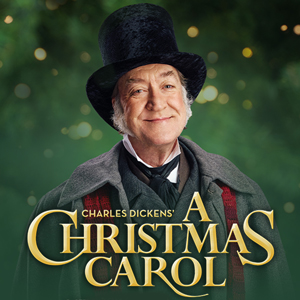
***** The 48th annual production of the Goodman Theatre’s “A Christmas Carol” is a one-of-a-kind Chicago experience. With fresh direction by Malkia Stampley, the 2025 version of Charles Dickens’ classic tale can boast of a new adaptation by Tom Creamer, making the show funnier and lighter than in previous years. Of course, there are still the same recognizable lines taken from Dickens’ original novel and the same basic structure. But the intentional overacting by a number of characters and the toning down of the plot in favor of physical comedy creates a show that starts to resemble vaudeville as compared to productions in the past. This does not mean that a less serious story is any less entertaining. Rather, the fine acting, singing, and dancing make the presentation unique and fun for those of all ages. But first a confession: I didn’t see the Goodman’s 2024 version, so any comparisons in this review are being based on the performance that I saw in 2023.
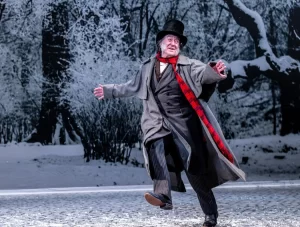
Christopher Donahue, now in his second year as Ebenezer Scrooge, brilliantly excels in this role. He provides just the right nuance and floors the audience with his use of exaggerated comedic gestures and silly facial expressions. He says “Bah, humbug!” more times than I can ever remember and inserts lots of ptooeys to express his scorn for others. He is especially demeaning of Bob Cratchit (Jon Hudson Odom) when his employee dares to request taking off work on Christmas Day. He is equally dismissive of his niece Frida (Amira Danan), despite her handing him a Christmas gift. In all, Scrooge is provoked to disgust whenever he perceives of other people getting in his way—and especially when they prevail upon him not to be so penny-pinching. And by playing Scrooge with his faults and his foibles in such a comical manner, Donahue makes him very human and thus quite relatable to us in the audience, for there may well be some part of Scrooge within each one of us.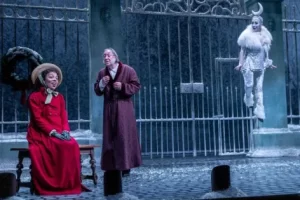
I have a suspicion that the majority of you are already familiar with Dickens’ tale, having studied the book in school or having seen the play or the iconic movie at least once. As a result, I’m not ruining it for you when I say that what eventually changes Scrooge for the better is what some people today might call “a near-death experience.” While it’s possible that Scrooge might have had a powerful dream or vision when he saw ghosts, it’s equally likely that he died in his sleep and was subsequently able to come back and tell us what happened. In either case, his unlikely journey profoundly changes his self-concept and his future actions.
Now going back to the play: Scrooge’s first visitation is from his former business partner Jacob Marley (Daniel José Molina), and from the beginning, it gets nailed into us that Marley was “dead as a doornail.” A visage of Marley first shows up at Scrooge’s home on his door knocker, followed by the ghost itself emerging from a bedroom wall. We see the length and heaviness of the chain that Marley has forged for himself in life, and the ghost warns Scrooge that if he doesn’t change his ways immediately, then his own chain will be much longer and heavier than it already is. The only way to possibly save himself from this terrible fate is to be visited by a series of three ghosts: the Ghost of Christmas Past (Lucky Stiff), the Ghost of Christmas Present (Bethany Thomas), and the Ghost of Christmas Yet-To-Come (Daniel José Molina).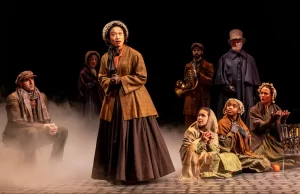
The first ghost, wearing a lovely crescent moon headpiece, gives Scrooge the opportunity to relive his personal past undetected. This is when he first sees himself back in boarding school as a schoolboy (Henry Lombardo) who comes from a troubled family with a drunken father but a warm and welcoming sister named Fanny (Sól Fuller). This scene is followed by Scrooge becoming an apprentice to Mr. Fezziwig (Robert Schleifer). Back in 2023, it was a stroke of genius to reimagine Scrooge’s former boss as being deaf and to give him and other characters the opportunity to incorporate sign language within the large production numbers. The physicality of using sign language to sing Christmas carols only adds to the show’s joyous spirit and its inclusiveness of those with disabilities, and I was delighted to see this idea being continued through the present day.
The second ghost focuses on the home life of Bob Cratchit. Clearly, Scrooge’s wage is insufficient for his family to live on, and by extension, this scene shows Scrooge that heads of household are forced to make do with the little money that they earn. Needless to say, the show would not be complete without some focus on Cratchit’s youngest son Tiny Tim (Ella Boparai), who walks with a cane and apparently has a serious health condition. In the next scene, Scrooge observes just how much he is disliked by his peers. But despite this, Frida offers a toast to her stingy uncle.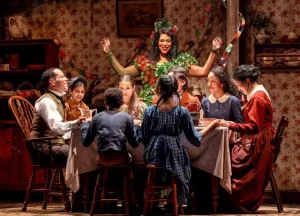
The third ghost (whose presence is more imagined than seen) offers Scrooge a glimpse into the days yet-to-come, where some unknown person has died. Scrooge then asks the ghost who this person is—but it doesn’t answer. In previous productions, when the ragpickers go through the man’s possessions and say that the deceased was such a horrible individual, Scrooge eventually looks at a tombstone and sees his own name on it. That’s the moment of his epiphany when he finally resolves to change his miserable ways. What becomes important to him is the internal reward of gaining the good opinion of others and creating a good reputation that will outlive his death. But the current script has changed all that. Today, a long and heavy chain is suddenly wrapped around Scrooge, just as Marley once predicted. Now it’s as if the man has gone to hell and back, and it’s this event that makes him fully regretful of his past behavior. It is this existential situation in the afterlife which ultimately brings him to the epiphany of choosing to become a good, kind, and generous person who actively wants to honor Christmas in his heart and try to keep it all year.
Set design by Todd Rosenthal is exceptional! The crooked room where Scrooge lives tells us so much about the person he is. The music direction by Gregory Hirte is great, together with the original music composed by Andrew Hansen. I loved the folk dancing numbers with authentic choreography by Tor Campbell. The musicians–Elleon Dobias (violin), Brian A. Goodwin (horn), Benjamin Heppner (percussion/guitar) and Hirte (violin)—are marvelous!
Costume design by Heidi Sue McMath is excellently done and true to the time period when Dickens wrote. Yet I would’ve preferred to see Scrooge travel backwards and forwards in time wearing a white nightshirt and knitted nightcap rather than the burgundy robe. This would have made it clearer that he was actually sleeping while all of these events were happening, and it would have added to the surreal nature of his experience. Perhaps more importantly, this would have enhanced the drama involving the ragpickers who find the white nightshirt during the scene with the Ghost of Christmas Yet-To-come. Regarding the lighting by Keith Parham, it’s generally very good but all the fluorescent lights are too overwhelming when the Ghost of Christmas Past first shows up. Plus, the lightning and thunderclap which starts out the second act scared a lot of people in the audience on opening night. Sound design by Pornchanok Kanchanabanca is remarkably fine, although one character does not project very well.
The story of “A Christmas Carol” is heartwarming. The acting is great. And the joyous music, dancing, and singing is sure captivate you. My guest said this was the most phenomenal thing she has ever seen. “I just loved it!” she proclaimed. She was incredibly mesmerized by the flying (provided by ZFK, Inc.), and she also said, “The jovialness enhanced the show.” But from my perspective, the comedic gags are overused. When we laugh at Scrooge a bit too much, he doesn’t entirely come off as the truly horrible person that he’s supposed to be. Instead, this miserly and insulting misanthrope suddenly becomes more hollow and less real and turns into a caricature of himself. And when we laugh at him as a caricature, this makes his stinginess less observable within ourselves. Moreover, when we see the long and heavy chain which Scrooge has forged in life and which now surrounds him, we may say to ourselves, “That’s not me. I may have my failings; I may make my mistakes. But I’m generally a good person.” So if it were up to me, the part with Scrooge’s chain should omitted and the script should be changed back to the way it was before, that is, when the man stares at his gravestone and thinks about how he will be remembered or not. This would allow the audience to identify more with the character and especially his parsimonious aspect.
All that being said, finding the right balance between the funny and serious elements of the show is what’s most important to its success. While it’s necessary for the production to be made less scary for the little ones, it’s equally essential for the tale to be convincing and the story to stay fresh for all.
“A Christmas Carol” is playing through December 31, 2025, at The Goodman Theatre, 170 N. Dearborn Street, Chicago, inside their 856-seat Albert Theatre.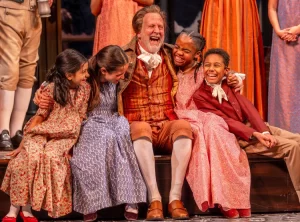
Tickets range from $34 – $173, subject to change
Group Tickets: Now available for 10+, email Groups@GoodmanTheatre.org for information on select discounted rates and perks.
Performance schedule:
Wednesday evenings – 7:00 p.m.
No 7:00 p.m. performances on December 24 (Christmas Eve) and December 31 (New Year’s Eve).
Wednesday matinees – December 17, December 24, and December 31 only, at 2:00 p.m.
Thursdays – 7:00 p.m.
No performances on November 27 (Thanksgiving Day) and December 25 (Christmas Day).
Friday evenings – 7:30 p.m.
Friday matinees – November 28, December 19, and December 26 only, at 2:00 p.m.
Saturdays: 2:00 p.m. and 7:30 p.m.
Sunday matinees: 2:00 p.m.
Sunday evenings – December 7, December 14, and December 21 only, at 7:00 p.m.
Additional performances:
Tuesday evenings – November 25, December 23, and December 30 only, at 7:00 p.m.
 Enhanced and Accessible Performances:
ASL-Interpreted: December 5 at 7:30 p.m. – An ASL interpreter signs the action/text as played.
Audio-Described: December 6 at 2:00 p.m.; Touch Tour; 12:30 p.m. – Action audibly enhanced via headset.
Open-Captioned: December 7 at 2:00 p.m. – LED sign presents dialogue in sync with the performance.
Spanish-Subtitled: December 7 at 7:00 p.m. – LED sign presents Spanish-translated dialogue.
Sensory-Friendly: December 28 at 2:00 p.m. – Lights and sounds are softened; sensory items available.
Visit https://www.goodmantheatre.org/tickets/accessibility/ for more information about The Goodman’s accessibility efforts.
For more information and to purchase tickets, go to https://www.goodmantheatre.org/show/a-christmas-carol/ or call 312-443-3800 or visit the Box Office at 170 N. Dearborn.
Please see the website for the performance dates when Johnson appears as Scrooge.
Note that the performance is 2 hours and 15 minutes, including an intermission.
Questions? Need help? Contact the Box Office at 312- 443-3800, 12:00 noon – 5:00 p.m., daily.
Note that on opening night, we were treated to Christmas carols sung by the Benet Academy Madrigal Singers followed by Indigenous flautist Bill Buchholtz. Then director Stampley made some brief remarks and led a countdown of the Christmas tree lighting, together with a group of young performers from this year’s show.
To see what others are saying, visit www.theatreinchicago.com, go to Review Round-Up and click at “A Christmas Carol”.



More Stories
“Dead Girl’s Quinceanera”
“Dial M For Murder”
“A Midsummer Night Scream” reviewed by Frank Meccia