
 **** Camerata Chicago opened its 23rd season with the theme of “A Midsummer Night’s Dream.” The first of three performances took place on Friday, October 16th inside the Buchanan Chapel at Fourth Presbyterian Church, off the Magnificent Mile in Chicago. A supremely powerful chamber orchestra of about forty musicians, led by Maestro Drostan Hall, grounded the concert. The program was largely based on fairy tales and traditional English folk tunes in a serendipitously entertaining musical presentation where the composers riffed on myth, sprites, and magic.
Dr. Tony Payne, Camerata Chicago’s newest composer-in-residence and professor emeritus at Wheaton College, started out the evening with a lecture about his inspiration for his new work, entitled “Fantasia on English Melodies” or “Fantasy on English Folk Tunes.” (The title varies depending on which part of the playbill you turn to.) This world premiere composition, which led the program, was based on Horatio Parker’s Penguin book of English folksongs, written in 1917. The reason that Dr. Payne called his composition a musical “fantasy” or “fantasia” is because “it is not constrained by the conventions of classical music.” Basically, he wanted to combine unrelated tunes without calling the final work a sonata or a rondo—or a theme and variation. He wanted his fantasy to incorporate a variety different folk tunes and all sorts of folk episodes assembled into one creation. He ultimately wanted to paid homage to Ralph Vaughan Williams, particularly his “Fantasy on a Theme by Tom Tallis” (1910), which had to do with Williams’s interpretation of Tallis’s music, particularly his third mode melody. At the same time, Maestro Hall describes Dr. Payne’s “Fantasy” as “beautifully cast in the mold of… Williams, who turned English folk tunes into wonderful, spiritually uplifting compositions.”
“Fantasy on English Folk Tunes” is an ambitious piece of music. Among the various themes within the fantasy is the folk ballad “Lovely Joan,” a tribute to Hall’s late mother Joan. There is also something that Dr. Payne calls the “Drostan theme”, in which he links Hall to the literary character of Puck from Shakespeare’s “A Midsummer Night’s Dream.” Puck is a trickster spirit akin to that of Robin Goodfellow, a mischievous household and woodland sprite from English folklore. Constant transitions in theme and musical style mark this fantasy, with Dr. Thomas Arne’s “Rule Brittania” (1740) ending the piece. The composition is notable by its reliance on solo flute, oboe, clarinet, bassoon, French horn, and violin to launch each of the folk themes. Because “a fantasy can be anything and can be without form or structure”, Dr. Payne wanted the audience to ask itself, “What is happening next?” It’s rare that I get to comment on a brand new piece of music. For my taste, the composition seemed to be too much of a mishmash of styles and themes that I felt were pulled together without a consistent type of artistry behind it. My guest liked it more than I did.
I should quickly add that it would have been preferable had Dr. Payne typed out all of his notes and printed them inside the program booklet. As things stood, there was an awful lot to recall about his talk as the orchestra played his music. The depth of detail would have been better served by listing the names of the various folksongs which we were listening to, so as to serve as a reference and put the larger piece in context. If I could have read more about it, maybe I might have had a fuller appreciation of the work and what went into it.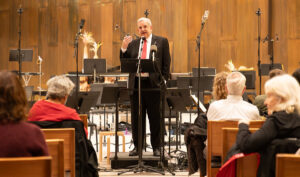
This world premiere composition was bookended by Felix Mendelssohn’s “A Midsummer Night’s Dream, Overture and Incidental Music to Shakespeare’s Play.” The entire second half, while dedicated to a performance of the music, was also interspersed with Drostan Hall’s dramatic readings of Shakespeare’s original text. By means of introduction, Hall told us at first that Mendelssohn originally wrote this work when he was only seventeen years old, that is, in 1826 as a concert overture after reading a German translation of the Shakespeare. But sixteen years later, at the request of King Frederick William IV of Prussia, he created incidental music (Op. 61) to accompany a staged production. This suite expanded the original overture with additional pieces to draw on other scenes from Shakespeare’s text. Hall also explained the details of the story: that the setting was Athens, Greece, where lovers found themselves in a magical forest… and the story went on from there.
Today’s presentation of the Mendelssohn suite was enlightening. Every so often, Maestro Hall would turn away from the orchestra and towards the audience to give us the scoop on the leitmotifs of the various characters who were part and parcel of the fairytale. Then he would recite numerous passages from the text so that the audience could follow the story and understand where Mendelssohn was going with his musical interpretation. It was good to hear what the story was about before everything else. It was also good to hear Hall’s dramatic narration in situ in Elizabethan English. That being said, the Overture was majestic and then breezy. The Scherzo introduced us to Puck’s theme, and the narration described Puck and the fairy queen. Hall showed us examples of the music and how they tied in with the fairytale, creating a coherent plotline and theme. Yet it would have been easier to follow the whole thing had several other individuals read the dialogue in addition to Hall. The main issue I had, however, was that his remarks on the story combined with his reading of the text became somewhat too repetitive over time.
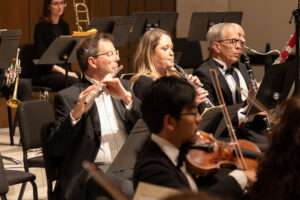
Sandwiched between two visions of “A Midsummer Night’s Dream” was Mozart’s Sinfonia Concertante for Four Winds in E-flat major, K. 297b, written in 1778. Today’s concert featured soloists Grace Hong (oboe), Elizandro Garcia Montoya (clarinet), Lee Shirer (horn), and Vincent Karamanov (bassoon). I loved listening to all these highly skilled instrumentalists! The tuneful Allegro movement is followed by an almost dreamy Adagio movement, where the melody moves from one instrument to the next. We see how Mozart is more interested in harmony and blend than in showcasing any one instrument, that is, until the Andantino movement, which features wonderful solos: from the bassoon to the clarinet to the oboe. It is interesting to note how the entire composition is simpler than Mozart’s later works, and it is in the third movement where the instruments begin to break out and presage his future accomplishments.
Maestro Hall was remarkable to watch. It was evident how well he feels the music and how brilliantly he conducts this magnificent chamber orchestra. Inasmuch as I enjoyed the performance, the Buchanan Chapel seemed too small for such a powerful mid-sized orchestra. Plus, the architectural layout of the room did not offer the best acoustics for an ensemble of this size and composition. In part, this was because of the slanted wall paneling behind the stage/altar, which made certain instruments predominate over others. Basically, the sound as a whole was somewhat different than what we might hear at a dedicated concert hall.
Yet the highlight of the evening could not have been any better as it built up to Mendelssohn’s Dan of the Clowns and then to his famous Wedding March at the very end. This spirited movement—live and in person—capped an amazing concert!
The Camerata Chicago Chamber Concert took place at Fourth Presbyterian Church, 126 E. Chestnut Street (at Michigan Avenue), in Chicago, on Friday, October 16, 2026.
Subsequent performances of the same repertoire took place at 3:00 p.m. on Saturday, October 17 at Armerding Concert Hall, 520 E. Kenilworth Avenue, in Wheaton, and at 3:00 p.m. on Sunday, October 18 at Union Church of Hinsdale, 137 S. Garfield Street, in Hinsdale.
 Tickets were $50 – adults
$40 – seniors 65 and over
$10 – students
$2 – children 14 and under.
VIP tickets were $75.
Using online code CCPR provided a 15% discount.
Group discounts were available.
All venues were general seating with special front sections for VIP ticket holders with the exception of Armerding Concert Hall at Wheaton College, which had assigned seating.
For further information about these concerts and to learn about future offerings, visit: https://www.cameratachicago.org/ or phone 312-799-0916 or email: andiamo@cameratachicago.org


More Stories
A Funny Thing Happened On The Way to Chicago-
“Fantasticus: Bach and Before” Bach in the City reviewed by Julia W. Rath
“The Carpenters Songbook: A Live Celebration” starring Christina Helene Braa as Karen