
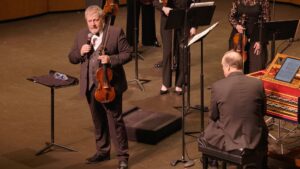
 ***** In one of the best concerts of the season, maestro and violin virtuoso Fabio Biondi took charge of the Music of the Baroque Orchestra in a program consisting of music from Italian Baroque masters. Entitled “Vivaldi & Friends”, the music was centered around composers who inspired Vivaldi and those whom Vivaldi inspired. But its presentation revolved around the world-renown Biondi, whose artistry is without equal and whose fiery performance on solo/first violin could not have been any better.
The first thing that we noticed on stage wa-s that, with the exception of the continuo, the musicians played their instruments while standing. This was a throwback to the era when Baroque music was first written, a time period when the violinist (i.e., concertmaster) used his bow and body movements to lead the orchestra.
Antonio Vivaldi’s Concerto for Strings in G Minor, RV 152 started out the program. The bright and beautiful Allegro molto was followed by a gorgeous combination of violin, viola, first cello, double bass, and harpsichord in the Andante molto movement, with the second Allegro molto very lively with lots of dynamics. This was followed by Giovanni Battista Sammartini’s Symphony No. 6 in F Major, with its Presto movement incorporating the pointedness of repeated measures and lots of runs in the concluding Allegro assai. Francesco Geminiani’s Concerto grosso in D Minor (La Follia) after Corelli, op. 5, no. 12 came next. The composition was made up of a theme and lots of variations. Biondi’s performance was amazing, and I especially loved the violin duet he played with Gina DiBello (now positioned so that she can face him, as compared to playing over his left shoulder). The variations were too many to count: some slow, some fast, some played staccato, some played legato, some in 4/4 time, some in 6/8 time, some duets, some with the introduction of the first cello (Callum Cook), some with more harpsichord (Stephen Alltop)—all fabulous.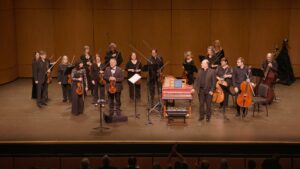
Immediately after the Geminiani, Biondi took the microphone and provided the audience with an “alternative explanation” of music history, where he put the lives and musical traditions of these composers into perspective. Particularly interesting was his statement that each region on the Italian peninsula had its own distinct musical style before being consolidated into the nation-state of Italy. Biondi’s choice of program thus showcased composers from different regions, with a prime influence being that of Arcangelo Corelli. Thus, it was appropriate to close out the first half with Corelli’s Concerto grosso in B-flat Major, op. 6, no. 11. Played all in one, the composition features lovely melodies and flourishes plus exquisite solo violin (Biondi).
After the intermission, we heard Pietro Nardini’s Concerto for Violin in A Major, op. 1, no. 1. Now Biondi mostly faced the audience, as is typical in the staging of most concertos. Biondi’s solo with accompaniment in the opening Allegro section offered great technique and lots of arpeggios. The Adagio was full of grace notes and trills, with even more grace notes and sixteenth notes in the closing Allegro assai portion. The cadenzas in each movement were delightful, each one with growing complexity that highlighted Biondi’s technical proficiency.
The composition that followed was Vivaldi’s Concerto for 2 Violins in G Minor, RV 517, which brought Gina DiBello back to center stage to join Biondi. Their duets with continuo were stellar in the opening Allegro, plus the power of two. Harpsichord and cello are most notable in the Andante movement. Plus, the famous closing Allegro can serve as an example of how well Biondi cued the orchestra by sweeping his bow like a baton, moving his head, and using his body language. When this portion of the concert ended, Biondi and DiBello hugged, and he kissed her hand.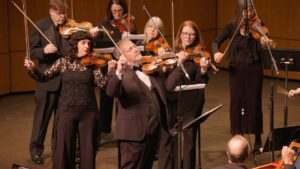
The small podium made its return for the final number: Gaetano Pugnani’s Sinfonia in B-flat Major. Also making its return during the opening Adagio section was the errant cell phone, whose ringing was not on key. What is interesting about this composition is that it starts out with an Adagio rather than the more traditional Allegro, and here the Allegro assai movement (which is the second movement) featured lots of dynamics and forcefulness. I particularly loved how Biondi cued the bass, using his bow like a spear. The closing Menuet featured a beautifully done viola solo (Elizabeth Hagen), not to mention the amusing ending with a Boomp!
Not only was Biondi phenomenal in playing violin while simultaneously conducting the orchestra, but it was impressive how well he brought lesser- known Baroque composers to the attention of an American audience. Bravo!
“Vivaldi & Friends” by the Music of the Baroque Orchestra took place on Sunday, April 12, 2026, at the North Shore Center for the Performing Arts, 9501 Skokie Boulevard, in Skokie.
This was followed by a performance on Monday, April 13, 2026, at the Harris Theater, in Millennium Park, 205 W. Randolph Drive, in Chicago.
 Both performances started at 7:30 p.m.
Live performance tickets ranged from $46 to $119. Discounts may be available for students and seniors.
On-demand performances will be available from Friday, April 17th at 5:00 p.m. through Sunday, May 17th. On-demand tickets are $18 including a $3 handling fee.
For on-demand tickets, visit:
For more information about this and future performances of Music of the Baroque, including times, dates, and locations, please go to: https://www.baroque.org/. For information about future ticketing, visit: https://www.baroque.org/tickets/.
Music of the Baroque is a resident company of the North Shore Center for the Performing Arts. To learn more about the venue, their future offerings, and ticket prices, visit: https://northshorecenter.org/.
To learn more about the Harris Theater, their future offerings, and ticket prices, go to: https://www.harristheaterchicago.org/.
One last word: I couldn’t believe it when my guest ordered a bottle of water at the concessions stand before the performance started, and they wouldn’t give her the bottle cap! She always buys water at the theatre, and this was a first. It’s not like ordering an alcoholic beverage, where they don’t want people to leave the theatre with it and drive home. It’s just water (for heaven’s sake), and it can easily spill inside the concert hall.
My guest couldn’t enjoy the concert, because she had to have a firm grip on the open bottle the whole time, and her hand got very tired. There was no putting the bottle down on the slanted floor, plus someone could easily kick it over in such a narrow row of seats. With one of her hands occupied, she had issues applauding, and that made her even more upset. So over intermission, my guest went to complain to management, but the supervisor was not on the floor, and she was told to show up after the performance ended. But by then, she was so disgusted that she didn’t feel like complaining anymore—and just wanted to leave.
And while I’m on this subject, what about the people who need to bring water into the theatre for medical reasons, such as to prevent coughing? Must everyone be required to purchase bottles at the concessions stand? I also remember the summer of 1995, after the dreadful heat wave where temperatures were consistently over 100 degrees. That was when most venues changed their rules and allowed people to bring their own bottle of water from home… complete with bottle cap!



More Stories
A Day In Volo!
Special Gifts
Special Gifts Theatre- new season and annual walk to raise funds