
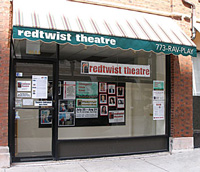
 **** Dominique Morisseau’s complex and multilayered script “The Confederates” is very creative and thought-provoking, a glimpse into the hidden past of the origins of racism and misogyny. The play asks the question: To what extent does racial bias against black people (and especially black women) stem from the history of enslavement during the Confederacy as well as subsequent racial prejudice and discrimination with Jim Crow? And why does this vicious and cruel legacy from the past persist in so many conscious and unconscious forms up through the present day?
Directed by Aaron Reese Boseman, this play is being produced both in honor of Black History Month and as part of RedTwist Theatre’s theme for its 21st season, entitled “Defiant Femmes.” The story starts out with an in-depth look at what it means to be an African American female professor at a mostly white university in today’s day and age. At the top, Sandra (Monique Marshaun) recites a litany of museums she has visited, places she has traveled to, books she has read, and articles she has written to indicate the tremendous amount of knowledge she has about the history of black people in America, plus she has a considerable wealth of experience being a tenured professor. Yet the question on the table is how she and her scholarly work are being perceived by students and faculty at the university. While she knows ahead of time that there are two strikes against her—being a woman and black—how does she respond to the unspoken (and often misguided) putdown that she might be “an affirmative action hire”, meaning that she must be lesser qualified as an academic simply because she is female and African American. The consequence of this racial and gender typecasting means that she is therefore not supposed to be taken as seriously as others in her profession—which becomes very hurtful on top of other things that are going on in her personal life.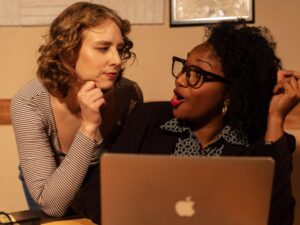
What frames the story is a paper written by one of Sandra’s students, named Malik (Makari Robinson-McNeese), who is one of the few black students at the university. We are told that in his paper, he has ostensibly compared the political and social situation surrounding the Emancipation Proclamation with the consequences of affirmative action over one hundred years later. But Sandra has marked his paper down, making him wonder whether his bad grade is truly a consequence of his own failings to understand history or whether Sandra, as a black female, is trying to show him that a black man has to work so very much harder so as to compete against his white colleagues, first at the university and later for jobs and income.
At around the same time, Sandra has become the target of hate. Some as-yet unknown individual apparently took an original antebellum photograph, photoshopped an image of the professor’s face on it, enlarged it, and then posted a copy on her office door as a means of demeaning and defaming her. And what does it mean to be the target of such a vicious act? Do both the black and white students and faculty fully grasp the gravity of the situation, or do they view it through a less socially conscious lens? And of course, one has to ask where did the original photograph come from before it was manipulated and turned into a malicious image?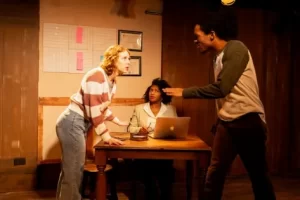
Morisseau believes that the key to comprehending the origins of racism in the United States and its persistence into the current era is to go back in time to examine people’s lives in the South. So in addition to the focus on Sandra and her problems, the playwright has created a second narrative, where the audience witnesses an enslaved woman named Sara (Shenise Brown), who lives on a plantation, works in the fields, and lives in a slave cabin during the time of the Civil War. This narrative begins when Sara fears for her life when her brother Abner (Makari Robinson-McNeese), an escaped slave, has now returned to visit her. In the recent past, he has joined the Union Army and, among other things, he has brought back the long gun that the army has given him to fight against the Confederacy. Sara is enamored with the gun, because, for her, it means the likelihood of freedom from bondage. She knows that the system is rigged against black people, but she has to get on in the best way that she can, so she has chosen to fight against the yoke of slavery in a very different way: by learning to read and educating herself on what the “good book” has to say. The person who has taught her to read (and who also thinks of Sara as her best friend) is a white woman named Missy Sue (Madelyn Loehr), the plantation’s mistress. Missy Sue is attracted to Sara in a lesbian way; and because of her affection, she arranges for Sara to work in the big house rather than outdoors. Inside the house, she meets up with Luanne (Toccara Castleman), who already works there as a domestic. We learn that after Sara’s mother was hanged, Luanne’s mother raised the two girls together. Yet neither woman fully trusts the other as there is some measure of competition between them: the roots of which lie in differential favoritism by the plantation’s (white) master and mistress.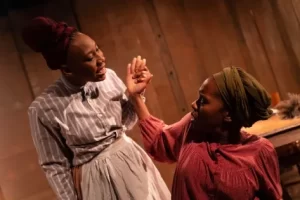
This leads to the fundamental structure of the plot. When Morisseau looks at the university professor’s life against the backdrop of the South’s “peculiar institution” of slavery, she counterposes Sandra and Sara, two strong women, each with their own struggles, who want to be treated as full human beings. As the two storylines shift back and forth, the minor characters in each of the time periods are played by the same actors, making for parallels in character and situation. But because the script has made structure primary, practically all of the characters wind up being placed in boxes in order to make a comparison between the past and the present. We see this when Missy Sue’s affection for Sara is later mirrored in the relationship between Sandra and her teaching assistant Candice (Loehr). We also see this when the tensions between Sara and her fellow domestic worker Luanne (Toccara Castleman) are mirrored in the distrust between Sandra and her untenured faculty colleague Jade (Castleman). Here it feels like a bit of a stretch when the battle for tenure at the university is being likened to the promotion of an enslaved woman from the fields to the plantation’s big house. Moreover, while the lesbianism serves as an important thread in the Civil War era account, its parallel in the present day is too overdone. Plus the nudity towards the end seems superfluous. Both of these things push the point of the story past its usefulness, because we’ve already gotten the message. Hence, the tale would have worked better had the characters been allowed to act more like their authentic selves as opposed to constantly being made to resemble their counterparts.
Costumes by Marquecia Jordan are done extremely well and are perfectly authentic for both eras. Lighting by Quinn Chisenhall nicely demarcates scenes, especially separating out the travel back and forth through time. For having such a small stage and an intimate setting, the scenic design by Kevin Rolfs is beautifully done. Having a sliding wooden panel which converts the right section of the stage from Sandra’s office to slave quarters is quite clever. Minimal props by Nick Barletson work well for both eras. Also worthy of mention is Dee Etti-Williams’ sound design and Greg Geffrard’s intimacy and violence design.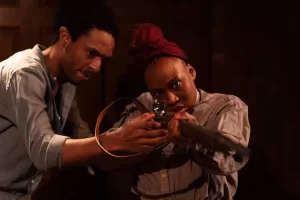
So we are left to ask: Is the hanging of an offensive poster on the professor’s door the moral equivalent of an actual hanging of an enslaved woman during the Confederate era? To put this another way, is this act equivalent to the use of the swastika in symbolizing the brutal murder of blacks, Jews, and other minorities in the past? I would argue that you should come to see this play and decide what this means for yourself.
“Confederates” is playing through March 8, 2026, at Redtwist Theatre, 1044 W. Bryn Mawr Avenue, in Chicago.
Tickets are $10-$60 with discounts available for seniors, students and veterans
Friday night performances are pay-what-you can.
Performance schedule:
Thursdays, Fridays, and Saturdays – 7:30 p.m.
Sundays – 3:30 p.m.
For more information and to purchase tickets, go to https://www.redtwisttheatre.org/.
To see what others are saying, visit www.theatreinchicago.com, go to Review Round-Up and click at “Confederates”.





More Stories
“Kowalski”
“The Front Page”
“The Attic: Things I’ve Seen While Lying On My Back”