

 *** I always enjoy when Pride Arts presents a world premiere. There is something exciting about seeing a play
for the first time, when there is nothing to compare it to and you can judge it strictly on what is in front of
you. You get to experience the story as the playwright and director intended it, without the expectations
that come with a production that has already been performed elsewhere.
Pride Arts is currently presenting Windows, a world-premiere play by Matt Schutz, directed by Taylor
Pasche. The play was the winner of the Pride Arts Queery Workshop, and Pride Arts subsequently
selected it for production.Schutz has been writing plays since his days at the University of Iowa, and Windows demonstrates a writer
who understands how ordinary lives can contain complicated dreams, disappointments, and possibilities.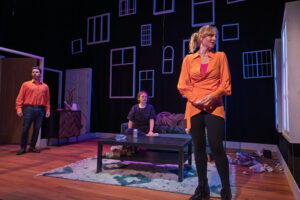
The story takes place in what could be described as Any Town, USA, and centers on three very different
people whose lives have become intertwined.
Olivia, played by Lucabella Sangin, is a former soccer player whose promising career came to a tragic end
after an accident on the field. She is now recuperating in the apartment of her lover, Natalie, whom she has
known since college. Natalie, played by Vinita Dixit, is an introvert who rarely tells people how she really feels. She isn’t much of
a complainer, either. After failing to get into medical school, she has settled into what appears to be a deadend job, while trying to maintain her relationship with Olivia.
The third member of this unusual household is Clay, played by River Ruiz, who owns the apartment. He inherited it after his boyfriend left him for what he considered a better job in San Francisco.
Put these three people together in a small apartment and you have plenty of opportunities for conflict. Olivia, unfortunately, isn’t exactly the ideal houseguest. She has become a total slob, using her injury as an excuse not to move forward with her life. She mooches off the people around her, looking for sympathy, food and attention rather than taking responsibility for getting better. But Olivia does have one form of entertainment that becomes central to the play: looking out the window at her neighbors.
She watches their lives and begins creating characters and stories in her imagination, writing the dialogue
she believes they are saying. Those imagined characters eventually come to life in the apartment, turning
the living room into a kind of theatrical extension of Olivia’s mind. The neighbors are portrayed by Ashley Kramer and David Lipschutz, and both actors make the most of the unusual concept. Lipschutz has been a fixture in Chicago theatre for more than a decade. His plays have been performed
internationally in more than six countries, and he is also a member of Hell in a Handbag Productions. But the real standout for me was Ashley Kramer. Kramer takes on at least five different characters, and each one is distinctly different. Her ability to switch personalities, voices and mannerisms is impressive. One of her strongest skills is her delivery, particularly
when she launches into a rapid-fire monologue. She speaks incredibly fast while remaining remarkably precise, and on several occasions the audience rewarded her with enthusiastic applause when she finished.
As Windows develops, we begin to understand that all three main characters are struggling with their own versions of disappointment. Clay finds himself considering whether to return to a failed relationship, even after achieving a much sought-after promotion. Natalie begins to realize that if she wants her relationship to grow and survive, she
needs to become more open and honest about her feelings. And Olivia must eventually face the biggest challenge of all: herself. She needs to understand that she can get better, that she can accomplish more, and that she cannot allow one terrible accident to define the rest of her life. She has to decide whether she is going to allow that
tragedy to turn her into a bitter person—or use it as an opportunity to become a better one. And that is where the title Windows becomes particularly meaningful.
All three characters spend their lives looking outward, watching the world and imagining what other people are doing behind their windows. But ultimately, they are really looking at themselves. Their dreams, fears, failures and hopes are reflected in the lives they imagine beyond the glass. There is something universal about that idea. We often look at other people’s lives and imagine that they have something we don’t. We create stories about strangers without knowing what is really happening behind their doors. And sometimes, those imagined lives can tell us more about ourselves than they do about the people we are watching.
The technical aspects of the production also deserve recognition. Scenic Designer Hayley Wallenfeldt has created a clever and effective apartment setting. The main windows face away from the audience, while the backlit windows in front of us allow the audience to see what Olivia is experiencing as she looks into the lives of her neighbors. It is a simple but very effective theatrical device that helps bring the concept of the play to life. Lighting Designer Lea Davis also deserves credit. The lighting works beautifully with the set and helps
establish the different worlds Olivia creates through her imagination. The lighting is right on throughout the production and adds another layer to the storytelling.
Windows runs approximately one hour and 45 minutes without an intermission.
For a first-time performance, I would suggest reconsidering the no-intermission format. The play asks the audience to stay
engaged for a fairly long stretch of time, and even a brief intermission could give both the audience and the performers a chance to reset.
That said, there is plenty of promise here.
Matt Schutz has created an interesting premise with characters who are flawed, funny, frustrating and,
ultimately, human. Taylor Pasche’s direction gives the production a strong theatrical identity, particularly in
the way Olivia’s imagination and the lives she creates through the windows are brought into the apartment.
For a world premiere, Windows is an intriguing beginning. It may still have some growing to do, but that is
part of the excitement of seeing a new play for the first time. You get to watch a playwright’s idea come
alive—and perhaps see the beginning of something that could have a life well beyond this production.
Windows runs through August 23 at the Center on Halsted, Hoover-Leppen Theatre, located at 3656 N. Halsted St.,
Parking is available in the garage downstairs.
If you enjoy supporting new playwrights, world premieres and Chicago’s ever-growing theatre scene,
Windows is worth taking a look through.
Tickets can be purchased at the box office or at www.pridearts.org.
Showtimes are Thursdays- Saturday at 7:00pm, Sundays at 3:oopm.
Tickets are $35, Seniors and Students receive a $5.00 discount, for more
information call 773-661-0770.
To see what others are saying, visit www.theatreinchicago.com, go to Review Round-Up and click at “Windows”.




More Stories
“The Notebook”
“The Outsiders” – even better the second time! Al Bresloff / 2nd review by Frank Meccia
“Marble” reviewed by Julia W. Rath