
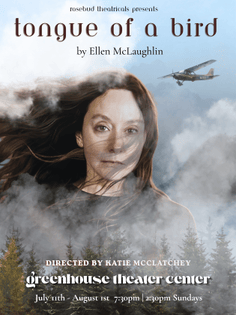
 ** In its inaugural production, Rosebud Theatricals has launched the world premiere of “Tongue of a Bird”, written by Ellen McLaughlin and directed by Katie McClatchey. It’s about mothers and daughters and the connections between them. We see how three generations of women share their vulnerabilities as they process the losses in their lives and even the loss of themselves. With its thoughtful and meaningful dialogue, it is a powerful reminder that sadness, depression, and grief can happen to any one of us at any time, and it emphasizes the importance of coping and healing, especially after losing a loved one.
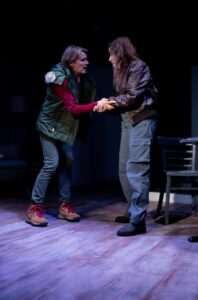
The problem with this play, however, is that it consists of two related stories of different genres uncomfortably rolled into one. The first story is largely a psychological drama that touches upon the supernatural and the yet-to-be revealed. Maxine (Lori Rohr) is obsessed with her mother’s death when she was a girl at the age of five or six and wants to learn how and why her mother committed suicide. Now as a grown adult, she has become a helicopter pilot, who does search and rescue operations to locate those lost in the Adirondacks. There she is very well acquainted with all of its ridges, valleys, and quagmires. Maxine’s profile is quite interesting. We learn that she has likened her deceased mother Evie (Lauren Pizzi)—who never flew a plane—to Amelia Earhart, who flew solo and disappeared without a trace. Now in her imagination (or perhaps via a spiritual vision or a ghostlike visitation), her late mother is dressed up in a flight suit to look very much like Earhart. More to the point, the thought that her mother will never return to her has even affected Maxine’s choice of career, that is, to become a pilot with the goal of playing the hero…. and successfully finding missing people before any harm has been done to them.
Enter in the second story. This is a reality-based mystery and a possible kidnapping or murder case. Dessa Hobart (Amy J. Johnson) is the mother of twelve-year-old Charlotte (Scarlett Brooks), who has suddenly gone missing, presumably abducted by a stranger during a school field trip. Dessa suspects that she has been kidnapped and possibly sexually assaulted and that she has been hidden somewhere up in the mountains. The grief-stricken Dessa does some research and decides to hire Maxine to find her lost daughter, even going so far as to accompany Maxine on some of her air sorties at all hours of the day and night.
Maxine subsequently shares her experience of looking for Charlotte with her grandmother Zofia (Jean Marie Koon), who raised her after her mother’s untimely death. Zofia, a first-generation American originally from Poland, knew a lot more about Maxine’s mother and her situation than she chose to reveal to her granddaughter. We also discover that the missing Charlotte is coincidentally the same age as Zofia when she first arrived in the United States, after having bombs dropped on her family during World War II. In Maxine’s case, the pain of losing her mother at such a young age has never gone away, whereas in Dessa’s case, the pain of not knowing the fate of her missing daughter has created an unassailable grief. And then there was the angst that Zofia has felt over the years which she could not reveal… until the moment was ripe.
The show also has to do with giving social support to friends and family and getting social support from them as well. For instance, Dessa and Maxine share confidences, and Maxine looks to her grandmother Zofia for reassurance. But what about all the men who were presumably in these women’s lives as fathers, brothers, sons, or husbands? Why are they never mentioned? How have they dealt with their share of losses too?
You need to know that the shape of the storytelling is odd: vaguely reminiscent of “The Twilight Zone” but bereft of Rod Serling’s explanation of exactly what we are watching. What we start to presume is that Maxine might have the gift of being able to see and communicate with the dead. It is unclear why, early on, Maxine does not want to be in contact with her mother’s spirit or ghost or vision. But apparently (spoiler alert), it is only once Maxine has discovered Charlotte being dead that she changes her mind and becomes willing to entertain the possibility that whatever appears to be her late mother’s spirit is not only real but comforting. Apparently, Charlotte’s death awoke something within Maxine. And that’s the best I can explain things without revealing too many great secrets.
The story as a whole works okay if you are prone to believing that there is a fantastical or metaphysical world out there. It will not work well if you are literal-minded and believe only in the material plane of existence. For example, Charlotte appears to Maxine a few times as a spirit or a ghost or a vision, streaked with blood. But apparently when Charlotte’s body was found, Maxine claims to Dessa that there was no blood on her at all. Was Maxine lying to protect the girl’s mother? Most likely, Maxine cannot bear seeing the gruesomeness of Charlotte’s lifeless body, and I would presume that the bloody spirit which Maxine saw was actually closer to reality than what she would care to admit.
At the moment when Dessa regrettably learns about her daughter’s death, she tells Maxine that she doesn’t ever want to see her again. And in so doing, the mystery portion of the tale comes to an abrupt end. But since we never get to the bottom of the whodunnit, we, as an audience, are left unsatisfied. I would have liked to see the grief-stricken Dessa grab Maxine at that moment and yell, “I just want to know what happened to her!” More to the point, we never learn of a detective or an investigator being involved, especially once the body has been found. I wanted to hear a sentence or two about the resulting death investigation. For example, Dessa could have hired an attorney to launch a criminal inquiry. It would have been helpful to know what the coroner said about the body or the prosecutor said about the likely perpetrator, and so on. To put this another way: the play should have been framed more around solving this mystery, since this is ultimately the engine that propels the plot forward.
The play combines lots of interesting ideas about spirits, visions, and mental health. But it tries much too hard to tie in Maxine’s life with the analogy of the lost bird inside the walls of her grandmother’s house. It’s “probably a greasy grackle” says Zofia, “with its black and flat tongue.” But why a grackle? In many traditional cultures, this bird has a spiritual meaning. According to the internet, a grackle is largely considered a spiritual messenger inviting a person to look beyond the surface and deeper into themselves. The reason for this analogy is that the bird’s color superficially looks black but is actually multi-colored and iridescent. “Their dark, glossy feathers often link grackles to the concept of the shadow self—the parts of our personality we repress or deny: our fears, insecurities, and unacknowledged desires.” Its tongue can be thought to give voice to a missing spiritual dimension of human existence, and it emphasizes the need for a person to find their own unique voice.
In all, while the portion of the story about Maxine’s spiritual development works decently enough, the portion having to do with Charlotte’s abduction and subsequent death is not adequately resolved. After the play is over, we are largely left in the same place as we were at the very beginning, that is, when Maxine was first hired. It’s all well and good when the twelve-year-old returns as a spirit, but what of the cause of her disappearance and who was responsible? While the merging of the psychological drama with the supernatural plus a murder mystery can potentially make for good theatre, the overlapping of these genres doesn’t work successfully in this case. Although the story is well-intentioned, we are left with much of the same mystery and the same search for answers.
“Tongue of a Bird” is playing through August 1, 2026, at the Greenhouse Theater Center, 2257 N. Lincoln Avenue, in Chicago.
General Admission Tickets (includes a $2 facility fee) – $27 + $4 online convenience fee = $31
Performance schedule:
Saturday, July 11th – 7:30 p.m.
 Sunday, July 12th – 2:30 p.m.
Thursday, July 16th – 7:30 p.m.
Friday, July 17th – 7:30 p.m.
Saturday, July 18th – 7:30 p.m.
Friday, July 24th – 7:30 p.m.
Saturday, July 25th – 7:30 p.m.
Saturday, July 26th – 2:30 p.m.
Thursday, July 30th – 7:30 p.m.
Friday, July 31st – 7:30 p.m.
Saturday, August 1st – 2:30 p.m.
For more information and to purchase tickets, visit or call the box office at 773-404-7336 or contact boxoffice@greenhousetheater.org.
To see what others are saying, visit www.theatreinchicago.com, go to Review Round-Up and click at “Tongue of a Bird”.



More Stories
“The Book of Mormon”
“Jersey Boys” 20th Anniversary Tour- MILWAUKEE
“Mud Row”