
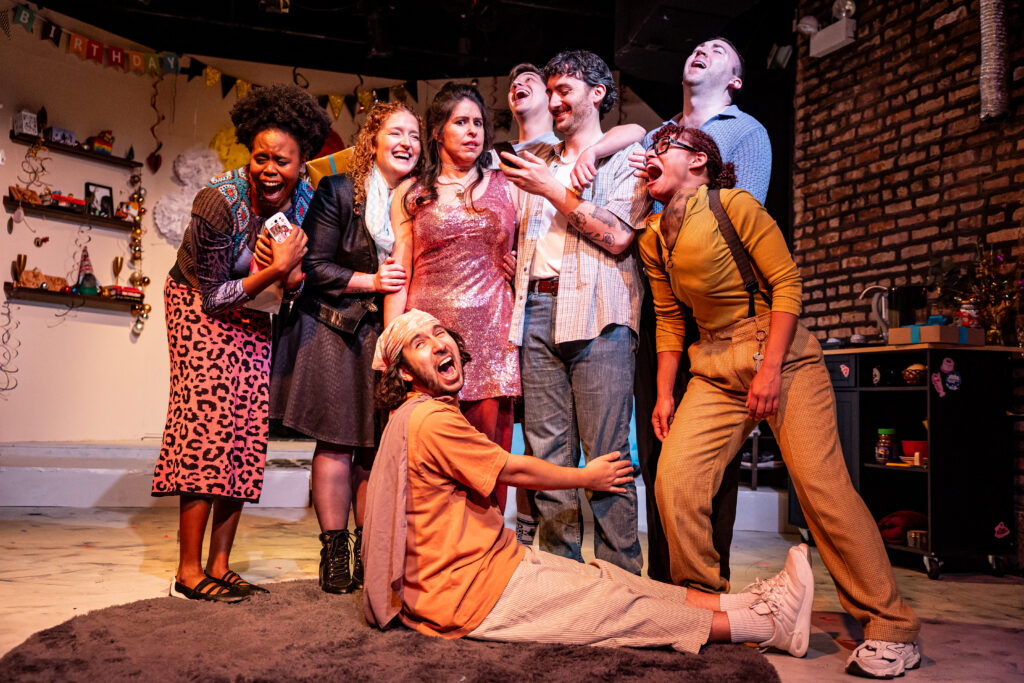
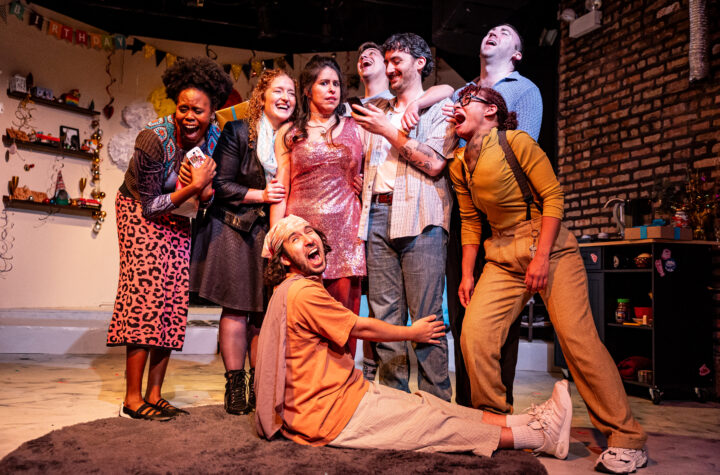
 **The World Premiere of “They Broke Up” by Skyler Tarnas has to do with how one couple’s relationship touches other people’s lives. This eight-character dramady demonstrates how the breakup of one couple gets close friends to rethink their own romantic connections, friendships, and love interests. This is not a sweet and sentimental story but, rather, one about the struggles within relationships and the questioning of commitments. What’s best about this play are the nicely developed characters and how well the audience comes to understand their multifaceted personalities. In addition, there are a lot of laughs throughout. However, the show has some major issues.The tale is as follows: Amy (Gabriela Diaz) and Brett (Alexander Attea) have been an item for over seven years but suddenly decide to call it quits. The two share a room in a communal house with six other housemates; and while Amy and Brett used to do things together and confide in each other, now suddenly the status quo has shifted. Their mutual friends think the couple should not have broken up, because they believe that the two of them are made for each other, so they try their best to get them back together again. But on another level, their friends want things to return to normal, and all of them are finding it difficult to adjust to this change. Suddenly the separated couple is becoming more of a burden, as their friends cannot get used to Brett’s and Amy’s greater demands on their time, energy, attention, and mental resources. Then there are the pragmatic aspects of the breakup: for example, Brett and Amy want to redo the housing arrangements so that they no longer sleep in the same room. Their situation thus touches everybody living in the house in so many ways.
Other housemates/friends include the straight couple Trudy (Reagan Kay James) and Derby (Mitch Fischer), who seem to tolerate each other but don’t overtly like each other; the gay couple Spencer (Jack Disselhorst) and Shy (Jo Tannous), who seem to have a strong loving bond; Violet (Maya McEntyre), who previously broke up with her lesbian lover Portia and, in her upset, has joined some bizarre religious cult; and KC (Ky Anderson), who is queer and happens to have a tumor that grows drastically from one scene to the next.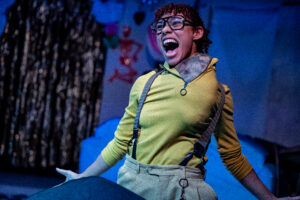
When things shift away from homeostasis, this forces all the housemates to take a cold, hard look as to whether and how they tolerate other people’s diverse personalities. Confiding in friends (rather than in each other) also changes Brett’s and Amy’s perspectives too. While almost too much time is spent on whether Amy decided to break up with Brett (or vice versa), the idea that two different people will have very different viewpoints on the breakup is indeed an insightful one. And we learn that the truth of the matter lies within each individual and how they interpret what their relationship means to them.
Yet far too much superfluous material has been inserted into this script: specifically, a whole host of elements related to zombies, aliens, monsters, weird birds, and so on, and this detracts from the strong emotions being stirred up by the dialogue. For example, we learn that KC’s tumor was caused from consuming drinking water poisoned by aliens. Does that really matter? While some diversion from the plot might offer a chuckle, the insertion of science fiction phenomena where they are not necessary dilutes the thrust of the story.
More to the point, when all sorts of bizarre events take away from the personal interactions among the characters, this trivializes their deep feelings, and the play becomes unfocused. Perhaps most importantly, the introduction of irrational details lengthens the performance for no good reason. Having Brett kill a zombie in the first act is funny, but so what? Inserting a monster in the second act is funny, but so what? These things become distractions. There is too much silliness in this show to the point of being ridiculous. Yes, it’s good to include comedy, but excising all the supernatural fluff would immediately make the story more profound and interesting. Above all, the script needs some serious revisions to make it shorter as well as sharper.
Billed as a 2-hour and 15-minute show including an intermission, the performance turned out to be long and drawn out at nearly three hours, with much of the second act being excessive. Despite this, I liked the segment when Amy reminisces about her previous situation with Brett and imagines what life might have been like had she been married to him some years prior. But there is no need to use a time machine to bring her back to an earlier point in her past and into another dimension to speculate what may have happened to her in an alternate universe. The use of a dream sequence would have been more than sufficient as a means of reflection, as compared to wasting huge gobs of time on the use of a time machine. It is also unnecessary to witness the torture that Amy goes through whenever KC uses the machine on her—in their role as the mad scientist.
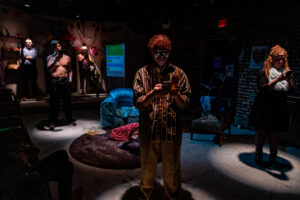
Projection design is unfortunate. While projecting texts from group chats is a good idea, the projections are frequently not clear enough to read (especially the last set towards the end). Not only might the text be blocked by the heads of other theatregoers (related to poor sightlines), but the words are occasionally blocked by articles on stage, such as slabs of wood over one window and a couch that has been dragged towards the back of the stage, hiding portions of the other window. Lighting and sound design are good for the space. I especially liked the use of otherworldly music. But once again, the science fiction stuff only muddies the story in favor of a few cheap laughs.
Note that this production would probably appeal most to Gen Z and Millennials, considering the uses of texts and group chats and the nature of the comedy.
In sum, we see how Brett’s and Amy’s breakup affects the bonds of all those surrounding them. More generally, the play takes on a rather profound topic, having to do with a social support system and the shift in real feelings among a friendship group. However, when the story devolves into something preposterous by the unnecessary inclusion of absurdism, then something important is lost—and we walk out of the theatre wondering exactly what we have gained.
“They Broke Up”, produced by Avalanche Theatre Ensemble and directed by Owen Hickle-Edwards, is running through November 22, 2026, at Rivendell Theatre, 5779 N. Ridge Avenue, in Chicago.
Tickets are $35.

Performance schedule:
Wed, Nov 11 – 7:30 p.m.
Thu, Nov 12 – 7:30 p.m.
Fri, Nov 13 – 7:30 p.m.
Sat, Nov 14 – 7:30 p.m.
Sun, Nov 15 – 2:00 p.m.
Mon, Nov 16 – 7:30 p.m.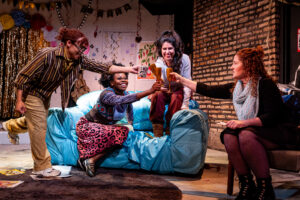
Wed, Nov 18 – 7:30 p.m.
Thu, Nov 19 – 7:30 p.m.
Fri, Nov 20 – 7:30 p.m.
Sat, Nov 21 – 7:30 p.m.
Sun, Nov 22 – 2:00 p.m.
For more information and to purchase tickets, visit https://www.avalanchetheatre.com/they-broke-up.
For general information about Avalanche Theatre and to see their other offerings, see https://www.avalanchetheatre.com/.
To see what others are saying, visit www.theatreinchicago.com, go to Review Round-Up and click on “They Broke Up”.



More Stories
“Little Shop of Horrors: reviewed by Paul Lisnek/Curtain Call Chicago
“A Body of Water” reviewed by Frank Meccia
“Million Dollar Quartet” rocks Oak Park reviewed by Frank Meccia