
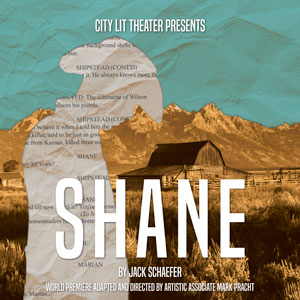
 **** Based on Jack Schaefer’s novel of the same name, “Shane” has migrated to the stage under the direction of Mark Pracht, who is also the story’s adapter. Pracht has taken some excellent material and has now included some exciting nuances that have brought something unique to the story, especially with respect to the lead role of Shane, captivatingly played by Michael B. Woods. Woods charms us with his soulful demeanor, large eyes, and slow walk in a way that no one else can, plus his interaction with the entire cast makes this play one of a kind. The addition of some physical comedy and a few one-liners add to copious moments of wit and dry humor and distinguish this production from the iconic 1953 movie, starring Alan Ladd and directed by George Stephens.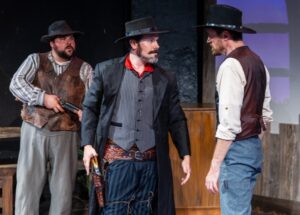
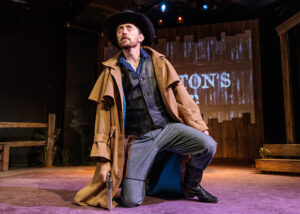 Act I basically provides the setup for Act II, where most of the action takes place. In Act I, Shane works on the Starrett’s family farm and comes off as an honest man who doesn’t carry a gun but who wants to right wrongs. From the beginning, he downplays the fact that he is a gunslinger. Fletcher is finally introduced in person in the second to the last scene in the first act (as compared to the farmers’ simply talking about him and what evil he has previously done). But it is in Act II when Shane finally proves his mettle and we see the fulfilment of the tale. A famous line from the George Stephens’ movie is repeated in this production: “A gun is a tool, Marian, no better or no worse than any other tool—an axe, a shovel or anything. A gun is as good or as bad as the man using it.”
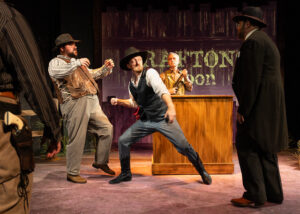
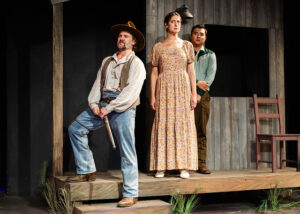 Pracht’s directing is perfect for this play. Considering the number of actors in this performance and how well one scene flows into the next, Pracht has clearly mastered the art of good blocking, which basically means guiding the audience’s focus, creating the rhythm and emotion of the scene, and conveying character relationships without dialogue.Scenic design by Jeremiah Barr is minimalist, with the outline of a wooden shack plus a wooden fence with horizontal rails and fake clumps of grass on the ground throughout. What takes the place of a sophisticated set is the nicely accomplished projection design by G. “Max” Maxin IV in combination with Jim Terry’s projection art. All of this creates the illusion of the outdoors in a very artsy way and advances the story well. I particularly enjoyed the scene with the two men taking axes to a giant stump (although if you watch carefully, you’ll notice that the axes in real life both have single heads…). Additionally, the projections show capital letters of the name “Shane” at the beginning of the performance in shades of purple with a sunrise and mountains in the distance; this later morphs into a series of black and white photographs of various cowboys and farmers, possibly taken from the movie. We see modest props by Jeff Brain, consisting of some furniture, like a square wooden table with three wooden chairs, and items such as guns and ropes, which we can associate with the Wild West. Lighting by Josiah Croegaert works well, especially when spotlighting Bob, the narrator, and separating him out from the action, that is, when he is addressing the audience directly versus when he is part of a scene himself. Sound design by Petter Wahlbäck could not have been better. The cowboy/Western music, featuring harmonica and guitar, only adds to the prevailing theme.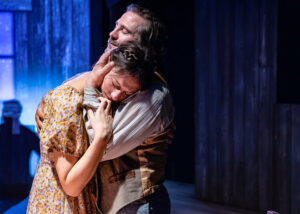
 “Shane” is playing through October 4, 2026, at City Lit Theater, located on the second floor of the historic Edgewater Presbyterian Church building at 1020 West Bryn Mawr Avenue, in Chicago (accessible via elevator).General admission tickets: $40Seniors: $35Students and active military: $22
 Performance schedule is as follows:
Fridays and Saturdays – 7:30 p.m.
Sundays – 3:00 p.m.
Additional performances:
Monday, September 21 and Monday, September 28, both at 7:30 p.m.




More Stories
“Escape to Margaritaville” reviewed by Julia W. Rath
“Instructions for a Seance” (Milwaukee) reviewed by Amy Menzel
“Vladimir” reviewed by Frank Meccia