
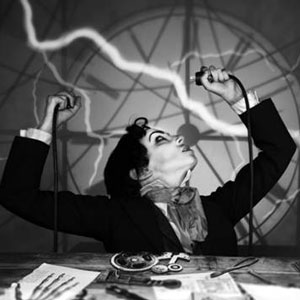
 A Gothic Masterpiece Brought to Life Through Shadows, Puppetry, and Imagination***** I love a good Gothic horror story, especially one that takes me back to the early days of horror films. Think Boris Karloff, Lon Chaney, and those wonderful black-and-white movies where atmosphere, makeup, lighting, and facial expressions did all the work. You didn’t need today’s elaborate special effects to scare an audience. Sometimes, what you couldn’t see was far more frightening than what you could.
That is exactly what Manual Cinema accomplishes with its extraordinary production of Frankenstein.
Most people know the story of Frankenstein, but not everyone knows that it was written by a woman, Mary Shelley. The story originated in the summer of 1816, when Mary, just 18 years old, was staying near Lake Geneva, Switzerland, with her future husband Percy Bysshe Shelley and the poet Lord Byron. During a period of terrible weather, Byron challenged everyone to write a ghost story. That friendly competition would eventually produce one of the most celebrated Gothic horror novels in literary history.
Mary Shelley’s personal life was also filled with tragedy, including the devastating loss of her infant daughter Clara. Those experiences of grief, mortality, and the fragility of life make the themes of Frankenstein all the more haunting.
Now, this is where Manual Cinema steps in and takes an already fascinating story in an entirely different direction.
Using four overhead projectors, the kind many of us remember from our school days, along with carefully designed lighting, screens, puppetry, and shadows, the company creates an extraordinary theatrical experience. The production reportedly uses more than 400 handmade paper and acetate shadow puppets. Watching this elaborate operation unfold is almost as fascinating as watching the story itself.
Much of the cast is seen primarily through shadows and silhouettes, making the audience concentrate on the movements, expressions, and emotions being projected onto the screen. The exceptions are Victor Frankenstein and Mary Shelley, portrayed by the talented Sarah Fornace, who is also one of the company’s artistic directors.
Kaylak Crosby plays Percy Shelley, Mary’s husband and fellow writer, while Kara Davidson brings the Creature to life. Along with puppet master and creator Felix May, this highly skilled creative team makes the entire production work seamlessly.
Presented in black and white, the show immediately takes you back to the horror films of the 1930s. There is something wonderfully nostalgic about watching a story unfold this way. The lighting, shadows, music, and physical performances create an atmosphere that modern technology sometimes struggles to reproduce. It reminds us that great storytelling doesn’t require a computer-generated monster or millions of dollars in special effects. It requires imagination, creativity, and talented performers.
Adding another dimension to the experience are five musicians who provide the live musical accompaniment. Their unusual instruments and distinctive sounds create an almost otherworldly atmosphere that perfectly complements the production.
The performance runs approximately 65 minutes, and there is one additional surprise that makes this production particularly special. At the conclusion, audience members are invited onto the stage to see firsthand how everything works. You can get an up-close look at the puppets, the shadow screens, and the remarkable equipment used to create the production. You can even take a picture with Sarah Fornace or Frankenstein himself!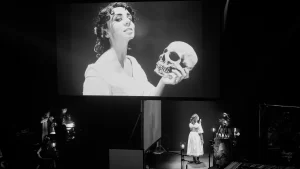
I have seen plenty of theatre over the years, but this is an experience that reminds me why live theatre continues to surprise us. Manual Cinema doesn’t simply tell a story; it allows us to see how imagination can transform an otherwise simple stage into an entirely different world.
If you enjoy Gothic horror, classic monster movies, or simply appreciate theatre companies willing to think outside the box, you do not want to miss Frankenstein.
And don’t forget, Manual Cinema will be bringing its unique storytelling back to Chicago with A Christmas Carol, December 18–27. That should be another interesting theatrical adventure!
Performance Information
Manual Cinema’s Frankenstein
 Venue: Historic Studebaker Theater, inside the Fine Arts Building
410 S. Michigan Avenue, Chicago
Chicago Performance Schedule: October 30 – November 1, 2026
- Friday, October 30: 7:30 PM
- Saturday, October 31: 2:00 PM and 7:30 PM
- Sunday, November 1: 3:00 PM
Tickets and Information:
Fine Arts Building Events
www.fineartsbuilding.com
Phone: 312-753-3210
Tickets are also available through secondary resale markets.
A Little Something to Eat Before or After the Show
If you’re looking for a quick bite or a place to sit down just a few steps from the theatre, let me introduce you to one of my favorite stops in the neighborhood: Fontano’s Pizza and Subs, located at 332 S. Michigan Avenue.
This family-run establishment serves some of the best subs in town. Their gelato and Italian ice are also among my favorites in Chicago.
Whenever I’m visiting the Fine Arts Building, Fontano’s has become my go-to place for a bite to eat. Stop in, enjoy a great sandwich, and tell the owner that Around The Town Chicago sent you!
My recommendation: Don’t miss Manual Cinema’s Frankenstein. It’s a little bit of old Hollywood horror, a little magic, and a whole lot of theatrical imagination.
To see what others are saying, visit www.theatreinchicago.com, go to Review Round-Up and click on Manual Cinema’s Frankenstein.



More Stories
“Church Hurt”
“Omar” reviewed by Jacob Davis
“The Time Traveler” reviewed by Frank Meccia