
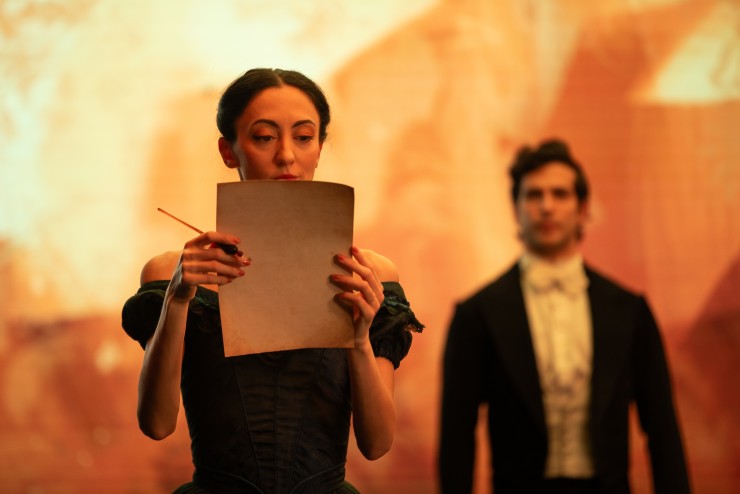
 ***** The Joffrey Ballet’s production of “Eugene Onegin” is stellar. A co-production between the Joffrey Ballet and the San Francisco Ballet, the Chicago premiere of this dance is so engaging and beautiful! Yuri Possokhov’s choreography is excellent and befits the original music by Ilya Demutsky. Based on Alexander Pushkin’s 1825–1832 novel, the story is about a haughty, arrogant, and restless young man named Eugene Onegin (José Pablo Castro Cuevas) who is too stubborn to realize all the good things that make his life worth living.
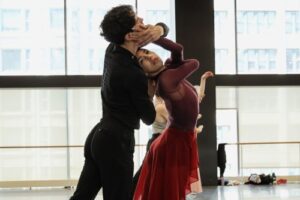
The tale is rather simple and straightforward. It begins when Onegin inherits his uncle’s rural estate. He subsequently joins up with his best friend Vladimir Lensky (Xavier Núñez) who decides to visit his fiancé Olga Larina (Anais Bueno). The two men travel by horse and buggy to the Larina family home in the country, where Lensky introduces Onegin to Olga’s sister Tatiana (Victoria Jaiani), under the careful watch of their mother Praskovya Larina (Christine Rocas). Tatiana takes an immediate like to Onegin and becomes infatuated with him. Whereas Lensky and Olga thoroughly enjoy being in each other’s company, Onegin scorns Tatiana. He treats her nastily, thinking that he is so much better and of a higher class than just a simple country girl. What fascinated me most was the pas de deux between Tatiana and Onegin, where Onegin demonstrates his distaste for Tatiana by dancing with her briefly and then casting her aside. His dislike is further indicated when he throws away her correspondence, discreetly passed along by Tatiana’s nanny Filipyevna (Lauren Quinn). Considering the extent to which he treats her with contempt, this is more than a relationship mismatch.
Since Onegin has no intention to become Tatiana’s suitor, he decides to toy with everybody’s emotions. This includes disrespecting his best friend by flirting with Olga. The dance between them turns out to be more than a harmless flirtation. When Lensky becomes prickled when he sees Onegin with Olga, the highlight of the show follows: a cleverly choreographed dance where both men are so hardheaded that neither wants to back down from their fateful duel. Urged on by Zaretsky, Lensky’s second (Paolo Randon), the duel takes place…. This scene is followed closely by the next: where the two sisters, each wearing a widow’s veil, dance in sadness after they find out that Onegin was responsible for Lensky’s untimely death.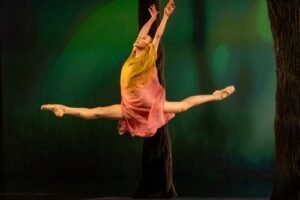
Years later, Tatiana moves on and subsequently marries Prince Gremin (Dylan Gutierrez). Just like the previous dances between Lensky and Olga, the pas de deux between Tatiana and Prince Gremin are equally sexy and symbolic of a partnership inherent in true love. Now Onegin, a visitor to St. Petersburg, happens upon Tatiana once again. Envious that the country girl whom he once spurned is now married to royalty, he tries to rekindle whatever affection she once had for him. Maybe Onegin really did love her after all, as we see the extent to which he is agonized when he sees her in another man’s arms, and we see how much he regrets not having pursued her. But then again, maybe Onegin is really in love with himself and seeks to equate himself with his “betters” via romance and marriage. It’s true that Tatiana still has some fondness for him over the years despite all of his cruelty to her, her sister, and his best friend. But Tatiana (thank goodness) demonstrates self-respect by closing the door on that chapter of her life. Onegin is devastated. “He’s gotten his comeuppance,” I thought. “No woman should ever want to be involved with a man who intentionally killed her sister’s fiancé.”
Expect this performance to be absent Tchaikovsky’s music, featured in the opera of the same name. (Interestingly enough, this was the most commented portion of the production when I circulated among the audience members at intermission. But I digress.) What I liked about the new music is its versatility, and it is well-conducted by Scott Speck, with live accompaniment by members of the Lyric Opera Orchestra. It’s sometimes intentionally discordant, and that’s a good thing as a descriptor of some of the action. There are spots, however, that seem more uniquely 19th century American where I would get the occasional feeling of a carnival ride as opposed to the softness and litheness of the dream sequences. These sequences consist of dances that entail all sorts of spirits, with different suites representing spring, summer, autumn, and winter. There are moments, almost like a Greek chorus, where these spirits point out what reality truly means or how it could be re-imagined in different and better ways. Yet especially during the first act, these dances can seem somewhat repetitive.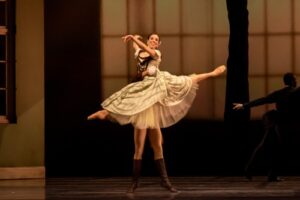
Without the Tchaikovsky, the only truly Russian element left in the production has to do with some of the costuming, such as the male aristocrats in military dress. But basically, the story could thus take place almost anywhere in Europe during the 19th century. Expertly designed by Tim Yip, the costumes range from men in the suits of that era and women in long dresses. Tatiana wears a light pink as a young country girl, which transforms into a sophisticated crimson once she is married to Prince Gremin. Olga always wears light green. Other costumes include, for example, the spring spirits wearing the rainbow from pink to green, the summer spirits wearing flame orange garb, and the winter spirits wearing diaphanous gowns in hombre, with white towards the top and navy blue towards the bottom.
Staged gorgeously by Adam Blyde, the production makes for a brilliant spectacle! I loved the scenic design by Tom Pye, especially the cab where you could imagine a horse-drawn carriage during several spots in the show. All of this is in conjunction with the projections by Finn Ross. The projection of the one crow as we assemble foreshadows the flying crows later on. The inclusion of the red drapes towards the end was marvelous, especially against all the black, white, and gray. The black trees against the gray background are meaningful, especially the broken branch hanging down low for the location where the duel is to take place. The lighting by Jim French neatly separates the fantasy scenes from life’s harsh realities.
The libretto by Valriy Pecheykin is curious. The poetry between scenes is sometimes serious and sometimes playful and sometimes just there. I wondered just how encompassing the sentiments were—or were meant to be—and just how literally to take all of this. Here I would have liked to know the original Russian verse from Pushkin’s novel. It was interesting to see how the screen would descend with each of the poems printed on it, although the poem near the end was much too dark in color and lacked contrast on the screen. (Was that intentional—since the story is supposed to be a tragedy—or a mistake on opening night?)
In all, “Eugene Onegin” is well worth seeing. It is creative. It is easy to follow. It is never dull. The audience needs to know every performance might feature different dancers. But no matter who the specific performers are, the Joffrey cannot be excelled!
“Eugene Onegin” is playing through June 14, 2026, at the Lyric Opera House, 20 N. Wacker Drive, Chicago.
Tickets range between $46 and $214, depending on date, time, and seat location.
Performance schedule:
 Thursdays and Fridays – 7:30 p.m.
Saturdays – 2:00 and 7:30 p.m.
Sundays – 2:00 p.m.
For more information and to purchase tickets, go to: https://joffrey.org/performances-and-tickets/25-26-season/eugene-onegin/ or call 312-386-8905 or in person at the Lyric Opera Box Office, 20 N. Wacker Drive.
To see what others are saying, visit www.theatreinchicago.com, go to Review Round-Up and click at “Eugene Onegin”.



More Stories
“Dead Girl’s Quinceanera”
“Dial M For Murder”
“A Midsummer Night Scream” reviewed by Frank Meccia