
 *** Every once in a while, a production comes along that leaves you wondering exactly what you just witnessed. That was my reaction to Engines and Instruments of Flight, a world premiere by playwright Calamity West at Jackalope Theatre. I have to admit, I was unfamiliar with the playwright, and even the exotic title had me wondering what I was about to experience.What I discovered was a three-hour production, including a 10-minute intermission, that takes storytelling in so many different directions that you sometimes find yourself wondering whether you are watching one play or several different stories woven together. Perhaps there was simply so much Calamity West wanted to say that this production could have benefited from being divided into two separate plays. Then again, maybe that is precisely the point of this unusual fantasia.
The six-person cast certainly has its work cut out for them.
At the center of the story is Tony, played by Niko Kourtis, an introverted, strong-willed individual who communicates best within the confines of his own home. In fact, he rarely ventures outside, except for the weekly playwrights’ forum he created. Tony has one overriding ambition: to write an award-winning play.
His personal life, however, is another story. His roommate and lover, Henry, played by Raphael Diaz, breaks up with him within the first ten minutes. After a long period without intimacy or any real connection, Henry decides it is time to leave. Tony is understandably upset, but he doesn’t allow the breakup to interfere with his ultimate goal of becoming a successful playwright.
Among the members of Tony’s writing circle is Eleanor, played by Mary Williamson, a strong, self-assured woman who is in a relationship with William, played by Julian Hester. Both are aspiring playwrights, sharing the same dreams and ambitions as the other members of this group of six.
Then there is Alvin, played by Andrew Burden-Swanson, a straight man who seems destined to play understudies and secretly harbors feelings for Eleanor. And finally, we have Gene, played by Johnard Washington, whom I would describe as the sensible one, a man grounded in reality and aware of what is happening around him. Gene helped Tony establish the playwrights’ group but eventually left to pursue a career in nursing. After six years, he returns.
Of course, what would a good play be without a little conflict, romance, and unexpected drama?
Eleanor eventually leaves William, who, despite believing himself to be straight, finds himself falling for Tony. The two begin an affair. 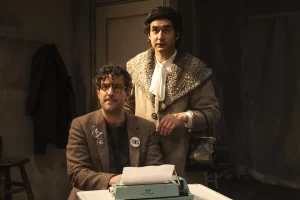 discovers what is happening when she visits Tony’s apartment to deliver some devastating news. She finds William’s coat and, in the process, learns that Henry, Tony’s former lover, is HIV-positive.
But this production is just getting started!
Whenever Tony becomes upset or finds himself struggling with his writing, he receives some rather unusual visitors. One is the ghost of Ethel Rosenberg, the woman executed alongside her husband in the 1950s for espionage. Apparently, Ethel wants her story told and hopes Tony can write a play that finally resolves the questions surrounding what really happened.
Then comes another unexpected visitor: Roy Cohn, the prosecutor involved in the Rosenberg case, who later died of AIDS in the 1980s. He, too, wants his story told.
So now Tony has two ghosts making regular appearances in his home, each with a story to tell and a different agenda.
Just when you think things couldn’t get any stranger, Tony wakes one night to discover a brilliant angel descending into his home, giving him the inspiration and energy to finally produce a great play. And if that isn’t enough, in the third act, he receives a visit from the fourth and final ghost: the playwright herself, Calamity West!
Somewhere amid all these supernatural encounters, Tony discovers that he does not have HIV, despite his fears stemming from his previous relationship. We also discover that his last name is Kushner, a rather interesting revelation considering the playwright behind Angels in America, Tony Kushner, and the themes of AIDS, relationships, and identity that run through that celebrated work.
The production eventually brings everything together when Tony’s friends return to congratulate him on his newly written Broadway play.
Now, let’s be clear: this is three hours of pure theatrical fiction. I suspect some of these ideas must have come to Calamity West in a dream! The production takes historical figures, personal relationships, ghosts, angels, sexuality, ambition, and the struggles of aspiring writers and throws them into one very unusual theatrical experience.
Director Jonathan Berry deserves credit for finding so many different ways to present this material. There are numerous approaches to storytelling, and he keeps the action moving despite the complicated nature of the script. The scenic design and lighting by Tianxuan Chen also deserve recognition. The set is relatively simple, and the scene changes are handled smoothly, allowing the production to move between its many different situations without unnecessary interruptions.
The cast works hard to bring these characters to life, particularly given the number of twists, turns, and unexpected developments they must navigate.
Engines and Instruments of Flight is certainly not your traditional evening at the theatre. It challenges the audience to follow a complicated journey that mixes history, fantasy, romance, comedy, and drama. At times, it may leave you scratching your head, but it is also refreshing to see a theatre company willing to take chances on an original work rather than simply producing another familiar title.
The production runs Mondays, Fridays, and Saturdays at 7 p.m. and Sundays at 1 p.m. through December 19.
Jackalope Theatre performs at the Broadway Armory, located at 5917 N. Broadway in Chicago.
For tickets, visit Jackalope Theatre’s website. www.jackalopetheatre.org
This time of year, practically every theatre company is presenting its holiday production. If the traditional holiday fare isn’t what you are looking for, perhaps it is time to try something completely different.
Engines and Instruments of Flight certainly fits that description. It is unusual, imaginative, ambitious, and unlike anything you are likely to find in the traditional holiday theatre lineup.
Sometimes, taking a chance on something different is exactly what going to the theatre should be about
To see what others are saying, visit www.theatreinchicago.com, go to Review Round-Up and click on “Engines And Instruments Of Flight”.


More Stories
“It’s A Wonderful Life: A Live Radio Play” ( Oil Lamp- Glenview) reviewed by Wayne Mell
” A Christmas Carol” the musical reviewed by Frank Meccia
“A Clockwork Orange: A Play With Music”