
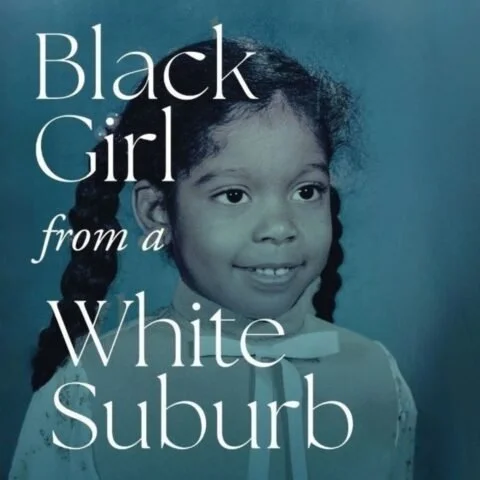
 **** Earnest and compelling, Tania Richard (pronounced “rish-ARD”) excels in her one-woman show “Black Girl from a White Suburb”, based on her autobiographical book of the same name. A 65-minute performance with no intermission, Richard powerfully narrates a good portion of her life story, with the emphasis on how she was the only black girl in her elementary school and high school and how this may have affected her sense of self, the growing awareness of her identity, and her subsequent interests and achievements.
Richard’s storytelling skills are nicely honed, and she engages the audience beautifully. Her narratives are structured well, using excellent sensory details, and she moves nicely from one episode in her life to the next, making her autobiography impactful.
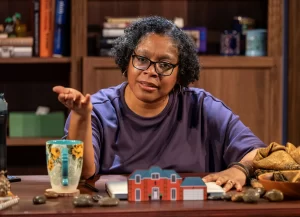
One of the things she had to deal with in her all-white schools was racism: how to discern it and how to handle it. How do you know it’s really racism and not just circumstance or something else? There can be a fine line here. Perhaps it was on account of race that Richard was not cast as Dorothy in “The Wiz”, when it logically seems that she should have gotten the role. What’s so interesting about her narrative is that it’s often hard to glean whether the racism is overt or covert or a factor at all, because white people generally don’t flat out tell you their prejudices, and these prejudices can be unconscious ones. You just have to figure this out by watching other people’s behavior. What makes the audience uncomfortable (and this is a good thing) is that this seeming ambiguity points up the fact that the exact same set of circumstances can be viewed by a white person or a black person very differently, depending on their background and experiences with race. To put this another way, if you’ve never experienced hate or dislike simply for being the person you were born into, then this show can be an eye-opener. But the extent of another person’s hurt might just go over your head if you can’t relate to it or don’t know how to relate to it.
Sharing any more specifics of Richard’s story would take away from the impact of the performance. However, at one moment during opening night, Richard asked the audience if there was something that they may have done in their lives in order to “fit in” and that they would care to share with the audience. And a gray-haired, elderly man replied that he had gotten into shoplifting years ago. That sparked the beginnings of an interesting discussion about what crowd you associate with (or choose to associate with).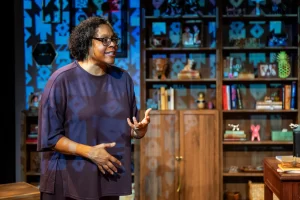
Here I’d like to bring up an aspect of the play that was only lightly touched upon if at all. We learn about various teachers’ prejudices against Richard. But what about her peers? Who were her friends before college? Were they white and from her school? Or were they black and from some other part of her life? Since I have not read her autobiography, this aspect may have been covered in the book, but reference to it was noticeably absent on stage. Richard mentions not feeling included among the white students, but how did they treat her? Was she singled out and teased because of her appearance—or simply avoided or not invited to parties or included in social activities? Did any of the white kids ever tell her, “You’re the first black person I ever met”? And, if so, was that meant to be a simple observation or a microaggression? Is there some hidden hostility inherent in asking the question, or does this reveal a certain level of openness and honesty? And other than meeting several fellow black theatre majors at Illinois State University, how did she get on with the majority white students on campus?
Richard explains that whiteness is both a color and a culture, and it frames a good part of the mainstream of American society. Then too, she describes how blackness is both a color and its own subculture. It is also a bold reaction to whiteness. She mentions the police killings of Breonna Taylor on March 13, 2020, as well as unarmed black men such as George Floyd, Ahmaud Arbery, and many others. “Say their names,” she proclaims. It is clear that identifying with Black Lives Matter is not far removed from her personal experience, even if she “talks white” (her words, not mine). Thus, Richard is a unique individual, having her foot in both the dominant white culture and the black subculture as a result of how and where she was raised. This neatly allows her to create a show such as this one and perform within it—and to serve as a translator between the white world and the black world.
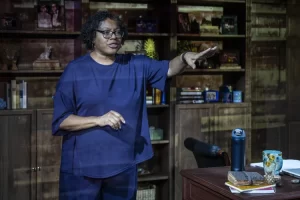
Fluid directing by J. Nichole Brooks creates physical movement on stage and in the aisles so that as Richard tells her tale, it’s not like watching a talking head. Starting and ending with Richard in a yoga posture creates a space in the audience’s mind where we know that we have been taken away from everyday reality, allowing the main character to take a step back from her own life to address all of us. Thanks to movement director Breon Arzell, the yoga exercises are done effectively.
Set design by Shokie Tseumah works well, with a home office or den and two windows on each side with oak bookshelves and cabinetry. Benches are underneath the windows. Tyson Carter’s prop design is gorgeous: The shelves hold all sorts of books and photos (including one of Richard’s parents) plus knickknacks and a sewing basket and other things that Richard could relate to, such as the folk art collage of black women on the back wall. There is a wooden desk and desk lamp and swivel desk chair that she uses to sail around the room. I loved the projection design by Paul Deziel. Photos of people often filled the two windows, and a checkerboard design and similar projections filled the backdrop of the stage. I especially liked seeing a map of Chicago’s South Side projected onto the rug on the floor early on. Lighting by Jason Lynch is well done. Not only is there a fluorescent spotlight over Richard’s desk but the lights follow her nicely as she goes up and down the aisles, and sound design by Willow James is perfect for this show, especially in the music being played before the performance starts and some of the piano riffs. Costume design by Rueben D. Echols is simple, with Richard wearing a mauve-sweatsuit throughout.
The tales Richard relates are poignant, indicating how she overcame racism and how she ultimately pursued her career as a successful dramatic actor. But by the end, I was left less with the journey through her personal history and more with recalling several repressed memories from my own experiences with prejudice and discrimination, that is, being Jewish and looking a little “too black” because of my curly/kinky hair as a child. Like Richard, I too know first-hand what it is like to be deliberately miscast in a play by a racist and antisemitic teacher in the seventh grade. But I digress.
While I liked the production a lot, it could have been maybe five or ten minutes longer to further explore how Richard found her own light (as in the subtitle of her book). Could her family or her church or some similar institution have been an inspiration to overcome racism? What about connections from outside of school, such as with those in Chicago’s Haitian community? While the show’s bottom line is to expose the assumptions and prejudices that black and white audience members may hold so that these communities could better understand each other, I nevertheless wanted some more detail about who Richard’s friends turned out to be. Were they supportive of her and her efforts? And did they validate her perspective or not? Since we learn that she didn’t become a doctor like her parents did, was it her family or her friends or her eventual colleagues who were the most encouraging of her career in theatre—and the person that she was meant to become?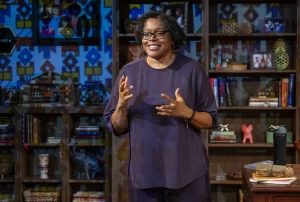
“Black Girl from a White Suburb” is playing through October 4, 2026, at American Blues Theater, 5627 N. Lincoln Avenue, Chicago.
Tickets range $34.50-$64.50.
Performance Schedule:
 Thursdays: 7:00 p.m.
No Thursday performance on September 24.
Fridays: 7:30 p.m.
Saturdays: 3:00 p.m. (September 19 and October 3 only); 7:30 p.m. (September 5, 12, and 26 only)
Sundays: 2:30 p.m.
Additional performance: Wednesday, September 23 at 2:00 p.m.
SPECIAL ACCESS EVENTS – $34.50 ticket – call: (773) 654-3103
ASL interpreted performance – Friday, September 18 at 7:30 p.m.
Touch tour – Sunday, September 20 at 1:30 p.m.
Audio-described performance – Sunday, September 20 at 2:30 p.m.
For more information and to purchase tickets, visit: https://americanbluestheater.com/black-girl-from-a-white-suburb/.
For general information and to learn about their other offerings, go to: https://americanbluestheater.com/.
To see what others are saying, visit www.theatreinchicago.com, go to Review Round-Up and click on “Black Girl from a White Suburb”.




More Stories
“The Book of Mormon”
“Jersey Boys” 20th Anniversary Tour- MILWAUKEE
“Mud Row”