
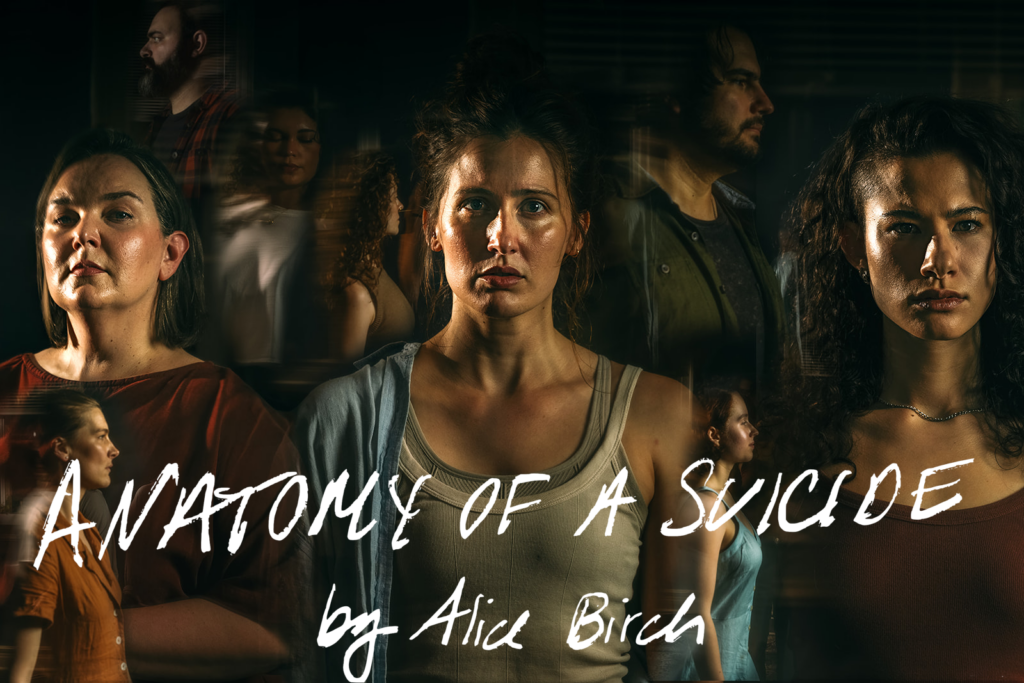
 ** “Anatomy of a Suicide” by Alice Birch is in essence a good story, but it’s not told well. The tale is about three generations of women from the same family who have yielded to societal pressure regarding the way a woman is supposed to find fulfillment in life. In all three cases, marriage and having children turn out not to be the panacea that they might have hoped for. Not only does each woman experience disappointments but each has struggled with her own self-concept, which teeters between wanting to do what others think is necessary and appropriate versus listening to her gut about her own needs, wants, and desires.
The acting is nicely done. Tatiana Pavela wildly excels in the role of Carol, a severely depressed mother suffering through post-partum mental illness that never goes away. Her daughter Anna (Taigé Lauren) subsequently suffers from the emotional pain caused by her mother’s untimely suicide as well as her own personal problems with finding herself. And Anna’s daughter Bonnie (Isabel Lee Roden) is acutely aware of the examples of her mother and grandmother and resists going down the same path.
But the play should have been structured and organized very differently, so as to elicit substantially more empathy from the audience. With a nonlinear plot being so fragmented and with several stories being told on stage at the same time, it is left for theatregoers not only to decipher the narrative but grasp why the show is being presented in such a tortuous fashion. It takes awhile for us to establish who the main characters are, not to mention the trajectory of the story. Several overlapping timelines of successive generations of women speaking at exactly the same moment make the play especially confusing. Distilling sentences from the cacophony makes it a chore to distinguish what everybody is saying, plus figure out its importance. The way that things are currently designed, simultaneous action makes it difficult for us to get deeply enough into the mindset of each character so as to gather necessary insights into their distraught lives.
When Carol and John (Josh Razavi) were having their baby Anna in the 1950s, there were strict gender roles that both men and women needed to follow, with marriage and having children and a family life supposed to be sufficient in providing fulfillment for a woman. But after Carol’s post-partum psychosis sank in, no amount of love or caring from her young daughter Anna (Laila Malak) could make up for the way she felt. So why did she feel this way? Was it a change in her hormones or her perceived lack of freedom to live a life above and beyond a prescribed familial role? When Carol could see no escape from the confines of having been born female and the pain it brought her, she began to entertain thoughts of suicide.
Anna grew up sometime in the late 1960s and ’70s, with the prevalence of street drugs, especially heroin. Unlike her mother who had to abide by strict gendered rules, Anna was coming to age at a time when female norms were not nearly as rigid to govern her behavior. After overcoming her substance abuse issues, she subsequently became excited about the prospect of marrying Jamie (Raúl Alonso) and thinks that having her own husband and family will finally give her a sense of purpose. Instead, the pain of being pregnant, having morning sickness, and giving birth as well as the agonies from unsuccessful surgeries make life much too horrible for her to handle.
What we see in both Carol’s case and Anna’s case is that rehab doesn’t help to stem thoughts of suicide. Telling a patient that they have everything to live for does not make a dent if they feel bad about themself and believe that they are worthless. Moreover, we see how electroshock therapy (once a predominant choice among doctors for the treatment of depression) is, at the very least, ineffective and, at most, destructive of the psyche of an emotionally fragile person who suffers from mental illness.
Now Anna’s daughter Bonnie, who is coming up in the 1990s or 2000s, wants to break the family cycle. She too is miserable but for largely different reasons. Her lesbian love life isn’t exactly what she expected. She has a job as a medical doctor and has to deal with the pressures of practicing medicine in this day and age with strict limits on her time, plus the inordinate demands of patients and their family members. When she doesn’t have enough free moments for herself, she doesn’t even have “the luxury” of time and energy to raise her own family, assuming that’s what she would want to do (which she doesn’t). Bonnie’s own attempt at a cure (spoiler alert) is wanting to be sterilized so as to prevent the possibility of yet another woman with suicidal thoughts continuing on into the next generation. It is also likely, however, that arranging for a medical mutilation actually means that Bonnie no longer wants to think of herself as a woman—and all the baggage and unhappiness that this entails.
This story is a tragedy without end. None of the main characters can escape the pressures, pain, and sadness tied to the experience of being a woman, regardless of what era they came up in. Having said that, we ought to know more about the power dynamics inherent in each woman’s family to fully grasp what a hard life the characters have been going through. For instance, we never learn enough about Carol’s husband John or Anna’s husband Jamie to determine whether their attitudes and behaviors towards their wives (and towards women in general) may have contributed to their partner’s sense of hopelessness and depression. (We all know that some husbands are more supportive of their wives in general, both financially and emotionally.) Without enough background about family dynamics to draw on, we don’t know if the suicides might have occurred regardless of how good or how poorly the wives’ relationships were with their intimate partners.
In addition, the playwright has included too many minor characters in the script, and it’s hard to keep them all straight. Because the director has double- and triple-casted a good number of actors, I kept wondering if an actor was playing the same character at a different time or a different character entirely. Yes, there were a good number of quick costume changes allowing us to somewhat distinguish one character from one another, but I still got confused. So not only does the timeline need to be better established, but the number of minor characters needs to be cut down so that all can be followed well.
The production takes place in a storefront theatre, whose “black box” is shaped like a bowling alley with the audience on the two long sides. The stage was often (but not always) divided into three areas to accommodate simultaneous action and present various events from each woman’s life which were transpiring at different times and places. If several biographies are to be told at once (and I have a sincere problem with this), then there needs to be enough clearance distance between the stage and the audience so that we don’t have to constantly turn our heads from side to side to observe where the action may be coming from. And in this show, the actors may present themselves from almost anywhere in the room! To put it bluntly, this play is not meant to be performed in such a small space, because the audience doesn’t know where to look next. With all the chaos on stage, it becomes difficult, if not nearly impossible, to determine what exactly is worthy of our attention.
I should have been sitting on the edge of my seat watching the downward spiral of the characters and witnessing their deep sorrow. But the writing, the setup, and the direction introduce needless layers of complexity, and we as an audience are working much too hard to absorb what exactly is going on. Endless flashforwards and flashbacks are distracting and detract from the entire show. Thus, the action needs to be presented in a plainer fashion rather than the playwright and director ponderously making intergenerational comparisons. Each woman’s narrative should be taken one at a time in some detail and yet tightly interwoven. More continuity and fewer time jolts would allow the audience to better grasp the play’s larger meaning, that is, the anatomy (or structure) of the suicides and their effects on loved ones. As a result, the story would become more moving and significant, and we can draw our own conclusions.
“Anatomy of a Suicide”, directed by Alex Mallory, is a project of the Metal Shop Performance Lab produced in partnership with JunkHeart. It runs through August 30, 2026, at Redtwist Theatre, 1044 W. Bryn Mawr Avenue, in Chicago.

 Tickets are $20 – $35.
Performance schedule:
Wednesdays, Thursdays, Fridays, and Saturdays at 7:30 p.m.
Sundays at 3:30 p.m.
For more information and to purchase tickets, visit https://www.themetalshop.org/.
To see what others are saying, visit www.theatreinchicago.com, go to Review Round-Up and click at “Anatomy of a Suicide”.





More Stories
“The Book of Mormon”
“Jersey Boys” 20th Anniversary Tour- MILWAUKEE
“Mud Row”