

 ***** Tennessee Williams’ “A Streetcar Named Desire” not only cemented his reputation as a master playwright but also launched a young Marlon Brando into theatrical legend when he originated the role of Stanley Kowalski on Broadway in 1947. Very long but very good, Skokie Theatre’s production of this classic script is fabulous! Under the sharply-tuned direction of Wayne Mell, the play, set in New Orleans just after World War II, is a slice of life about how the destructive forces of toxic masculinity and male chauvinism can damage the lives of both men and women.
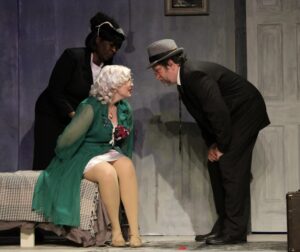
Hailey Hance delivers an incomparable performance in the lead role of Blanche DuBois. Authentic and delightful, she radiates Southern charm: with its myth of purity, chastity, and beatitude. Though she always wants to lead a magical life, it turns out that she, in fact, leads a double one: a reality that slowly creeps in when she comes to visit her sister Stella (Elyna Mellen) from their hometown of Laurel, Mississippi. Stella is excited to see her sister again but is initially afraid to inform her belligerent and manipulative husband Stanley Kowalski (Nathaniel Kohlmeier) of her visit. Kohlmeier, in an emotionally powerful performance as Stanley, astounds the audience with his amazing ability to trigger aggression and rage from one split second to the next—and then move on to expressing sincere romantic feelings. What incredible acting! What incredible timing! Whereas Blanche sees Stanley for the abusive man that he is, her younger sister is realistic about her situation (as she perceives of it) and accepts his insults and maltreatment so that she can continue living her life. After all, it could be so much worse to be destitute or homeless or possibly in an even worse situation, especially with a baby on the way.
The introduction of Harold “Mitch” Mitchell (Denis Vorobyev) into the story allows the audience to see that not all of Stanley’s buddies are disdainful. The conversation between him and Blanche at the beginning of the second act drags a bit, but that’s important grounding for Williams’ plot and only enhances it. Other characters include Stella’s upstairs neighbor Eunice Hubbell (Kimmy Higginbotham) and her husband Steve (Wyatt DeLair), plus Mabel Brown (Dee Dee Logan), Pablo Gonzales (Neil Figuracion), and the Collector (AJ Carchi).
The beautifully claustrophobic set, designed by Brian Wasserman, transports the audience into the world of the New Orleans French Quarter but not the part that tourists see. We find ourselves in Stanley and Stella’s cramped two‑room apartment, perfectly decorated by prop designer Michael Dwiggins. Here we see a small kitchen with a red refrigerator and liquor bottles on top of it, not to mention a kitchen table with chairs. There is a small bedroom area—and most important to the plot—a black gauze curtain that separates this area from the kitchen. The uses of a door in the back of the set to represent the door to the bathroom is priceless. Then too, there is a telephone….
Fight choreography by Brian Plocharczyk and intimacy design by Christa Retka both take center stage in this presentation. These two elements are especially crucial on such a small stage, which especially embraces the vulnerability of the female characters. A rape scene is included (as the script requires), and this is handled with restraint and sensitivity. With all of the fight scenes and simulated sex scenes, the play contains a content warning that it is “for mature audiences only due to depictions of sex and violence on stage.”

Pat Henderson’s lighting and Elijah McTiernan’s sound design shape the atmosphere with subtle force—and the uses of polka music from time to time is a nod to Stanley’s Polish heritage. Last but not least, Dame Erickson’s period costumes from the 1940s complete the illusion that we have stepped back in time. But have we really? This type of lifestyle and culture probably persists among some sliver of Americans today.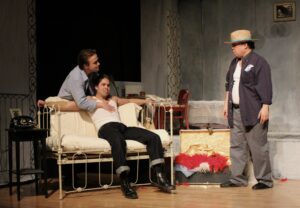
On opening night, the production ran over three hours (including an intermission which was supposed to be ten minutes but felt more like twenty). But the Skokie Theatre is a small space, and the restrooms are tiny in proportion, so that might have been the reason for the delay in beginning the second act. The concession stand was also doing a brisk business between acts.
The play’s title comes from a real streetcar line that once rattled through the French Quarter, and it is on this symbolic route that Blanche DuBois arrives. And of course, there are a number of double entendres throughout the show having to do with the meaning of the word “desire.” Does “desire” have to do with sexual predation or romance or the desire for a better life or the desire to forget one’s life from the past—or the magical desire to become whatever one wishes?
MadKap Productions has outdone itself in the revival of this psychological drama. If you’ve never seen “A Streetcar Named Desire” before, then you must see this production. And if you have seen the play (or movie) before, then today’s show will not disappoint! It is wonderfully directed and magnificently acted and staged. Above all, this story holds up well in the present-day, nearly eighty years after it made its first appearance.
“A Streetcar Named Desire is playing through April 26, 2026, at the Skokie Theatre, 7924 N. Lincoln Avenue, in Skokie.
 General Admission Tickets $42
Seniors/Students $38
Performance schedule:
Fridays and Saturdays at 7:30 p.m.
Sundays at 2:00 p.m.
Wednesday Matinee April 15th at 1:30 p.m.
No performances April 3th through April 5th!
For more information and to purchase tickets, visit www.SkokieTheatre.org or call 847-677-7761.
To see what others are saying, visit www.theatreinchicago.com, go to Review Round-Up and click at “A Streetcar Named Desire”.





More Stories
“Dead Girl’s Quinceanera”
“Dial M For Murder”
“A Midsummer Night Scream” reviewed by Frank Meccia