

 **** “Fantasticus: Bach and Before” was a chamber concert performed on Sunday afternoon October 4th by Bach in the City at De Paul University’s Allen Recital Hall. The program was built upon those composers who influenced Johann Sebastian Bach’s music. Conductor and co-music director Jason Moy led the chamber orchestra as its harpsichordist/organist, with the other players being Amelia Sie (violin), Alyssa Campbell (violin), Kiyoe Matsuura (violin and viola), Timothy Holman (viola), Anna Steinhoff (viola da gamba and cello), Jerry Fuller (double bass), and Brandon Acker (lute and theorbo).
 The highlight of the program was J. S. Bach’s Cantata: “Jauchzet Gott in allen Landen, BWV 51”, featuring soprano Hannah De Priest. It was a joy to listen to her warm, welcoming, and powerful voice and hear her easy-going approach to all the arias, recitatives, and chorales, not to mention the high notes at the very end during the Alleluja! section. Her incredible vocals were enhanced by the resplendent performance by Ryan Berndt on the natural trumpet. I also learned a lot from Moy’s commentary: that the clergy in the 17th century came to the realization that more people were going to the opera than attending church, so why not make religious music more operatic? Also note that the introduction of the trumpet in Christian services did not begin until the 15th century and later flourished during the Baroque period in the 17th and 18th centuries.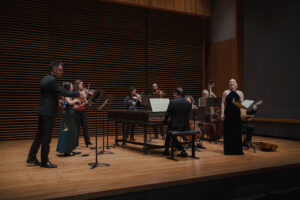
The concert began with Heinrich Ignaz Franz Biber’s “Sonata à 6 in C major”, featuring a lovely violin solo (Campbell) then trumpet solo (Berndt). Biber’s music also led off the second half with his comical “Sonata violino solo representativa”, inspired by Athanasius Kircher, who wrote the first comprehensive encyclopedia of music, which included a compendium of the sounds of birds and other animals. Using Kircher’s “Musurgia Universalis” as a guide, Biber has the violin (Sie) re-create the sounds of the cuckoo, the nightingale, the frog, the rooster, and numerous others. The rhythms and effects are so interesting that Moy stated to the audience that this is one of his favorite pieces of music. Because so many bird songs are featured, a bird graces the cover of the playbill. But the joke is that the featured bird is the parrot, having to do with Kircher’s idea that parrots are one step above other birds on the evolutionary scale for the reason that they don’t sing but, rather, talk. Thus, it is only fitting that the sounds of the woodland would be replaced by those of man, where the cello (Steinhoff) imitates a drum in the Musketeer’s March. Yet to my mind, the music towards the end is reminiscent of that associated with the American Indian during the Colonial era, which coincides with the time of his writing.
It is the improvisational composing style of “Stylus Fantasticus” that lends its name to the title of this concert. Dietrich Buxtehude, who wrote in this style, is the second composer on the program after Biber. His “Sonata in A Minor, Bux WV 272”, features two repeated baselines and only four instruments. Lots of passages feature solo violin (Sie) and accompaniment, followed by a wonderful viola da gamba solo (Steinhoff) and then a solo on the theorbo (Brandon Acker). We also heard the story that J.S. Bach traveled 200 miles in order to be in the company of Buxtehude, because he admired his music so much. Next on the program was Johann Rosenmüller’s “Sonata Decima à 5 in F Major”, with its Italian flair and a fuller chamber orchestra, where the sound keeps moving throughout. The viola solo (Matsuura) is particularly stirring.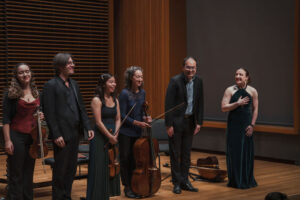
In addition to some of the composers on the program being Bach’s teachers, there is also the influence of his first cousin Johann Christoph Bach, a respected keyboardist and organist, not to be confused with his older brother of the same name. Stirring, sorrowful, and mellow is the voice of Ryan Belongie, who sang countertenor in J.C. Bach’s “Lamento: Ach, dass ich Wassers gnug hätte.”
The second half of the program is marked by Johann Pachelbel’s “Canon and Gigue in D Major”, comprised of three violins and continuo (Baroque rhythm section). The extremely familiar and majestic canon is, to my mind, one of the most beautiful pieces of instrumental music. As Moy explained it: “The infamy of this piece overshadows the composer.” And he described the composition as puzzle pieces and “an endlessly repeating pattern of eight notes… constructed over a ground bass.” But there is some risk in performing such a famous work. Sunday’s performance was played at a brisker, more authentic tempo than that of the “romanticized renditions most people are familiar with.” But when the audience seems to know every note once the first bar is played, we are tempted to compare professional recordings to what we hear today. And this implicit comparison makes the sound appear too thin as compared to what we “hear in our heads” from memory. This, of course, begs the question of whether the authentic version or the more modern romanticized one is “better.” Putting that discussion aside, I was grateful to hear this music live and in concert with the knowledge that this was how the piece was originally written. The canon was immediately followed by Pachelbel’s rarely played and far less familiar gigue.
This was the first time I was inside De Paul University’s Holtschneider Performance Center, which was built in 2018, and the Allen Recital Hall is particularly gorgeous with wide horizontal wooden panels flanking the back of the stage and long vertical wooden panels elsewhere, rising all the way up to the tall ceiling, which makes the room feel airy and spacious and, at the same time, quite intimate. The shapes of trees can be found as part of the railing that separates the accessible area from the rest of the audience. The lighting was perfect for a musical presentation. Then too, those were the longest gray shades I’ve ever seen, which covered the long Western-facing windows, a necessity for an afternoon presentation.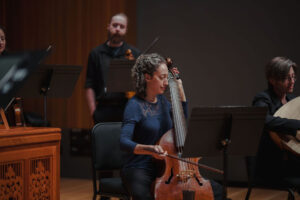
One advantage of having this concert at the Allen Recital Hall is that the acoustics are excellent, making the entire program much more pleasing to modern ears. Even though period instruments were being used throughout, their sound was amplified in this venue, creating an experience unlike the one at the church where Bach in the City often plays their concerts. Church acoustics, while more authentic to the 17th century, tend to be more echoey, and this makes the instruments sound muddier—whereas Sunday’s performance was crystal clear.
In all, this was a very enjoyable afternoon, and I learned a lot about the composers who preceded J.S. Bach and made an impact on his life and work. “Fantasticus” was fantastic!
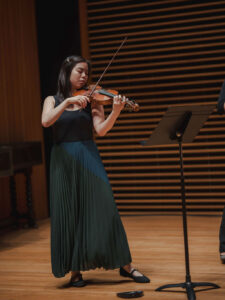 “Fantasticus: Bach and Before” was presented on Sunday, October 4, at 3:00 p.m., at the Allen Recital Hall in DePaul University’s Holtschneider Performance Center, 2330 N. Halsted Street, Chicago.
Single tickets were $45 for VIP admission, which included reserved seating; $30 adult general admission; $25 seniors 65 and older; and $10 for students.
For more information about this program, see: https://www.bachinthecity.org/fantasticus.
For general information and a list of their other offerings, visit https://www.bachinthecity.org/ or call 312-273-9834.


More Stories
“The Carpenters Songbook: A Live Celebration” starring Christina Helene Braa as Karen
“Battle of the Burgers” at Amrican Place Casino-
Ravinia Musical Festival presents ” Sing Along Grease” reviewed by Frank Meccia