
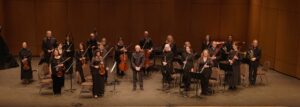
 ***** “If there were a heaven, this is what it would be!” exclaimed one of the audience members at the conclusion of Sunday night’s Music of the Baroque concert, entitled “Vivaldi & Beyond.” And I heard whispers: “So lovely!” What a delightful performance, featuring the orchestra, conductor and harpsichordist Nicholas Kraemer, and phenomenal soloists to boot!
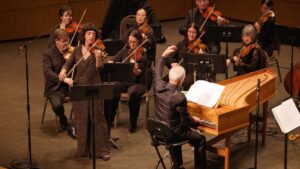
DiBello’s performance could not have been any better! Her technique was excellent: precise, swift, and dynamic. The Allegro section features a joyful melody and often one can hear the solo violin and harpsichord (Kraemer) only, followed by the other instruments joining in. The Largo section was bold and so cool. Chord combinations on the solo violin plus viola accompaniment (Terri Van Valkinburgh) were great! And the final Allegro was outstanding. I loved this! There were a few moments when the violin sounded like a fiddle interspersed among classical ideas, and sequences of broken chords kept getting louder. The cadenza was great. All said, this was extraordinary violin playing!
The next composition was Georg Philipp Telemann’s “Concerto in E Minor for Recorder and Flute, TWV 52:e1, featuring Mary Stolper on flute and Laura Osterlund on recorder. This buoyant composition is characterized by its rigorous articulation demands and technically challenging passages. Both soloists did a wonderful job, with the contrast in their woodwind sounds providing interest. This piece reminded me of two different species of birds in conversation with each other and sometimes repeating what the other has said. Behind their alternating solos was a fuller string orchestra, including cello and double bass (continuo) accompaniment. Fast execution and beautiful trills made for a captivating performance.
After intermission, the orchestra regrouped and DiBello and Stolper returned to their seats, with DiBello as concertmaster, and Alltop returned to the large (French) harpsichord. Next on the program was Carl Philipp Emanuel Bach’s “Symphony in D Major, Wq. 183/1 (H. 663). This composition is notable by its triad of two oboes plus bassoon, later followed by a triad of two flutes (Stolper and Alyce Johnson) plus cello (Matt Agnew).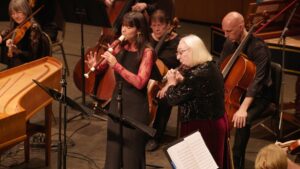
The final number was Franz Joseph Haydn’s “Symphony No. 80 in D Minor, Hob. 1:80”, replete with Haydn’s jocular style, incorporating (as Maestro Kraemer put it) “humor and darkness.” A second bassoon (Galina Kiep) was added. Kraemer conducted with no score, and during a good portion he used circular hand movements plus cueing. The Allegro spiritoso movement is akin to a carousel ride that speeds up and slows down and has lots of dynamics. The Adagio that followed included lots of descending notes, grace notes, and pregnant pauses. The slow Minuet featured a horn melody (Oto Carrillo) and violins playing lots of arpeggios. The Finale (of this work and of the program) featured violins, cello, and double bass, alongside strong horn and bassoon as a backdrop. Watching the powerful skill of the violins and the other strings is spellbinding, and it is a joy to listen to how the tunes played by the oboes plus flutes are mimicked by the rest of the orchestra.
What an inspiring, charming, and lively concert! What incredible soloists! Such great talent! Bravo to all!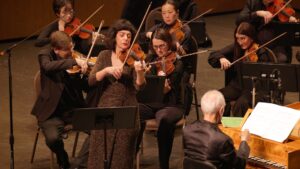
“Vivaldi & Beyond”, Music of the Baroque took place on Sunday, October 18, 2026, at the North Shore Center for the Performing Arts, 9501 Skokie Boulevard, in Skokie. This was followed on Monday, October 19 by a performance at the Harris Theater, in Millennium Park, 205 W. Randolph Drive, in Chicago. Both concerts began at 7:30 p.m.
For more information about this and future performances of Music of the Baroque, including times, dates, and locations, please go to: https://www.baroque.org/.
To purchase an OnDemand Pass of this performance for $18 (good from October 23 through November 23), visit: https://www.baroque.org/Seasons/2026-2027/vivaldi-beyond. Terms and conditions apply.
To purchase tickets for Music of the Baroque’s other offerings this concert season, go to: https://www.baroque.org/Seasons/2026-2027
Music of the Baroque is a resident company of the North Shore Center for the Performing Arts. To learn more about the venue, their future offerings, and ticket prices, visit: https://northshorecenter.org/.
To learn more about the Harris Theater, its future offerings, and ticket prices, go to: https://www.harristheaterchicago.org/.

More Stories
Funny is Female Comedy Festival in Oak Park
Camarata Chicago Chamber Orchestra reviewed by Julia W. Rath
A Funny Thing Happened On The Way to Chicago-