
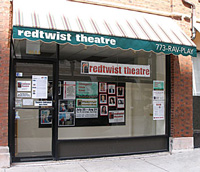
 *** “Deserted”, written by Melanie Coffey and directed by Laura Sturm, is a meaningful show about the extent to which climate change and drought have created lives of quiet desperation. The diminishing food and water supply impacts the connections that people have with one another, whether these are romantic relationships, neighborly bonds, or professional interactions. However, while the script is based on an interesting idea about the viability of human life and its likely adaptation to a changing environment, it needs more work. The biggest issue is that the play is too drawn out to tell this story well, with its total running time of 2 hours and 20 minutes including an intermission.
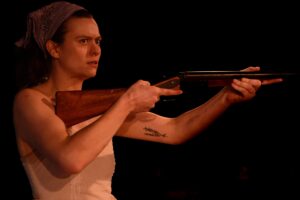
The secret of this story is in its name. The word “deserted” could be read in the traditional manner, meaning an area absent of people… or the fact that the earth has deserted its human residents. It could also be read with the accent on the first syllable, as in an area that has been turned into a desert. Each of these meanings are applicable to this show, considering that Jodie (Macaria Chaparro Martinez) and Emma (Hannah McCauley) have chosen to live in a dilapidated shack on Midwest farmland that once belonged to Jodie’s grandmother Molly and then Jodie’s mother. And now it belongs to Jodie and her lesbian lover. For whatever reason, the two have decided to remain as far from civilization as is possible, and in so doing, they have chosen to participate in what is called The Prairie Program. This is a special grant program where the two women would receive some amount of nourishing soil, water, and seeds so that (at least in theory) they could get the land to grow again and ultimately harvest crops for their own use. Cam (Sherise Danyel) is one of the administrators of the program, and she regularly comes around to see how the grantees are doing.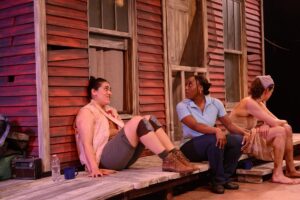
Unfortunately, the faults in the script are several. There is too much verbiage, and not everything has to be explained in dialogue… and by default, to the audience. Good acting (which is the case here) can neatly fill in the blanks. There are moments in the show when every other line could have been eliminated with no loss of meaning. In the process of showing how the lesbian couple falls in and out of favor with each other, the amount of togetherness and sexuality sometimes reaches the point when these scenes seem overdone and gratuitous. Of course, the point is for the audience to observe the extent to which Jodie’s and Emma’s relationship declines as they face the reality of crops that won’t grow, plus a lack of food and water. Then too, there are differences of opinion between them about their “friendly neighbor” (Emma Mansfield) and the hiker (Dontaye Albert) who happens to stray onto their property. But the audience gets the point already: that the two women are often on the same page, while at other moments, they aren’t, with a good deal of their disagreements—as with most couples—having to do with dissimilar reactions to their shared situation. Now having said this, the scenes having to do with sex and violence are done well due to the fine work of intimacy director Courtney Abbott.
Some of the irrationality contained within the script made me lose interest. While it’s understandable that Emma has a romanticized view of what it might take to live on a farm, she acts very emotionally when she destroys the landline phone, the only tie with people other than Jodie. She’s tired of it ringing all the time, because it’s either a family member or someone who wants something from her. Jodie asks her why she doesn’t just take it off the hook. I get it that Emma wants to be left alone. But with cell phone service in that isolated rural area being non-existent, a landline is the only means of communication, and there needs to be some way to call out in the event of an emergency. Besides, what if Cam (or some other official) wants to reach the two of them, if only to check up on their progress. This relates to another odd portion of the script: Since their home is only six miles from the nearest 7-11 (and not 40 miles away), it’s not in the middle of nowhere. Yes, it’s far from the big city. But if the 7-11 is so close by, then something should have been said about the two having no money to buy anything there, and hence they need to rely solely on the crops that they are growing.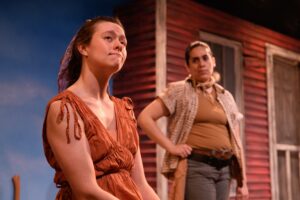
I didn’t think that the character of the hiker was necessary except to explain that this is a deserted area and that the two women didn’t want trespassers on their property or possibly any reminders of modern civilization. More to the point, it adds a racial or male-gender bias that takes the play off-track and potentially introduces an element tangential to the plot, especially as the man shows up for a moment at the very beginning and then briefly again in the second act.
Then there is the dystopian/horror aspect of the story. Ultimately, what propels the plot forward is the “friendly neighbor”, who not only wants to partake in the women’s harvest (at least, that’s what we are led to believe initially) but stealthily goes onto their property to eat their soil and grass. What I like about this character in the first act is that she seems to foreshadow the fact that the crops may not grow and that Jodie and Emma are likely to starve, just as she is. However, in the second act, their non-neighborly relationship becomes something much worse. The question is whether she is still a human being who descends into cannibalism or whether she devolves into a less than human creature as a result of starvation—or whether she is actually some kind of alien who eats things that are not edible, like clothes off the clothesline. If you’re into horror for horror’s sake, then you’re probably okay with the ending or what seems like multiple endings.
There is also a moment when the women say that they will plant their tomato seeds for next year’s harvest. But with no water in which to grow them or for them to drink and with no food to sustain them throughout the entire year (except for a few cans of soup and peaches, etc.), how will they survive? Their seeming hopefulness about growing a crop of tomatoes flies in the face of a stark reality that they may no longer qualify for a grant from The Prairie Program. It is fundamentally clear to the audience that while Emma and Jodie have each other, their loving relationship is simply not enough to prevent them from going hungry. Might they have to live on handouts or learn how to eat grass? Might they too turn into nonhuman creatures as their neighbor did? Or is it simply time for both of them to chuck life on the prairie (er, desert) and—like it or not—return to civilization, however defined?
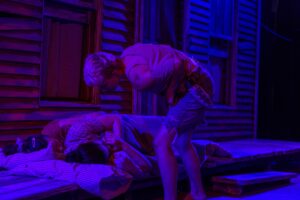
Set design by Eric Luchen is very good. We see a frontier-like shack with a raised wooden floor and wooden doors and windows that possibly dates from the 19th century. And there’s a sky blue wall to simulate the outdoors. Prop design by Leo Bassow features, among other things, clothes which are hanging outdoors. We see two raised planters for crops, an old-fashioned 1960s radio, and a water pump for a well, where the water table keeps going lower and lower. Costume design by Natalie Schoch is perfectly fitting. Lighting by Seojung Jang flows smoothly and sets the right mood for this show, and sound by Autumn R Dancy is fine for this very small theatre.
Because the show is so long and slow-moving, there were moments when I couldn’t wait for it to end. But the play is important. The story describes what can happen when a new dust bowl forms in the rural Midwest, and it is meant to be contemporary. According to the internet, desertification is the official word for what happens when once arable land devolves into a desert and the earth starts to die. And yes, it’s happening as we speak.
“Deserted” is playing through August 2, 2026, at Redtwist Theatre, 1044 W. Bryn Mawr Avenue, in Chicago.
 Tickets are $10-$60.
Performance schedule:
Thursdays, Fridays, and Saturdays –7:30 p.m.
Sundays – 3:30 p.m.
For further information and to purchase tickets, visit: https://www.redtwisttheatre.org/.
To see what others are saying, visit theatreinchicago.com , go to Review Round-Up and click at “Deserted”.



More Stories
“Mud Row”
“The Winters Tale” reviewed by Mark Reinecke
“Hayward”