
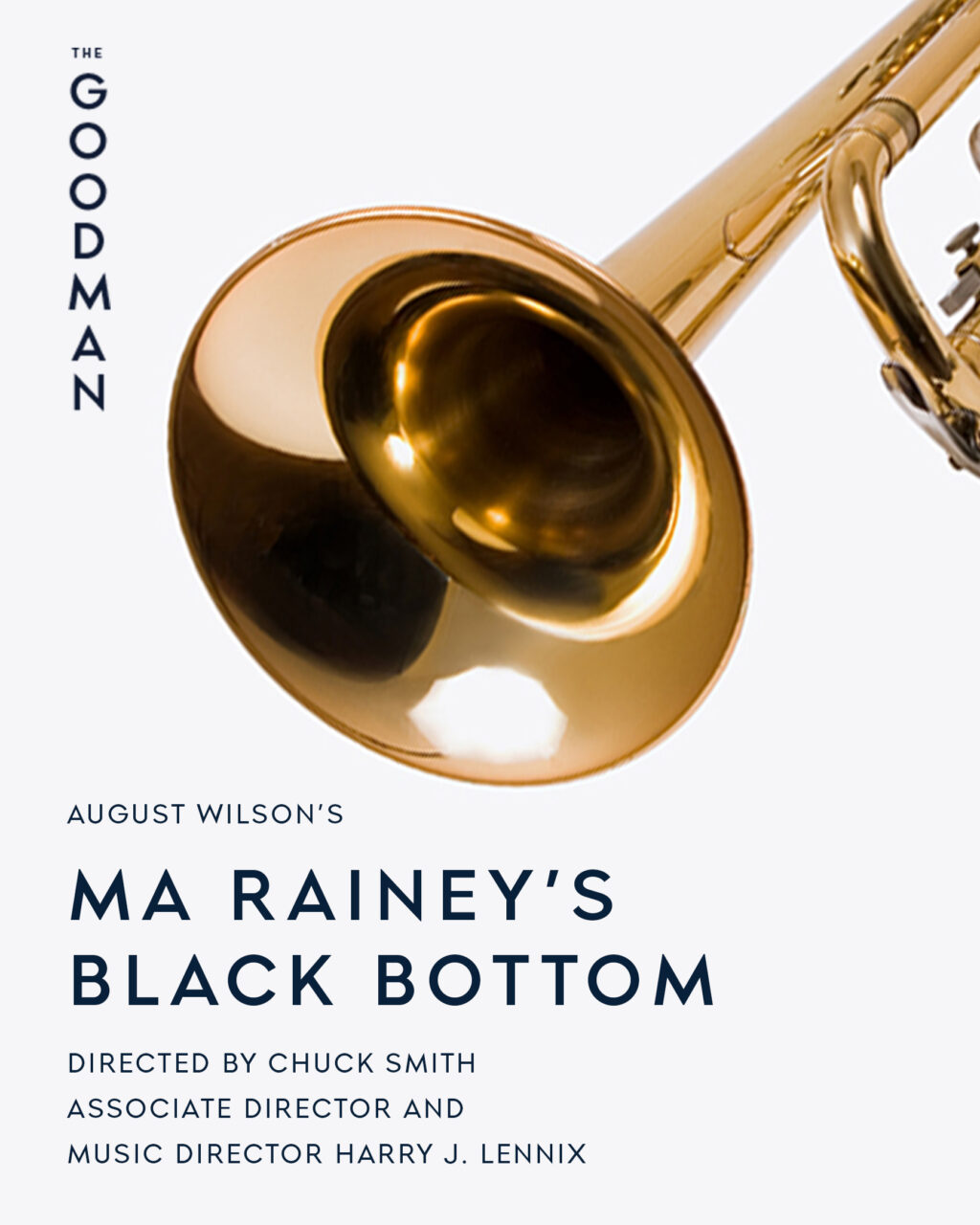
 ***** Chicago’s Goodman Theatre featured “Ma Rainey’s Black Bottom” back in 1997. Now in a stellar revival nearly thirty years later, August Wilson’s story about the uneasy relationship between black musicians and the white-controlled recording industry in the 1920s continues to leave the audience breathless. Reunited in this production are director Chuck Smith and associate director and music director Harry J. Lennix, who recreate this slice of life about Chicago’s black community, inspired by the legendary “Mother of the Blues,” Gertrude “Ma” Rainey. In this show, we see what it means to a contemporary audience to witness a night that reveals the pressures, hopes, and heartbreaks of artists navigating a world stacked against them.
We are first introduced to Sturdyvant (Matt DeCaro) and his business partner Irvin (Marc Grapey), two white men who own a recording studio and who seek to make a profit from producing and selling records of top African American vocalists singing the blues. This is at a time when any crossover in musical tastes between blacks and whites was nominal, except perhaps in an area of the city like Bronzeville. Especially high in demand in the year 1927 was blues singer Ma Rainey (E. Faye Butler), known for her provocative song “Black Bottom.” The two producers have arranged for Ma and her backup musicians to record their songs in a single recording session.
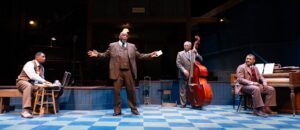
With Ma running late (which neatly fits her role as diva), her team of musicians arrive well before she does. We have Levee on cornet (Al’Jaleel McGhee, in an astonishingly powerful performance); Toledo on piano (Kelvin Roston, Jr., with his amazing charm), Slow Drag on double bass (Cedric Young), and Cutler on trombone (David Alan Anderson). Cutler is also the band leader, and there is often tension between him and Levee, who prefers his own musical arrangements and who seeks a certain amount of independence from the group. In addition to Harry Lennix’s performance at the Goodman in 1997, many others in the cast have performed Wilson’s work before but in different roles (such as at Court Theatre in 2009 and at Writers Theatre in 2019). Their combined familiarity with Wilson’s characters thus results in a tight connection among the actors as evinced by their pointed dialogue.
All throughout, the four men tease, debate, reminisce, and dream, with each man carrying his own scars from a world that has not treated him kindly. Yet despite the bickering, barb-throwing, and stories about duplicity, there is a lot of humor in the men’s banter. Here Wilson is playing to his audience: It doesn’t matter if its members are white or black or some other group: You squirm as you smile, and the smile is Wilson’s means to an end, laying claim to an underlying truth about the everlasting effects of racial discrimination and bigotry. Hence, this is not only a story about how African Americans have been slighted and disparaged by culture and custom by those who would willfully take advantage of them. Rather, a major part of Wilson’s play is to shock us into understanding how oppression, inequality, and violations of human dignity can take their toll on any one individual’s psyche.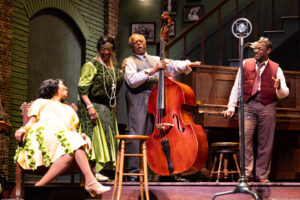
Without revealing any great secrets, the anger that the four have against “the white man” and the white establishment is ultimately directed against themselves—in large part because there is no good way to attack the prevailing and unequal power structure. Yet the same social structure that emasculates black men actually works in favor of Ma Rainey. She’s a prima donna who knows her full worth and thus she’s a force to be reckoned with. As the ruler of the roost, she unleashes her strong personality and sticks up for herself against the record producers—and, for that matter, her own musicians—to get exactly what she wants. Her “take it or leave it” attitude is demonstrated in how strongly she advocates on behalf of her stuttering nephew Sylvester (Jabari Khaliq) when she wants him to deliver the spoken‑word introduction to the title song. Promoting his self-confidence while supporting a family member means much more to her than simply conducting a business relationship. Other characters in the play include Ma’s companion Dussie Mae (Tiffany Renee Johnson) and the policeman (Scott Aiello).
A well-functioning, three-level multi-purpose set, designed by Linda Buchanan, is meant to represent a recording studio, complete with tech booth as well as the green room/rehearsal room in the basement and a bit of an outdoor area at stage right. Olive drab painted brick and paneling unify the entire set and work nicely to create the illusion. Two pianos—one in the rehearsal room and the other inside the recording area—frame the space. Lighting design by Jared Gooding nicely delineates the areas of the set where the actors perform their roles. Period costumes by Evelyn M. Danner are perfect for the era. Orchestrations by Dwight Andrews could not have been better. Sound design by Rob Milburn and Michael Bodeen works well regarding how the music is balanced with the vocals, although on opening night, there were a few moments where spoken words were a bit too soft. Last but not least, intimacy and violence coach Greg Geffrard has done a fantastic job to ensure realistic-looking physical fights among the actors.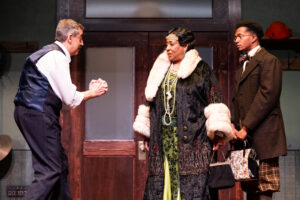
Watching “Ma Rainey’s Black Bottom” today, we recognize not only the struggles of the past but the echoes that persist in our own time. The play not only reveals the underbelly of an industry biased against black artists but also the enduring power of the blues. Across two and a half hours (including a brief intermission), this production offers not only wonderful music but a meditation on the world: the one that is the reality of the early twentieth century, the one that exists today (a hundred years later), and the one that is being hoped for in the future. In all, the performance moves with the rhythm of a blues composition: slow simmering passages, bursts of humor, sudden clashes, and a final crescendo. As with Wilson’s other nine works that comprise his “American Century Cycle”, this play follows in the general trend of reminding us that history is not abstract: It is personal, painful, joyful, and ongoing.
“Ma Rainey’s Black Bottom” has been extended due to popular demand and is running through May 3, 2026, at the Goodman Theatre, 170 N. Dearborn Street, Chicago, inside their 856-seat Albert Theatre.
Tickets range from $34 to $109, subject to change.
Performance schedule:
 Thursdays – 2:00 p.m. and 7:30 p.m.
Fridays – 7:30 p.m.
Saturdays – 2:00 p.m. and 7:30 p.m.
Sundays – 2:00 p.m.
Additional Sunday performance: April 12th at 7:30 p.m.
Special performance:
College Night on Wednesday, April 22nd at 6:00 p.m.
Tickets: $13 (reception plus show admission)
Use code COLLEGE when purchasing a ticket for this performance online: A valid college ID will be required to pick up tickets at Will Call.
For more information about this show and to purchase tickets, visit https://www.goodmantheatre.org/show/ma-raineys-black-bottom/.
For general information about the Goodman Theatre and their other offerings, see: https://www.goodmantheatre.org/.
For more information about enhanced and accessible performances, visit https://www.goodmantheatre.org/access.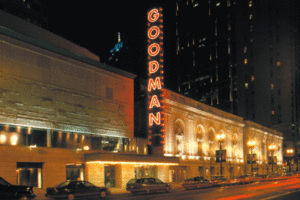
ASL-Interpreted: Friday, April 17th at 7:30 p.m.
Audio-Described: Saturday, April 18th at 2:00 p.m.; Touch Tour at 12:30 p.m.
Spanish-Subtitled: Saturday, April 18th at 7:30 p.m.
Open-Captioned: Sunday, April 19th at 2:00 p.m.
To see what others are saying, visit www.theatreinchicago.com, go to Review Round-Up and click at “Ma Rainey’s Black Bottom”.
 Review: “Ma Rainey’s Black Bottom” at Goodman Theatre
By:
Paul Lisnek, Curtain Call Chicago
****/4 HIGHLY RECOMMENDED
“Ma Rainey’s Black Bottom is a Masterpiece Tribute to August Wilson!”
You feel the energy, the tension, and the deep but troubling history in this Chicago-set story of a day in the blues world of Ma Rainey, the Mother of the Blues. Set in 1927, this powerhouse of a play feels as alive, relevant and hot as ever.
I had no doubt that E. Faye Butler would rule that stage, from her attention commanding entrance thru every line, every note, every song. She is one of Chicago’s most beloved presences on a stage, filling every corner of the stage with depth and soul. E. Faye was born to play this role! She doesn’t just play Ma Rainey, she seems to channel her before our very eyes.
Ma enters the recording studio knowing exactly who she is and what her worth commands, and heaven help the producer or musician who forgets it. She is the rule breaker that would land most others challenging the white-controlled system in jail; she is a study in confidence challenged by but willing to confront the weight of society and history. Ma challenged every restriction…she wanted what she wanted…and if she wanted a Coke-cola, you best go get her one…..make that three!
Butler plays Rainey as less the icon that she was, and more a living force that propelled her influence in a time that gave more credit to others like Bessie Smith than to Ma.
Adorning E Faye’s powerful presence is a similarly powerful and electric ensemble performance by a group of amazing actors who make up her band. Al’Jaleel McGhee as Levee fires off Wilson’s lines with an intensity that ranges from the funny to the heartbreakingly raw. David Alan Anderson, Kelvin Roston, Jr. and Cedric Young don’t just round out the band, they ground the play with warmth and lived experience like a pair of fine shoes that define a man. Their banter flies between them reflecting musicians who’ve shared many years of cramped rehearsal rooms and unfair treatment by studio bosses. As a group they make the recording studio feel less like a workplace and more like a pressure cooker, ready to blow at any moment.
The Goodman’s production balances intimacy with intensity. The set design captures a cool, stressed setting of an old recording space but infusing it with the heat of ambition for professional success and a decently lived life. Kudos to seasoned director Chuck Smith who guides the cast’s natural tempos to shine and breathe — every silence, every laugh, every look between them allowed to hang just long enough to make its impact.
When you leave the theater, you’ll sense that this August Wilson classic (the only one of his decades series set in Chicago) has accomplished what only great theater can: it takes the past and makes it feel uncomfortably current. This is August Wilson’s art at full power — and trusted in Butler’s hands, Ma Rainey’s blues sings out like a warning, a celebration, and a challenge all at once.
This revival is pure, passionate Chicago theater and not to be missed.
Ma Rainey’s Black Bottom runs thru May 3rd and tickets can be purchased at: www.Goodmantheatre.org




More Stories
“Shane” Reviewed by Julia W. Rath
“Sunday In The Park With George”
“Buddy- The Buddy Holly Story”