
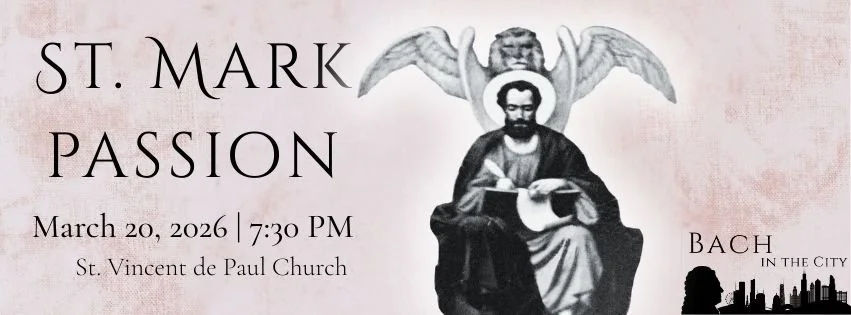
 **** Johann Sebastian Bach is known for his St. Matthew Passion and his St. John Passion. However, he never wrote a St. Mark Passion. But had he done so, what would he have come up with? What might it have sounded like?
One such speculative reconstruction was offered to an eager audience on Friday, March 20th at the St. Vincent de Paul Church on the De Paul University campus. Using several cantatas in Bach’s repertoire, Chicago’s Bach in the City and its music director Richard Webster presented a newly conceived performance of this “lost” Passion, featuring vocal soloists, orchestra, and chorus. With texts and translations of the Scriptures in modern English and German, Webster creatively stitched his own recitatives into Bach’s music to create a one-of-a-kind composition. This not only made Bach’s work accessible to today’s concertgoers but also furthered the meaning of the New Testament. Since the St. Mark Passion was a Chicago and Midwest premiere, we experienced how a German audience of Bach’s day would have received such a composition upon hearing it for the first time. To put this another way, Bach’s work no longer lived in the past but was suddenly made brand new and charismatic.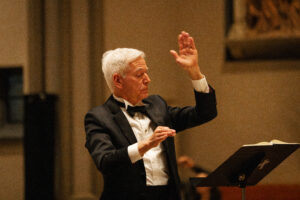
The concert toed the line between what would suit Baroque listeners and contemporary ones, not only in the use of the vernacular but also in its approach to the text. In this vein, the various arias were sung in German and ofttimes repeated. The recitatives in English were read only once through. Considering that there were not as many phrase repetitions in the current work as compared to Bach’s originals, the Passion nicely held our attention while it neatly explained the story of the Gospel according to St. Mark.
The concert was superior in large part due to the quality of the vocalists. Throughout the program, soprano Hannah De Priest and tenor Oliver Camacho switched off in the role of the Evangelist “for a variety of color and dramatic approach.” De Priest has such a mellifluous and stirring voice that makes our spirits ascend to incredibly high places where it has never been before, while Camacho has an amazing range from alto to tenor. Remarkably exceptional were the arias sung by countertenor Ryan Belongie as Judas, Peter, and others. David McFerrin, in the role of Jesus Christ, forcefully burst through the others with his bright and booming bass voice and profound execution. (Historically, the earliest settings for the St. John and St. Matthew Passion had the role of Jesus sung in lower pitches and slower speeds, and this Passion is in keeping with this tradition.) Additionally, Ana Miranda-Gonzalez played the role of Pilate; Samuel Curry was the Centurion, and Lisa Rogers Lee was the High Priest and Serving Maid. Plus the 37-member chorus often played the role of the turbae as they also sang many dramatic chorales that heightened feelings and emotions.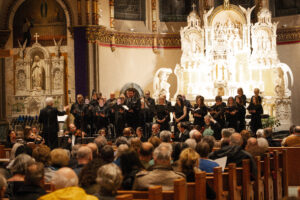
In addition to the weighty vocals, a relatively small but effective orchestra was made up of 16 players and kept to the Baroque style of instrumentation and orchestration. Their instruments were typically replications of those from that era and either custom-made or modified from a modern instrument. There was also the use of the convex bow, common among those earlier violinists (as compared to the modern concave bow). Note that a Baroque orchestra is tuned to A = 415 Hz, roughly a 1/2 step lower than the modern orchestra, which is tuned to the current standard pitch of A= 440 Hz. Also note that inside a church, a more echoey sound is expected than in a concert hall. So when we first heard the full orchestra and choir, it sounded a bit muddy. But when fewer instruments and vocalists were performing at once, everything could be heard more clearly. Among the featured instrumental solos were those performed by concertmaster Emily Nebel (first violinist), flautist Taya König-Tarasevich, and oboe d’amore player Sarah Schilling. Special credit must also go to Jason Moy, the harpsichordist and associate music director, who worked alongside Webster in editing his work and providing him with “sensitive guidance.”
The program was structured in ten parts before the intermission and ten parts after. Yet Webster considered the highlight of the evening to be what he called “entering into the Passion experience.” This was when the audience was encouraged to join the chorus in singing the penultimate movement, #19: Befiehl du deine Wege, more commonly known as the Passion Chorale. For our convenience, the words and music for the four-part harmony were reprinted on page 18 of the texts and translations handout.
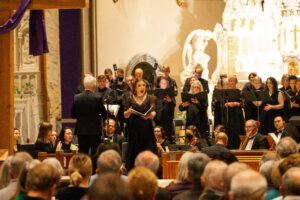
Would Bach have written something like this St. Mark Passion had he lived longer? It’s possible that he could have teamed up with a librettist of his era familiar with the English language. But then, we wouldn’t have had today’s unique inspiration! While Bach purists may scoff at the idea of piecing together his work to recreate a Passion that may have been “lost”, I liked the idea, because it was fresh and exciting. The program was designed to be one of the more innovative ways of promoting the Scriptures and getting the audience (i.e., congregants) involved. Hence, this was a very approachable concert for the Advent season and something which Christian churches could use to welcome in Good Friday.
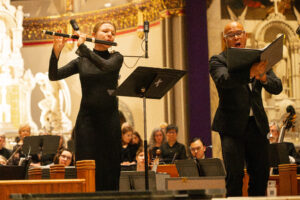 St. Mark Passion was performed on Friday, March 20, 2026, at St. Vincent de Paul Catholic Church,
1010 West Webster Avenue, in Chicago, on the DePaul University campus.

Tickets for the St. Mark Passion were $45 for VIP admission, which included reserved seating; $30 adult general admission; $25 seniors 65 and older; and $10 students (with valid ID) and children.
For further information, visit https://www.bachinthecity.org/ or call 312-273-9834.



More Stories
“Buddy- The Buddy Holly Story”
“Adolescent Salvation” reviewed by Paul Lisnek (Curtain Call Chicago)
“That’s Weird, Grandma’s 25th Birthday” reviewed by Julia W. Rath