

 **** Paramount Theatre’s smash hit musical “Million Dollar Quartet” has been extended an additional three months at the nearby Stolp Island Theatre in Aurora. Whether you’ve seen this musical previously or not, you probably know what it’s about even before walking into the theatre, that is, after hearing all the media hype about it over the years. But in essence, this production differs from all others, because both the theatre and the show were custom-built to create an intimate experience like none else, where it is staged inside a replica of the original Sun Records studio in Memphis, Tennessee.
The musical dramatizes that fateful evening on December 4, 1956 when four rock ’n’ roll giants—Elvis Presley (Corey McKinney), Johnny Cash (Michael Potter), Carl Perkins (Matt McClure), and Jerry Lee Lewis (Garrett Forrestal)—came together for the one and only time to perform as a group in an impromptu session. It was a gathering soon to become legendary. Perkins was initially scheduled to record his own music at Sun Records together with his brother Jay (Roy James Brown) on double bass. Lewis had been called on to play piano as background, but, as we learn, his goal was to make a name for himself. The already nationally-famous Presley dropped by unannounced together with his girlfriend Dyanne (Madison Palmer). And Johnny Cash just happened upon there also. What a great coincidence! Above all, we learn that this jukebox musical, written by Colin Escott and Floyd Mutrux, is really about the genius of Sam Phillips (Brian Grey), the fasttalking, risktaking founder of Sun Records, who believed in the four of them and their music before the world did.
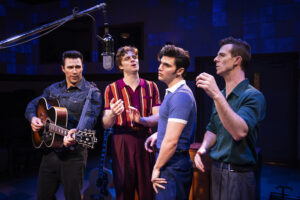
None of the artists ever repeated this unplanned three-hour jam session. But ever since the original production of “Million Dollar Quartet” in 2010, it’s been constantly being reinvented using successive actors/impersonators who are themselves fine singers and instrumentalists. The score is a treasure trove of early rock, country, and gospel: “Blue Suede Shoes,” “I Walk the Line,” “Hound Dog,” “Sixteen Tons,” “Whole Lotta Shakin’ Goin’ On,” and much, much more!
Basically, the genius of Sam Phillips in the 1950s lay in the novelty of having “white boys” singing the blues in a style which they picked up from listening to black recording artists. Phillips basically urged the racial crossover of musical genres, while, at the same time, he understood the novelty of fusing rock ’n’ roll and country music to appeal to a wider audience. Thus, the show is characterized by rockability, having to do with upbeat tempos and twangy guitar riffs and energetic vocals. It also features soulfulness and rhythms taken from gospel music sung in the Black Church. Specifically, the production by Stolp Island Theatre, directed by Jim Corti and Creg Sclavi, is unique in its intimacy and its one-of-a-kind detailed set.
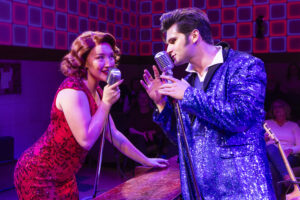
This is not a big stage. We see a large rectangle, in a runway layout, with the audience on two sides and the stage in the center, together with a recording booth up a few steps at the far end from the main doorway. The piano is closest to the door, and the artists’ instruments are stored on the farther side, where Jay Perkins, the double bass player, and W. S. “Fluke” Holland, the drummer (Robert Brandon), sit just in front and underneath the tech booth, manned by Marion (Maeghan Looney). We see standing microphones and boom microphones at various points throughout the show, including the moments when Elvis (McKinney) repositions the standing microphone from vertical to horizontal.
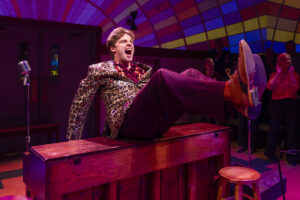
Scenic design by Jeffrey D. Kmiec is a hoot! The pink and turquoise tile floor is a gas, not to mention the design of the lobby area just outside the theatre. Jonathan Berg-Einhorn, the properties designer must get special credit for placing spinning records on the wall of the lobby containing a bit of the history of the four rock ’n’ roll giants, together with a Royal Enfield motorcycle. Plus, the design of Sam Phillips’ office adds a homey touch. The photographs and posters on the wall are great as is his desk filled with an old-fashioned manual typewriter, a dial telephone, a blade fan, an in and out box, and chachkas from the 1950s.
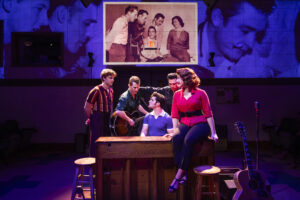
Costumes by Matt Guthier are great especially during the finale! Katie Cordts, the wig, hair, and makeup designer, has done a marvelous job recreating the appearance of the original artists. I particularly loved the lighting design by Greg Hofmann, especially the various colored lights behind the tiles, which flashed perfectly to accompany song rhythms, especially at the finale. (And who would have predicted a series of lines for “I Walked the Line”?) Scenes are nicely projected above the audience due to the work of Mike Tutaj, the projections designer. The panorama of early 1900s buildings really does immerse us into the time period. My favorite projection, however, happens to be that of the original photo of the four stars plus Elvis’s girlfriend. Additionally, Kory Danielson, the music director, has done a fine job with coordinating all the musicians and making sure that they are true to the score. Adam Rosenthal’s sound design is good; but because we were in such a small space, I had to wear a set of earplugs throughout the entire performance. Last (but far from least), I adored the playbill, which was brilliantly designed to look like a 45-r.p.m. record cover with the program placed inside the sleeve and the reverse side listing all of the songs in the order in which they are sung.
One of the best parts is the finale—with the energetic Lewis jumping off the piano, and Elvis and Cash getting down on the ground (limbo style) while playing their instruments, and Perkins playing the guitar upside-down. But from my point of view, the production takes place on too small of a stage, making it feel as if the actors are constrained in their roles and that they are holding themselves back as they carry out their signature physical moves: like Johnny Cash’s locomotive-like walk and Elvis’s hip gyrations, leg shakes, footwork, and heel pivots. For the actors to knock it out of the ballpark, they need more space to walk around and maneuver. Moreover, performing on a larger stage in a larger venue would also allow for a bigger audience that could get charged up—and add even more vital energy to a show where the crowd is already wildly enthusiastic.
Just remember that having this musical presented in a relatively small space is not necessarily a flaw. There are many pluses to this intimate venue where the house is full to capacity daily. The show’s extreme popularity can be attested to by the people sitting next to us in the audience. They told me that this is the fifth time that they have attended the Stolp Island Theatre production, which has been going on for the last year and a half, and they have made it a special point to bring guests from out-of-town to see it. And as I discovered when talking to the head usher, these audience members are not unique in repeating a wonderful experience at the theatre. She constantly meets lots of patrons who want to take a stroll back in time and be thrilled by the nostalgia of the original performers and their music. The show is sweet and lovely as it is: It’s just different from what you might see in downtown Chicago.
Paramount Theatre’s “Million Dollar Quartet” is playing at the Stolp Island Theatre, 5 East Downer Place, Suite G, in downtown Aurora through May 31, 2026. The entrance is off the river between Benton Street and Downer Place.
Tickets: $76 for all seats when purchased in person.
Additional fees apply for phone and online orders.
Performance schedule:
Wednesdays at 1:30 p.m. and 7:00 p.m.
Thursdays at 7:00 p.m.
Fridays at 7:00 p.m.
Saturdays at 2:00 p.m. and 7:00 p.m.
Sundays at 1:00 p.m. and 5:30 p.m.
For more information about this show and other offerings, go to: https://events.paramountaurora.com/
To purchase tickets, visit https://events.paramountaurora.com/online/default.asp, or call (630) 896-6666, or stop by the Paramount Theatre box office, 23 E. Galena Blvd., Monday–Saturday, 10:00 a.m. to 6:00 p.m., and until showtime on show days.
Note that easy, affordable parking is just a short walk away. If you are going to dinner first, choose the six-hour parking lot (where the six hours expires at 5:00 p.m.). If you’re going directly to the theatre, then choose a parking garage or street parking area that offers three-hour parking.
Check out the downtown parking map at https://gis.aurora.il.us/portal/apps/View/index.html?appid=54981ff102644b81b0da02a9c2d9d43d&extent=-88.3257,41.7542,-88.3052,41.7617
My suggestion is to park at Lot Q, which is the bronze parking lot off Benton Street, or the lot by the former post office and museum, unless your meal choices take you to a different area of downtown Aurora.
Note that there is a lot of construction going on at the intersection of I-294 and I-88, so if you’re driving to Aurora from the north, make sure to include additional time to get to your destination. My guest and I took I-355 on our return trip to avoid the traffic congestion and the lane shifts, and we made much better time.
To see what others are saying, visit www.theatreinchicago.com, go to Review Round-Up and click at “Million Dollar Quartet”. photos: Boris Martin



More Stories
“Shane” Reviewed by Julia W. Rath
“Sunday In The Park With George”
“Buddy- The Buddy Holly Story”