

*** Based on an 1888 novel by August Strindberg and translated by Harry G. Carlson, “Miss Julie” is a timeless story of a restless, suffering bird locked in a gilded cage. She has a luxurious life, but is severely restricted by rigid, centuries-old traditions and a lack of personal freedom.
From the opening moments of this play, Director Gabrielle Randle-Bent plants an early suggestion that Miss Julie is not cut out for the sorrows of the world. This is a tragic drama in one act. We are placed in Strindberg’s patriarchal world with its rigid hierarchy of masters and servants and its entrenched puritanical ethos. The focus throughout is devoted nearly entirely to highbrow/lowbrow class issues. This leaves some of the play’s more subtle motifs of the battling sexes, stifling societal gender rules, religious beliefs, and the burgeoning field of psychology rather neglected.
There are only three characters: Miss Julie, daughter of a wealthy aristocrat, (Mi Kang); Jean, the household valet, (Kelvin Roston, Jr.); and Kristin, the cook, (Rebecca Spence). The plot is equally spare. Set against the revelry of a single, long night – Midsummer’s Eve – many lines get crossed and the status quo altered. The holiday festivities are kept off-stage, suggesting that the characters on stage might be interrupted at any moment. Julie’s fall from grace (of course the “shame” is always placed on the woman) and Jean’s dreams of upward mobility lead the two to plot potential escapes in-between refilling their beer steins and wine glasses. Ultimately, their dreams lead to nothing. Jean comes to realize that the woman he idolizes has fallen irrevocably from her pedestal, while Miss Julie’s encroaching despair, loathing, and degradation steer her to a self-destructive fate that was perhaps predetermined.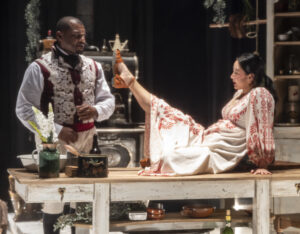
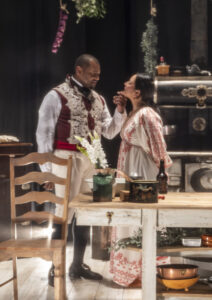
There is so much overload to unpack. Words between Miss Julie and Jean are sexual foreplay. There is sadomasochism in their sparing. Jean and Miss Julie might not be equal by any socioeconomic measure, but they match each other toe-to-toe in their penchants for bull-headed argument, dangerous flirtation, and selfishly-motivated manipulation. Julie gets lashed with harsh truths. The sex – presumably terribly unfulfilling sex – ultimately is a mortal wounding intended to destroy oneself and each other. As soon as their coy banter turns to doomed romance, the play reaches its high point; it simultaneously blurs and sharpens the characters’ true natures and their desires to be anything but who they are.
Each actor delivers rather challenging monologues with conviction. And watching these actors at work is the main pleasure of “Miss Julie.” Mi Kang is able to convincingly oscillate between imperiousness and vulnerability, between control and submission. Her character rode and trained horses throughout her life, and she seems to use those mastering techniques to dominate Jean. Kelvin Roston, Jr. brings a certain ease and adaptability to his role. Despite being in a relationship with Kristine, he cannot say no to Julie’s heedless orders. Roston has the acting skills to set a redline with a kid glove and to firmly communicate that Julie is playing with fire. Jean will not be trifled with. And you believe him. Jean is a man trapped in his social station, yet has a worldliness, exposure and experience Julie lacks.
Rebecca Spence as Kristine is horrified and betrayed by Miss Julie’s inappropriate behavior and the activities going on in “her” kitchen (and with her man). Some of the best moments in the play are Spence’s measured and powerful reactions. With the many words being thrown about among the characters, Spence’s body language, especially when she walks out of her kitchen in obvious anguish, tells the story more clearly than words. And she challenges the audience to understand the circumstances of the servant as she works quietly and often in silence.
There are beautiful, impressive staging aesthetics, as to be expected at Court Theatre. The well-stocked kitchen (John Culbert, scenic designer) with its period stove and cooking accoutrements provides a homey, charming set. When cans and cups and bowls get kicked and knocked about as the anxiety intensifies, the stage works as a mirror and metaphor for the titular character’s psychological state. For the duration of the production, there was a mesh screen fully encapsulating the stage. I struggled to understand this detail and to not allow it to distract. Was this screen to draw a parallel with Julie’s captive and doomed caged green finch? I felt the proximity to the stage and to its actors was compromised as a result.
The sound (Willow James, sound designer) and lighting (Keith Parham, lighting designer) worked together – in a kinetic, artistic, dream-like way – to transport us to an uncertain time and place. Along with good costume design (Raquel Adorno), the production team (and a strong cast) did a remarkable heavy lift to make this play interesting and more understandable.
The desolation, the raw feelings and emotions, the shifting power dynamics, the downward spiraling towards tragedy takes post-coital revulsion to an unrealistic extreme. I did not see a clear statement on the problems with the misogyny of Strindberg’s original work. It’s difficult to look past a show with such tragic images and ideas – one that should be emotionally devastating – and find it merely striking.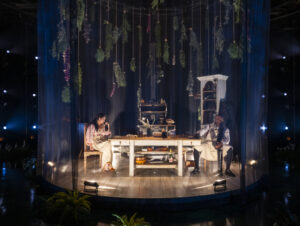
Fact Sheet / Miss Julie
Miss Julie
By: August Strindberg
Translated by: Harry G. Carlson
Directed by: Associate Artistic Director Gabrielle Randle-Bent
 Through March 8, 2026
Wed/Thurs/Fri: 7:30 pm
Sat/Sun: 2:00 pm & 7:30 pm
Court Theatre
5535 S. Ellis Avenue
Chicago, IL
Tickets: $60 – $90 (student, group and military discounts available)
Box Office: Located at 5535 S. Ellis Avenue; (773) 753-4472 or www.CourtTheatre.org
Free garage parking adjacent to the theater.
To see what others are saying, visit www.theatreinchicago.com, go to Review Round-Up and click at “Miss Julie”





More Stories
“Adolescent Salvation” reviewed by Paul Lisnek (Curtain Call Chicago)
“That’s Weird, Grandma’s 25th Birthday” reviewed by Julia W. Rath
“Vape: the Grease Parody”