

***** Spectacularly directed by Lili-Anne Brown and smartly choreographed by Breon Arzell, “The Color Purple: The Musical” is a marvel, having won two Tony Awards in 2016 for best revival of a musical production. Featuring energetic gospel singing and a variety of lively dance numbers, this colorful show tells a very dark story having to do with physical violence, domestic abuse, and lives of misery and desperation within an African-American family in the rural South. The creation of a book by Marsha Norman takes the original novel by Alice Walker and the movie by Warner Bros./Amblin Entertainment to greater heights, especially with the addition of music and lyrics by Renda Russell, Allee Willis, and Stephen Bray. Although the story depicts a type of family life where intimidation and corporal punishment prevail, this show, above all, is meant to be a morality play, designed to elevate the role of women—particularly black women—based on personal empowerment and the rule of kindness. Hence, while the tale teeters on the balance of hopelessness, helplessness, and inapt optimism, all of this is surpassed by God’s gift of spirituality and of love, joy, and forgiveness. And music—also part of God’s creation—not only serves as a nepenthe but as some measure of promise that a brighter future can exist for all.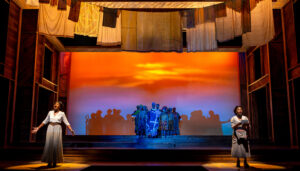
The story spans the years 1911 through 1945. It’s an account of a young black woman named Celie—a splendid performance by Britney Mack with her incredible acting and gorgeous and powerful singing voice! Celie has been raped twice by the age of 14 and forced by her widowed father (Michael Earvin Martin) to give up both children at birth, so that she can continue putting in long hours to accomplish household chores. Celie’s only happiness comes from her close relationship with her younger sister Nettie (Shantel Renee Cribbs). Celie is eventually “sold off” to a very abusive common-law husband called Mister a/k/a Albert (Evan Tyrone Martin), who constantly humiliates her and makes her bow to his every whim by striking her with a whip. He hides the letters sent to her by Nettie and wants Celie to believe that her sister is dead. Basically, he manipulates her and treats her like a slave: a scenario that Albert’s father (Sean Blake) well remembers, considering that he grew up under the last vestiges of that “peculiar institution.” Feeling depressed and worthless, Celie contemplates the assured bliss of the afterlife. At the same time, Albert is in love with Shug Avery (Aerie Williams), a thin, graceful, assertive bisexual woman, who travels from town to town as a flashy singer and dancer. But Shug does not care for him. When she comes to visit his home, Shug, in her own way, notices Celie’s sadness and her shuffling demeanor and realizes just how much she lacks any type of love in her life. When Shug shows Celie affection, she tells her that God is in everything: from the purple flowers in the fields, to the pleasures of love and sex, and to the music that gives people some sense of ecstasy and release.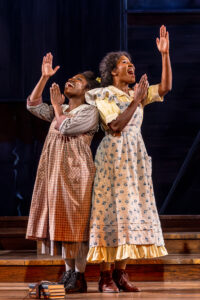
Parallel to Celie’s marital relationship with Albert is the on-again/off-again relationship between Albert’s son Harpo (Gilbert Domally) and his significant other Sofia (Nicole Michelle Haskins, with an absolutely lovely singing voice). Harpo could never figure out why he was so attracted to Sofia, considering that she is the type of person who stands up for herself and interacts very differently from his father and Celie. Without giving too much away, the first act ends on a high note, with Celie realizing that her sister Nettie is not dead but is living in Africa as a missionary, brought there by the preacher at their church (Juwon Tyrel Perry), together with her two abandoned children Olivia and Adam, who are miraculously still alive! In the second act, we notice that Albert might have learned something about the meaning of love, possibly by witnessing his son’s relationship with his wife or by noticing just how much Celie loved her sister Nettie that she was willing to defy her husband’s orders. While don’t really know why Albert had a “come to Jesus moment”, what becomes evident is Celie’s emotional growth, brilliantly expressed in her showstopper song, “I’m Here.” This and the theme song and reprise called “The Color Purple” represent some of the most thrilling moments of the performance.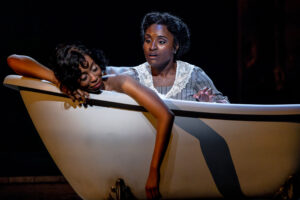
All throughout, there is some measure of comic relief from all the darkness and despair in the form of a Greek chorus, specifically, three women who reflect upon Celie’s situation with their collective voice. In the first act, the three are jubilant gospel singers, dressed in their Sunday best, whose names are Doris (Lachrisa Grandberry), Darlene (Sharriese Hamilton), and Jarene (Reneisha Jenskins). And in the second act, the same three are now wives of the tribal chief Olinkan (Sean Blake) and are dressed in native African clothing. Costume designer Samantha C. Jones has created a vivid wardrobe for the production, contemporaneous with early 20th century styles. The women’s African costumes are largely a takeoff on native African-inspired fabrics using sewing patterns for American clothing during the 1930s. While the dresses that Shug wears are particularly becoming, so are the women’s pants later in the show.
Set design by Arnel Sancianco plus the occasional props (like a wheeled in telephone) are more than appropriate to tell this story. Lighting design by Heather Gilbert and projection design by Michael Salvatore Commendatore and Rasean Davonté Johnson are nicely accomplished, especially with all of the purple accents, although we never see the purple flowers that grace the playbill’s cover. What is very useful, however, is having the various years of Celie’s life being projected on screen, thus providing some grounding for each scene’s action. Intimacy and violence design by Gregory Geffrard is especially important to this tale that involves close contact among the actors. Sound design by Stephanie Farina and Sarah Ramos could not have been better: Every word, spoken or sung, is as clear as a bell. Above all, the music needs to be credited, starting with music director Jermaine Hill. Conductor John Bronston (keyboard 1) has done a remarkable job with all the songs and the musical numbers, guiding both the vocalists and the orchestra consisting of Vijay Tellis-Nayak (keyboard 2, shaker), Felton Offard (electric and acoustic guitar, dobro guitar, and harmonica), Chuck Webb (electric and acoustic bass), Charles Heath (drumset/percussion), Rajiv Halim (alto sax, clarinet, and flute), Linda Van Dyke (baritone and tenor sax, clarinet, and bass clarinet), and Derrick Gardner (trumpet and flugelhorn).
It is important to note that the philosophical underpinnings of “The Color Purple” have to do with the coincidence of three types of spirituality. There is God’s gift of nature: the ever-changing masterpiece of earthly abundance, where life unfolds in harmony and beauty through forests, fields, and oceans and every living thing in between. Then there is the spiritual expression of native African religion, which emphasizes harmony with nature, reverence for community, and a dynamic relationship with a Supreme Being plus a whole host of spirits and deities. Yet the overarching form of spirituality depicted in this play is that of Christianity and the salvation that it offers via the Black Church, an institution that emerged from the struggle against slavery and oppression. By means of the loving expression of the Gospel, the local church serves as a vital center of faith, resistance, community, social justice, and missionary work—and a source of music… which allows the Greek chorus to tell Celie’s difficult story in song and dance.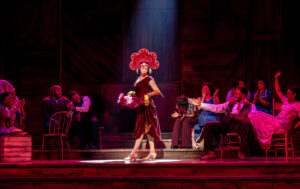
While the setting is that of the early twentieth century South, a narrow-minded mentality that is associated with demeaning, dehumanizing, and mistreating other human beings can exist in any era. Cruelty may take many different forms but is not time-limited. Hence, the sentiments expressed in this show are just as relevant in today’s America as in the past, including the idea that evil exists and that even the most reprehensible person is capable of repentance from their misdeeds.
In sum, it’s good to know that there is still love in this world. “Be the person who comes through with love.” That’s ultimately what “The Color Purple” is all about.
“The Color Purple : The Musical” runs through August 3, 2025, in the 856-seat Albert Theatre, at the Goodman Theatre, 170 N Dearborn Street, Chicago.
Tickets range from $33-$143, subject to change.
Performance Schedule:
Select Tuesdays – July 8, 15, and 22 at 7:30 p.m.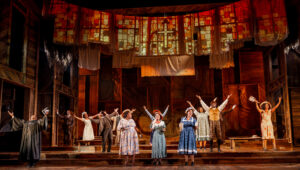
Select Wednesdays – July 9, 16, and 23 at 7:30 p.m.
Thursdays and Saturdays- 2:00 p.m. and 7:30 p.m.
No 2:00 p.m. performance on Thursday, July 31st
Fridays – 7:30 p.m.
No performance: Friday, July 4th
Sundays – 2:00 p.m.
Additional Performances:
Sunday, July 6 at 7:30 p.m.
Wednesday, July 30 at 2:00 p.m.
Enhanced and Accessible Performances:
Touch Tour and Audio-Described: Saturday, July 12th – 12:30 p.m. touch tour, 2:00 show.
Spanish-Subtitled: Saturday, July 12th – 7:30 p.m.
Open-Captioned: Sunday, July 13th – 2:00 p.m.
ASL-Interpreted: Friday, July 18th – 7:30 p.m.
For more information about the show and to purchase tickets, visit https://www.goodmantheatre.org/show/the-color-purple/ or phone the box office at 312-443-3800.
For information about the Goodman Theatre and their other offerings, please see: https://www.goodmantheatre.org/.
To see what others are saying, visit www.theatreinchicago.com, go to Review Round-Up and click at “The Color Purple: The Musical”.



More Stories
“Buddy- The Buddy Holly Story”
“Adolescent Salvation” reviewed by Paul Lisnek (Curtain Call Chicago)
“That’s Weird, Grandma’s 25th Birthday” reviewed by Julia W. Rath