
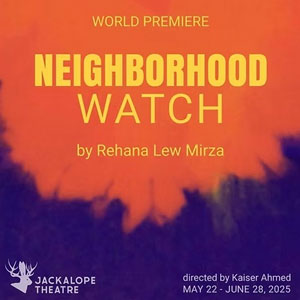
**** “Don’t be sorry; be better.” This is perhaps the biggest takeaway from “Neighborhood Watch”, Jackalope Theatre’s world premiere dramady about white Americans’ fear of the stranger. Set in December 2024, right after the election of Donald Trump to a second term in office, the story is very loosely taken from the real-life circumstance of Treyvon Martin in 2012. It focuses on the left-wing liberal Paul (Frank Nall) and his MAGA neighbor Shawn (Victor Holstein), who are white men involved in their “neighborhood watch” presumably in a South Florida suburban community. Featuring a finely written script by Rehana Lew Mirza, nice direction by Kaiser Ahmed, and decent performances, the initial focus has to do with these two men spending lots of time outside in the fresh air, people-watching. While Paul and Shawn don’t like each other and have completely different politics, the play reveals that they are actually two sides of the same coin.
The story begins with Paul and his daughter Becca (Jamie Herb) trading barbs while he wants her to help him grow an outdoor garden. That is when Shawn appears and says that he has just noticed a young Muslim man moving into the house in between the two of them. Paul, who is superficially friendly, wants to find out more about this Muslim stranger, so he goes next door and meets the new owner, a young man who calls himself Mo (Harsch Gagoomal—who does a phenomenal job of acting and holding the play together; his timing is brilliant). Mo is a name shortened from Mohammed, presumably so that he could better assimilate himself to mainstream American culture. While overtly trying to act sociable and friendly, Paul hints that Mo could actually be a terrorist in disguise—and Mo cleverly plays along with Paul’s prejudices and intentionally needles him to provoke a response. This is all very funny, because the audience knows that Mo is actually goading Paul. Shawn likewise tries to play it cool while choosing to spy on their next-door neighbor. Among other things, he falls off the roof of Mo’s house while secretly observing him. Here we see how several investigative mishaps add comedic elements to the show.
Paul’s daughter Becca, who is 22 years old, becomes intrigued by her new neighbor, and the two of them start dating. Paul simultaneously wants to protect his daughter from this “strange” man while at the same time, he says to her that she’s an adult and free to do as she wishes. But behind the scenes he is anxious to pay Shawn to continue his snooping, despite the fact that Shawn is sixteen years older than Becca and inappropriately interested in his daughter for himself and somewhat jealous of her interest in Mo.
The emphasis shifts with the introduction of Mo’s younger cousin/brother Javed (Omar Bader) at the end of the first act. The same age as Becca, Javed has decided that he wants to move in with Mo. When he arrives on the scene, Javed initially seems like a nuisance, basically barging into Mo’s house and insisting that he live there, and at some level, Mo seems helpless or overly polite and gives into his relative’s wishes. But unlike Mo, Javed is not assimilated to mainstream American culture—nor does he want to be—and he doesn’t act like Mo at all. In fact, he believes that Mo has strayed too far from his roots. When he first meets Becca, he thinks that Mo must be paying her to be his girlfriend because she’s such a pretty white girl (akin to the movie “Can’t Buy Me Love”). While Javed is staunch in his native-born culture, so is Becca, who takes her “white privilege” in America for granted. Even though she seems to be in love with Mo, the question is whether she really loves him—or whether she is attracted to him because he’s new and different or because she knows that her father disapproves of their relationship at some level. Then too, as much as Mo wants to fit in and be a part of white American culture, the introduction of the character of Javed proves that he never really can, considering that both are viewed by their (white) neighbors with suspicion, no matter how much or how little they have chosen to assimilate. In fact, when both Mo and Paul recall their college days at the University of Michigan, this scene demonstrates that despite the common bond of undergraduate life, there really is no bonding between the two men. Ironically, it is Paul, Shawn, and Becca who wind up straining the bond between Mo and Javed, almost to the breaking point.
The characters in this production are well-developed, and the dialogue is very perceptive and thought-provoking. The question of the day is whether it is essential or superficial to want to fully adopt American culture if you are a member of a minority group. And if you’re a person of color from another culture or country, can you ever be fully accepted by the majority? Above all, the play has a great reveal (which I won’t divulge) that is excellent and complex. Yet moments seem a bit choppy and some dialogue seems repetitive from time to time, particularly during a portion of the second act. The elimination of some small amount of verbiage here and there could make the performance maybe ten minutes shorter without losing its emphasis. (Currently it’s at 2 hours and 10 minutes with a 10-minute intermission.) What I have an issue with, however, is a scene towards the end (which I also won’t discuss in detail) where the characters sit around a kitchen table; this, to my mind, seems forced and more violent than necessary. Yet it does provide a pretext for resolving the drama and creating some type of meaningful ending. So now you’ll have to see the show for yourself to understand exactly what I mean!
The set design by Tianxuan Chen is very plain, with a lot of green indoor/outdoor carpeting to resemble grass, considering that Paul and Shawn sit outside so much of time to watch the activity in their neighborhood. The stage is largely divided in two halves: The front of the stage largely forms Mo’s living room, while the rear of the stage is slightly higher and largely forms the observation point for both Paul and Shawn—with stairs and a sloping ramp between them. Ahmed’s directing allows for the smooth flow of the actors between these two main portions of the stage. Prop design by Roman Jones is simple: There are yard signs on the left side of the stage that name various political candidates who just ran in the November 2024 election; most of whom are on the Democratic side of the spectrum, with the name on the Trump sign having been crossed out in red marker. I especially loved the wicker garden chair in the sunburst design. Clothing by costume designer Delena Bradley is casual and appropriate for the current era. I liked the variety of t-shirts, especially those ones worn by Paul to express his political opinions. But, of course, the shirt that says “#1 Dad” is the one that governs, since Paul believes that he deserves high marks on how he has raised his daughter, especially considering that he is a single parent whose wife passed away some time ago. The intimacy design by Tristin Hall is nicely done, particularly when it comes to Mo’s and Becca’s relationship. Sound design by Newton Schottelkotte is very good, with its pops and clicks and perfect music, and this is interwoven with Maaz Ahmed’s lighting design, especially the various flashing lights between scenes. Not only are scene changes handled deftly but so are the numerous costume changes.
The script tells an important tale about overt and subtle discrimination against minorities in the United States today, in this case, having to do with fearfulness against Muslims as a group. Underlying this tale is the presumed return of the Muslim ban, which Trump tried to enact during his first term. In addition to the story’s serious underpinnings and messages, it is quite funny and has a light touch. My expectation is that this show will improve as the run goes on and as the actors become more comfortable in their roles. All in all, this play has a very good future.
“Neighborhood Watch” is playing through June 28, 2025, at Broadway Armory Park, 5917 N. Broadway Street, in Chicago.
General Admission Tickets are $15 – $40 with student and Edgewater resident discounts available.
Performance schedule:
Fridays, Saturdays and Mondays at 7:30 p.m.
Sundays at 2:00 p.m.*
Open captioned performance: Monday, June 16 at 7:30 p.m.
*Audio-described performance: Sunday, June 22, touch tour at 1:30 p.m., performance at 2:30 p.m.
For more information and to purchase tickets, please go to https://www.jackalopetheatre.org/neighborhood-watch or call/text the box office at 773-340-2543.
To see what others are saying, visit www.theatreinchicago.com, go to Review Round-Up and click at “Neighborhood Watch”.


More Stories
“Shane” Reviewed by Julia W. Rath
“Sunday In The Park With George”
“Buddy- The Buddy Holly Story”