

*** Theatre is full of surprises, but few plays redefine the boundaries of live performance like White Rabbit Red Rabbit, the brilliant and daring creation by Iranian playwright Nassim Soleimanpour. Written in 2010 while Soleimanpour was forbidden from leaving Iran, the piece was conceived as a way for his voice to travel beyond borders, even if he physically could not. What resulted is not so much a play in the traditional sense, but an experiment in trust, spontaneity, and vulnerability—one that places equal weight on the performer, the text, and the audience. In this play, the actor reads instructions and a script written by Nassim Soleimanpour. The artistic director for this production is Artistic Director Jacqueline Stone.
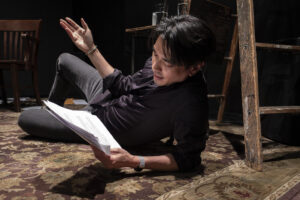
TUTA’s opening night performance, featuring company member Huy Nguyen, embraced this concept wholeheartedly. With no prior knowledge of the script, no rehearsal, and no direction, Nguyen took the stage armed only with courage and curiosity. The performance space was intentionally stripped to its bones: a black stage, a single chair, a tiny table, and a ladder. The starkness wasn’t an absence—it was an invitation. Every moment became a discovery not just for the audience, but for Nguyen himself, who, in real time, was reading and reacting to the text as it unfolded in front of him. It reminded me of going to a performance at the Chicago Dramatists Theatre, where they would read a script to you, to get your reaction, and see if they should accept this as a future play.
Nguyen proved to be an excellent choice for this experiment. With charm, wit, and a grounded presence, he navigated the meta-theatrical terrain of Soleimanpour’s script—a script that is as much about obedience and defiance as it is about theater itself. Part lecture, part confession, part philosophical dare, White Rabbit Red Rabbit plays with form and expectation. It tasks the performer with moral dilemmas, strange requests, and moments of deep reflection. There are rabbits, yes—but also questions of power, conformity, and the invisible contracts between artist and audience.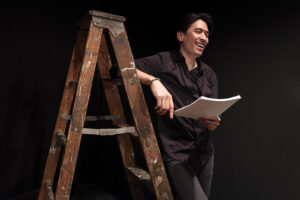
Nguyen was nimble, both intellectually and emotionally. He allowed the script to guide him while still infusing the performance with his personality and sense of humor. The result was an engrossing 80-minute theatrical high-wire act, where laughter and tension lived side-by-side. You could feel the audience leaning in, not only to follow the narrative but to witness Nguyen’s unfiltered responses—to see if he would comply, resist, or reinterpret the instructions Soleimanpour left behind.
The beauty of White Rabbit Red Rabbit lies in its ephemeral nature. No two performances are the same, and in that sense, it captures the purest essence of live theatre: once it’s over, it’s gone. You don’t just watch this play, you experience it with the performer, together in a kind of silent pact. Nguyen honored that pact beautifully. TUTA’s choice to present this piece aligns perfectly with their mission to push theatrical boundaries. With Nguyen’s engaging performance at the helm, opening night was not just a success, but a testament to the power of simplicity, honesty, and risk in theatre. White Rabbit Red Rabbit reminds us why we gather in the dark: to watch something unfold in real time, and to be changed by it—one rabbit at a time.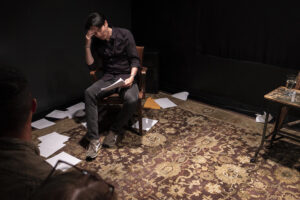
This play is performed in rotating repertory with Jeff Recommended TOM & ELIZA. Prices for all performances are $20, $45, and $60 plus a $3.00 per ticket fee.
Tickets can be bought online at https://tutatheatre.org/summer-rep-2025tickets
“White Rabbit, Red Rabbit “will perform every Monday and Tuesday till the final performance on Aug 11th at 7:30. TUTA theatre in the charming neighborhood of Ravenswood, the train stops 1 block away on Francisco Street. The theatre is located at 4670 N. Manor Ave, Chicago, 60625.
To see what others are saying, visit www.theatreinchicago.com, go to Review Round-Up and click at “White Rabbit, Red Rabbit”.





More Stories
“The Brief Wonderous Life of Oscar Wao” reviewed by Paul Lisnek, Curtain Call Chicago
“The Play That Goes Wrong”
“Carmen” reviewed by Frank Meccia