

** “Top Girls”, written by Caryl Churchill, takes place during the era when Maggie Thatcher was Prime Minister of Great Britain. She was known as “The Iron Lady”, strong and forceful in her role in setting domestic policy and also on the international stage. But was she really made of iron on the inside? That is the leading question behind a more generalized study of the strength and resilience of those who have chosen to be “career women.” This play is largely about competent, professional women who have often sacrificed their family life in favor of being in a “man’s world.” This is not just about their success, inner strength, and professionalism but also about their overall happiness. Are the sacrifices that these working women have gone through worthy of their investment of time and energy? Would it have been more satisfying to have raised children instead or, at least, to prioritize their children over their career? Basically, are these women satisfied with the direction of their lives? Or are they regretting the choices which they have made when it comes to their families?
Despite the fascinating questions being raised, the story is much too choppy and overly wordy. At 2 hours and 40 minutes with two intermissions, the performance is entirely too long, especially as it’s only in the third act that we start to figure out the purpose behind it all. By then, it’s almost too late. Churchill has created a nonlinear plot, with the elements being presented in such an unfocused manner that we start to lose the thread even before the argument is presented in full.
Nicely directed by Lucky Stiff, the play starts out in a locale that is presumably heaven or a holding area just outside of heaven, with the backdrop being fluffy gray clouds. There we are introduced to five women, seated around a dining table, who are now deceased but were alive in different centuries. Each of them once achieved some kind of high position, high standing, or high regard, separate from traditional female roles within marriage and the family. Throughout the first act, we watch them being served food, wine, and other alcoholic beverages as they converse about their accomplishments and their place in society.
The host of this dinner party is Marlene (Claire Kaplan), wearing a bright red dress. Of her guests, the most interesting character is Pope Joan (Morgan Lavenstein). (In fact, Lavenstein portrays the character so well that I wanted to find out more about this rogue Pope during the first intermission, but I digress.) Another guest of interest is Dull Gret (Yourtana Sulaiman), who was once an artist’s model. She steals the show when she steals food, drinks to excess, and talks about having seen hell. Other guests are Lady Nijo (Hannah Kato), the mistress/courtesan of the emperor of Japan; Isabella Bird (Susaan Jamshidi) an explorer with a Scottish accent, and Patient Griselda (Luke Halpern) from “The Clerk’s Tale” in Geoffrey Chaucer’s Canterbury Tales. While their talk generally centers on work, each of them in their own way brings up what they are missing in life: having a good family and enjoying the children they might have raised.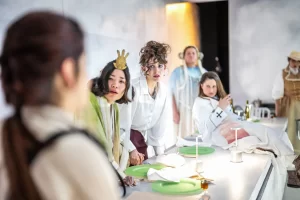
It is only when Marlene introduces each of the women to the tardy Griselda (and to the audience by default) that we are suddenly not so lost about who these various guests are. But nobody introduces Marlene to the audience, and thus she is the least interesting of the heavenly group, that is, until we realize in Act II, Scene Two that she is meant to be the focal character, who works as a headhunter in a modern office called the Top Girls Employment Agency. She is the soon-to-become managing director and has been rising in the ranks for years. What’s worse is that the second act is so radically different from the first that we start to wonder if this play is meant to be a series of vignettes as compared to having one overriding plot. The good part, however, is that all of this is finally tied together when we reach Act III. That’s when we come to realize that Marlene is supposed to be the modern equivalent of these historical “top girls”, now in heaven… or possibly in some transcendental dream of hers.
Once we’ve already grown somewhat accustomed to seeing these six women, the second act starts off radically different, that is, in Angie’s bedroom in the modern-day. Angie (Sulaiman) is nine years old and her best friend Kit, or Kitty (Collin Quinn Rice), is several years older, post-pubescent. Angie confides in Kit that she doesn’t believe that Joyce (Jamshidi) is her real mother, but maybe her aunt Marlene is. Angie wants to make it her mission to find out if this is really the case, and among other things, she travels to London to visit her Aunt Marlene’s office: an all-female company of headhunters who interview women candidates to find the top people for various jobs. As the audience watches the women who work in the agency interview prospective job applicants, we notice how they perpetuate stereotypes of women and the types of jobs they can hold, ironically promoting and perpetuating the existing male hierarchy. And (I’m not ruining it for you) we eventually find out that Marlene pursues a career in middle management, in part because she believes that being in the working class is despicable. Marlene is aspirational in wanting to rise above her station and looks up to Maggie Thatcher and the Tories and wants to be more like them, with their beliefs in capitalist individualism and in keeping with the relatively rigid class structure in the United Kingdom.
Act I was not so easy to figure out with lots of different accents and lots of verbiage. As one woman in the audience put it afterwards: “I wanted supertitles.” Yet the biggest complaint was that some characters talk over each other, only adding to the fray and confusion. But when the setting shifted radically in the second act, I noticed that some audience members weren’t as engaged in the story, with the exception of following one-liner humor. Adding to the confusion is the fact that we are told in the program that Act III takes place a year earlier than Act II, but the characters seem to have gotten older. These conflicting elements muddy the underlying theme about the troubles and travails of being a “career woman” regardless of one’s era or place in history.
The multipurpose scenic design by Joonhee Park is good. I liked the sparse stage with steely gray walls to resemble clouds, plus movable panels along the back and side of the stage. Prop design by Paloma Locsin seemed fine in the first act when we see a long table with six chairs and a tea cart. But in the program, we are told that the first scene in Act II is Joyce’s backyard, when, in fact, we see what resembles Angie’s bedroom. We are also told that the set in Act III is Joyce’s kitchen, but it looks like her living room. As for lighting design by Ben Carne, the horizontal light strip across the back of the stage works wonders, and I liked the uses of the electronic candles throughout. Lighting gets more interesting in the second act, when we start off with Angie’s bedroom, which morphs into an office setting. Three fluorescent ceiling fixtures at stage right work well when the stage is transformed into an office. I especially liked the shadows of the characters backlit against the panels. Sound design by Dee Etti-Williams could not have been better. My favorite, however, are the costumes in the first act, thanks to Anna Wooden and Anna Finerty. The ingenuity involved in creating a female Pope outfit, the knight garb worn by Dull Gret, and the flowy gowns worn by the other guests is no less than spectacular.
I would imagine that when Churchill’s play first came out in 1982, it represented a novel understanding of what feminism is about: not just about having a job or career, but, instead, leading a fulfilling and balanced life, including the joy of having children. But the show doesn’t play as well with today’s American audience, largely because we lack familiarity with many of its political, historical, and scholarly references. When we get lost in the intricacies of figuring out who the characters are and why the script is structured as it is, what becomes sacrificed is the underlying thesis: that feminism must be multidimensional, above and beyond a woman’s work life, in order to fulfill its promise. The best part of the performance is the dialogue about a woman’s place in this world not being respected enough. This is extremely heartfelt, clear, and meaningful. On opening night, the reflected light from the stage was bright enough that you could see lots of women in the audience nodding yes—and I was one of them!
 “Top Girls” is playing through March 22, 2026, at Raven Theatre, 6157 N. Clark Street, Chicago.
Tickets: General Admission: $45; Student, Military, and Industry tickets $20. Previews $30.
Performance schedule:
Thursdays, Fridays, and Saturdays at 7:30 p.m.
Sundays at 3:00 p.m.
For more information about this show and to purchase tickets, visit: https://www.raventheatre.com/stage/topgirls/.
For information about their other offerings, go to: https://www.raventheatre.com/.
To see what others are saying, visit www.theatreinchicago.com, go to Review Round-Up and click at “Top Girls”
Top Pot Girls Marathon Tickets
This is a ticket package for tickets to our marathon day of theatre. You get 2 tickets, 1 for Top Girls and 1 for Pot Girls on one of our 2 show days (2/21 or 3/1) and don’t worry, there will be snacks in between the performances! $100 for all!





More Stories
“The Drowsy Chaperone”
“White Rooster” Reviews by Al Bresloff and a second by Paul Lisnek Curtain Call Chicago
“Fully Committed” reviewed by Frank Meccia