
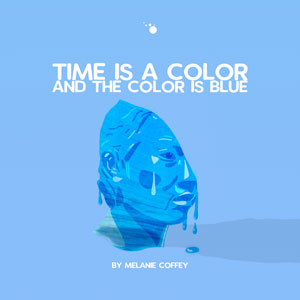
** Alice Wu excels as Whittaker, the Ph.D.-educated glaciologist in “Time Is a Color and the Color Is Blue.” Because of her quest to find out more about the origins of human life on earth, Whittaker decides to explore an ice cave in dangerously cold and snowy weather. But is venturing out during such a bad storm actually a death wish?
Melanie Coffey’s intense psychological portrayal has been developed into a well-crafted production as part of Avalanche Theatre’s play incubator series. Skillfully directed by Zoe Sjogerman, the premise is a good one: having to do with envisioning people whom you know and love just before you think you’re going to die. Yet the play drags too much in spots: That’s because it is being undercut by superfluous elements that detract from the introspective nature of the story.
On press night as we walked into this small black box theatre, the audience could not help but be impressed with the set. The stage was transformed into an ice cave, consisting of stalactites and ice shelves made of clear plastic, bubble wrap, butcher paper, Styrofoam, and ceramics. Congratulations to Ab Rieve and Micaela McCabe for such a clever scenic design. Then too, the air conditioning was blowing, and it was quite cold inside the room! I zipped up my coat and put on my hat, while my guest had her coat on and at one time her gloves. We were speculating whether all this cold air was intentional, considering the theme of the show. But let’s put all that aside….
The story begins with Tilda (Harper McCoy) and Milly (Mary Mikva) creating a cave painting on an ice wall directly in front of us. These two cavewomen are supposed to be some of the earliest human beings: bipedal, communicative, self-aware, and shrew-like. Then in the next scene, Whittaker comes upon their painting in the course of exploring an ice cavern. The drawing is thought to represent a self-portrait of the first human beings in that part of the world (or on the planet), and Whittaker is delighted by her discovery.* Unfortunately, shortly thereafter, Whittaker finds herself trapped in the cave, and her walkie-talkie doesn’t work. At the same time, her glaciologist companions Jackson (Bryan Nicholas Carter) and Bridget (Martina Logan) constantly pull out their walkie-talkies and try to reach her without success. Cold and shivering, the two of them wind up talking to each other: blaming themselves about who might have been the one responsible for Whittaker’s choice to go outside in such an intense storm when she should have been stopped. But, of course, since nobody knows the future, how could either of them have predicted that she would become lost? After all, this was something that Whittaker really wanted to do, and does anyone ever know the true risks of an adventure in advance?
Whittaker’s overriding guilt—buried deep inside of her—comes to the fore once she is on the verge of death. Now she explores a sadness that runs deep within herself as people from her personal past return to her as if in a vision. Among others, these people include her mother (a fabulous performance by Sabine Wan), her older sister (Stephanie Fongheiser), and her ex-girlfriend (Gabriela Diaz). In time, we learn that this scenario is intentionally meant to parallel one from Whittaker’s childhood: when her mother took a risk and died suddenly when a tornado struck their Chicago home. Jackson and Bridget also come to Whittaker’s mind—and that’s when they shed their down jackets. Similarly, when Whittaker loses oxygen, she takes off her own jacket too as she is dying and imagines herself interacting with the others. Giving the audience the privilege of visibly differentiating what is real versus what is imaginary is a sign of Sjogerman’s excellent directing!
Whittaker’s fascination with ice could be analogized to having been emotionally frozen for many years. The color blue (which can be equated with sadness) can be found within the deepest layers of ice, hundreds of thousands of years old. Lighting design by Nathan Keiller is excellently done: meaningful but not obtrusive. In addition to seeing the blue as the deepest coldness, we also see the yellow-tinged white lights over Jackson’s and Bridget’s heads in different parts of the stage when they are outdoors, discussing Whittaker’s location and what to do next. Sound design by Alexander Attea works well for this space, and original music by Eva Mattioli could not have been better. Martina Logan’s costume design befits the actors who wear cold-weather gear: down jackets, thermal pants, and insulated black vests. I also liked the use of solid colors among the cast and the lavender dress worn by Wan.
Unfortunately, the play has its problems. It’s more than sufficient to witness Tilda and Milly paint on the wall in the first scene, but there’s no reason for these cave dwellers to show up later on in Whittaker’s imagination. They were never a part of her life, so why do they come to her now when she thinks that she might die? The two actors’ antics reminded me of the show “Cats”, and it’s weird to see them slithering around and even weirder to watch them sit in the background and observe how other characters in Whittaker’s mind interact with each other. Briefly, the presence of these cavewomen creates moments which make it hard to take the play seriously. Eliminating these characters entirely would improve the story by making the remaining characters more compelling and believable as a whole. And the show could simply start out with the cave paintings already being present on the ice wall. Now having said that, one could make the argument that Tilda and Milly are in the tale to represent the earth and to inform Whittaker about how human beings are destroying it. But then one has to ask why Whittaker blames herself for the desecration of the planet in the first place.
Moreover, I would suggest that the character of Whittaker’s father be introduced into the script. I sincerely wondered about his absence and would have liked to see his interaction with his family members. Rather than having other characters relate facts about him, seeing the man in person would allow the audience to hear his advice first-hand and witness his drunkenness. His presence might help to bring in several of the environmental issues that the playwright wants to talk about, since apparently, he previously discussed the future of the earth with his daughters and the fact that the seasons are no longer the same. But perhaps the whole theme about earth’s environment might not be needed at all, and thus the story could become more timeless and universal, just like many action-adventure dramas on TV.
In all, this is a tough production to rate. Given the highly personal nature and emotional tugs within the story, the narrative should have been more enthralling. As my guest put it, the directing and acting deserve 4 stars while the script deserves only 2. To my mind, this 75-minute performance might work better if it were cut to 45 minutes, that is, by keeping all of the projections of loved ones and by eliminating the fantastical characters. Alternatively, the script could work as a feature-length play if a strong subplot were added. I won’t ruin the ending for you, but I had mixed feelings about that too. Basically, the script requires additional work and more material to work with. I’m looking forward to the next draft.
“Time Is a Color, and the Color Is Blue” is playing through May 24, 2025, at Bramble Arts Loft, 5545 N. Clark Street, 2nd Floor, Chicago.
Tickets range from $15 to $45.
A special edition of the script, published by Avalanche Theatre, will also be available for purchase for an additional $12.
Performance schedule:
Thursdays, Fridays, and Saturdays – 7:30 p.m.
Sundays – 7:00 p.m.
Additional performances: Monday, May 5th and Monday, May 12th – 7:30 p.m.
For more information and to purchase tickets, visit https://www.avalanchetheatre.com/time-is-a-color.
For general information and to learn more about Avalanche Theatre’s other offerings, please go to: https://www.avalanchetheatre.com/.
*Note that the paint is in red, but I would have been happier had some other color been chosen—or perhaps some combination of red and black—because these marks looked too much like random bloodstains to me when I first saw them. But then I digress.
To see what others are saying, visit www.theatreinchicago.com, go to Review Round-Up and click at “Time Is a Color, and the Color Is Blue”.





More Stories
“The Brief Wonderous Life of Oscar Wao” reviewed by Paul Lisnek, Curtain Call Chicago
“The Play That Goes Wrong”
“Carmen” reviewed by Frank Meccia