
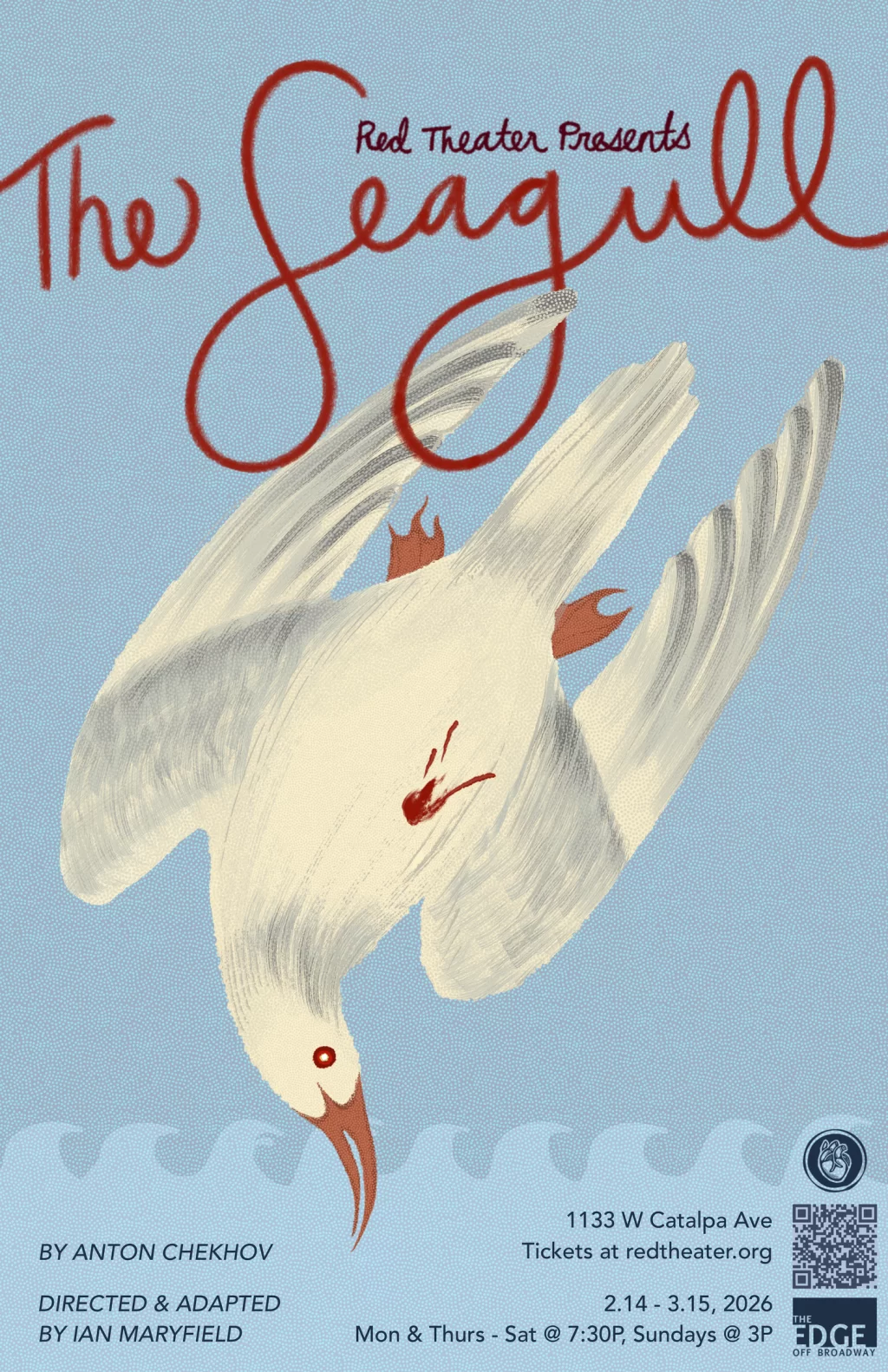
 **** First performed in 1896, “The Seagull” is one of Anton Chekhov’s masterpieces, filled with longing, quiet desperation, and deep emotional struggles.
The unmatched beauty of the serene Russian countryside is the backdrop for this play, which centers on a group of artists and lovers whose ambitions and desires collide at a rural estate, owned by Sorin (Chuck Munro, in a heartfelt role). Here his nephew the young idealistic writer Kostya or Konstantin (Kason Chesky) longs to revolutionize the theater and win the admiration of Nina, an aspiring actress (Jamie Herb). The show starts with Kostya putting on one of the plays he has written. Nina disregards his love for her and is more enamored of Trigorin (Josh Razavi), in part because he is an established novelist, as compared to Kostya, who is as yet an unknown writer. Yet Trigorin is already romantically involved with Kostya’s mother Arkadina (a splendid performance by Ann Sheridan Smith), who is a famous, self‑absorbed, and aging actress. She has already learned that only in making men contented that women can find some measure of status. Yet Nina, dazzled by Trigorin’s fame, chooses to ignore the fact that Trigorin is already involved with Arkadina. She chases after him even after he specifically makes it a point to tell her that he can easily chew her up and spit her out. He likens her to a seagull that Kostya recently shot just for the thrill of killing a magnificent and harmless creature, evocative of nature’s bounty and freedom.
The estate’s staff observe the visitors as they seek romantic fulfillment or chase artistic glory. They include Shamraev the boisterous manager (Joe Zarrow), his long‑suffering wife Polina (Ana Ortiz-Monasterio Draa), and their depressed daughter Masha (Magdalena Dalzell), who constantly drinks from a silver flask, hidden on her person. As affections build into painful triangles, emotional currents deepen. Masha longs for Kostya, though she is pursued by the earnest schoolteacher Medvedenko (Ben Murphy). Polina yearns for the doctor Dorn (Chris Hainsworth), who responds with gentle detachment. And of course, Nina, continues to leave Kostya devastated, because, within her limited role as wife and mother (and sometime actress), she sees no good alternative to her bad marriage. Others like Yakov the handyman (Bobby Bowman) ground the estate in everyday life as he and others constantly move all sorts of furniture and heavy trunks around the set, sometimes quickly, sometimes quietly, and sometimes with a loud bang (causing two of the actors to break character with hearty laughs).
The second act revisits the characters at a later point in time, and we observe changes in their life trajectories. For some, what were once wild ideas have come to fruition and have become everyday realities, whereas for others, dashed aspirations and unfulfilled dreams remain. When all of them reconnoiter, the elderly and dying Sorin pines for the life he has never lived. Arkadina suffers the consequences of fading youth. As for the others, careers don’t go as they should, and marriage and romance are far from expectations. There is far too much hurtfulness and (unnecessary) suffering in everybody’s life. In the case of the women, there is the realization that their social roles are limited and they lack of personal freedom: They put on their best face to get over acknowledging this reality. But while the cultural patriarchy generally allows men to be comparatively better off than women in Russia in the 1890s, life for a man nevertheless brings with it lack of satisfaction and—perhaps as part of the human condition—a longing to acquire whatever it is that they don’t already possess, such as fame, fortune, property, or the woman of their desire.
The costume design by Maggie McGlenn is superb! Not only are the period garments authentic, but they are lovely. The green brocade dress worn by Smith and the off-white dress with yellow-green trim and lace worn by Herb are particularly elegant. There is a lot of creativity involved in Hunter Cole’s set. Prominent in the background throughout is a large painting by Isaac Levitan entitled Wood Lake, which has been recreated by Cole. Suzanne Barnes’ prop design scatters all sorts of set elements throughout the stage and its edges, making it seem as if the audience were a part of the room. The funniest props are the two uneven poles with curtains that are supposed to represent a stage, as in a play within a play. I also liked the window which hangs from the ceiling. Changes in lighting by Brenden Marble gives us a sense of the passage of time and the change in scene. Sound by Kate Schnetzer is great for such a small space, and intimacy design by Victoria Nassif is nicely done. Composer Jonathan Hannau has done a fine job with the appropriate piano music for the era. Last but not least, I was especially fond of the frameable art by Skyler Simpson. It was very creative to have the reverse side of the informative program open up into a well-designed poster with restful colors. Small but mighty!
In addition to seeing into the various personalities of the characters, the story makes us wonder about the society and culture of late 19th century Russia. For example, what makes some novels of better quality than others and consequently their authors more famous? Is it the novelty of the ideas being expressed or the fact that their writings follow preestablished guidelines of thought and phrase? More specifically, even if Trigorin’s work is more trivial than deep, the reality is that he is already famous—and in a patriarchal society, being married to him would (theoretically) give Nina more prestige than if she were to marry someone like Kostya, who has an uncertain future. Status and excitement and the prospect of money may, in fact, trump love in a society where women are dependent on men for their very identity and survival. Perhaps the more central question has to do with what it means to be an actress in that era. This occupation placed women a strangely double position, in that they were highly visible, culturally important, increasingly respected, and theoretically more independent than their female counterparts in terms of making money and having an ability to interact with men outside of marriage and the family. Yet being an actress was still shadowed by old prejudices that associated such working women with having loose morals, and thus actresses were often lumped in with courtesans. Hence the ambiguous standing of women in Chekhov’s play—having to do with their simultaneous independence from men and dependence on them—is ultimately what this story is all about.
“The Seagull” is playing through March 15, 2026, at The Edge Off Broadway Theater, 1133 W. Catalpa Avenue, in Chicago.
Performance schedule:
Mondays, Thursdays, Fridays, and Saturdays – 7:30 p.m.
Sundays – 3:00 p.m.
General admission tickets are $30.
A limited number of $10 access tickets are available for students, artists, or anyone
on a tight budget.
Purchasing a ticket at our $50 pay-it-forward tier helps us sustain Red Theater’s accessibility efforts.
Use code ACCESS at checkout for $10 tickets.
Use code ANTON for half price tickets on Monday nights, which are Industry Nights for artists and service industry professionals.
For more information and to purchase tickets, go to https://redtheater.org/.
Direct Box Office Link: https://ci.ovationtix.com/35021/production/1264035.
To see what others are saying, visit www.theatreinchicago.com, go to Review Round-Up and click at “The Seagull”.





More Stories
“The Drowsy Chaperone”
“White Rooster” Reviews by Al Bresloff and a second by Paul Lisnek Curtain Call Chicago
“Fully Committed” reviewed by Frank Meccia