

***** “Rome Sweet Home”, created and directed by the Q Brothers Collective (GQ, JQ, JAX and POS), is a sung-through musical satire about what happens when a democracy slides into a dictatorship. This loud, bold, and brassy production is intentionally anachronistic and largely consists of a series of razor sharp comedy bits combined with hip-hop music and the art of rap. Developed in collaboration with Edward Hall and Ericka Ratcliff and nominally based on Shakespeare’s play “Julius Caesar”, this is an extremely creative takeoff on the downfall of the Roman Empire—with parallels being made to U.S. politics and government in the era of Donald Trump. When Julius Caesar (Postelle Pringle [POS]) feels the need to promote his Caesar salad and the gluten-free craze by not providing bread to the populace, this adds a unique layer to the original gripes of the Roman population. Now hunger and rising poverty have been added to the loss of liberty and the erosion of freedom. And yet most of Caesar’s minions believe he can do no wrong—with the exception of such leaders as Brutus (Victor Musoni) and Cash (Jonathan Shaboo).
With ebullient singing voices and wonderful choreography by Tanji Harper, not to mention clever stagecraft by the entire cast and crew, the play is never dull. Its musical inspiration comes from lots of performing artists, for example, Public Enemy’s “Welcome to the Terrordome”, Ludacris’s “Cry Babies (Oh No)”, and LL Cool J’s “To Do Break of Dawn”, with the songs embedded nicely within the story’s dialogue. While sometimes a bit too obvious and corny, there are tons of thinly-veiled references to contemporary cable news programs, modern Italian restaurants, and, most of all, deli sandwiches and a wide array of breads and buns in addition to the intrigue of the Roman court. One of the funniest segments has to do with the bit about the various components of sandwiches—with the lettuce being somewhat too healthy to make the grade in an era of fast food.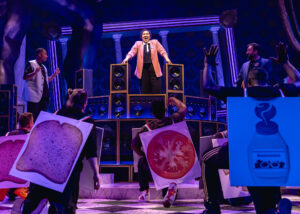
Thanks to costume designer Jos N. Banks for the sandwich-board costumes, which are a stitch, not to mention all of the other fabulous garments created for this play such as some conglomeration of Romanesque clothing, vests which are more appropriate to the era of Shakespeare’s writing, as well as more contemporary styles. Having the ensemble wear black pants to allow for quick costume changes works very well. Then there is the Halloween theme as well, with the holiday being the appointed day for the assassination of Caesar(rather than the Ides of March). And true to form, it is Purny (Bri Sudia) who, in a prophetic dream, foresees the death of her husband. Then there’s Caesar’s best friend Tony (Cage Sebastian Pierre) who sticks with him throughout but constantly sways like a reed in the wind once Caesar is killed when he agrees with everybody that he should be dead. Other characters include Lucy (Janyce Caraballo), Casca (Danielle Davis, with a marvelous blues singing voice), Tre Bone (Jax), C-Pimp (Maya Vinice Prentiss), and Metta (JQ).
Scenic design by Collette Pollard features a thrust stage, which works well for a production that is supposed to be Shakespeare with a twist. In the background of the multipurpose set is a crooked image of Roman forum (which describes the tale in an instant), together with marijuana-patterned wallpaper. The lighting by Jesse Klug is incredible with its labyrinth of primary colors and patterns and rotations, especially the blood red. I liked the extent to which the wallpaper changes colors entirely when different lights are thrown on it, together with all of the trapezoid-shaped outlines that are differentially lit up, depending on the scene and the action within it. Also as part of the set on stage right is a gigantic waist-down statue of Julius Caesar, who is mooning the audience, with his genitals unseen but are referred to as needing a large Romaine leaf to cover them. Prominent is the symbol of the empire on the proscenium arch: This is represented by a gold eagle surrounded by a wreath, featuring the abbreviation PFL (Peace, Freedom, and Liberty). I particularly liked the discussion that several characters had about this symbol and how the words freedom and liberty are redundant. (Now take a moment to ruminate on the multiple meanings of the word “redundant” and see what you come up with!) Also note that this abbreviation finds its way onto a round silver pin which partisans are supposed to wear to demonstrate their loyalty.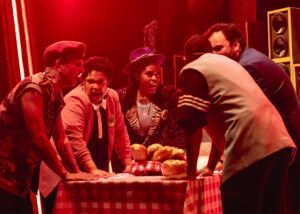
Open captioning is essential for this performance, considering that the songs feature unusual rhyming schemes and unexpected words and wording. Whether if you’re comfortable with listening to rap or not, you’ll still need to read the captions just off stage left or you’ll miss a good part of the underlying meaning of the show. At first, it wasn’t so simple to follow the written words while watching the actors, their body language, their expressions, and their interactions with one another. But as time went on and we became more familiar with the characters, it got easier to follow the action and read the captions at the same time. Yet depending on one’s sightline, some people in the audience needed to work just a little too hard. An additional screen would have helped.
The playbill mentions the timeliness of the production in allowing the audience to “find levity in the chaos and a space to process the real frustrations and stresses we might feel as modern politics unfold”—much as it was in Shakespeare’s day when England’s Elizabeth I had no clear successor. However, the least funny part of the show is the most poignant: What we learn after Caesar’s death is that once democracy is lost, nothing ever really changes. Another autocrat simply takes over—in this case Octavius (Pringle)—who kills off his personal enemies, whom he defines as such. Yet there’s a moment near the end when the music suddenly stops and one of the characters paces around the thrust stage asking the audience (as if it weren’t already obvious), “What are you going to do about it?” With the exception of this one question, the future looks like a fait accompli: that the United States too might have already begun an endless cycle of autocracy, corruption, and political violence, where suddenly more and more people who supported the previous administration willingly or unwillingly become human sacrifices to Mt. Vesuvius.
Coincidentally, on Sunday the 28th when all of us were inside Navy Pier awaiting the 2:30 performance, border patrol agents started their operations downtown and were spotted with guns walking along the Chicago River and up Michigan Avenue. One story is that some of them were trying to arrest a man who fled from Clark and Kinzie Streets up to Superior Street, which is literally walking distance from the theatre. The question is what has happened to him and the others who have been arrested as part of Operation Midway Blitz? Will they be accorded due process of law? And what about their right to Peace, Freedom, and Liberty? So while one of the purposes of the show is to allow the audience to draw implicit comparisons between historical events from Ancient Rome and current events today, it has become impossible to predict what new and pressing situation can and will arise where federal authorities have become more emboldened—and which the play could not have anticipated.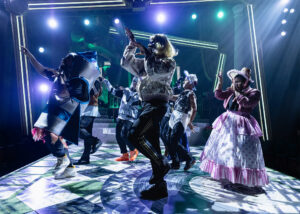
Yet the other purpose of the production is to be in the moment and enjoy the ride: the dancing, the singing, the alacrity, and the uses of the English language (including lots of obscenities). Even though we know the story of Caesar, the overall unpredictability of this story cannot be understated. As a consequence, there’s almost too much to take in! So as to fully catch all the references and the humor, you may have to see the show a second time.
“Rome Sweet Rome” is playing through October 19 at the Chicago Shakespeare Theater, 800 East Grand Avenue, at Navy Pier, in their Jentes Family Courtyard Theater.
Tickets range from $73-$95, depending on date and time of performance.
(Note that price includes all fees.)
Performance schedule:
 Tuesdays at 7:30 p.m.
Wednesdays at 1:00 p.m. and 7:30 p.m. (no matinee September 24th)
Thursdays at 7:30 p.m.
Fridays at 7:30 p.m.
Saturdays at 2:30 p.m. and 7:30 p.m. (no matinee September 27th)
Sundays at 2:30 p.m.
“Chicago Shakespeare strives to make its facility and performances accessible to all patrons. Accessible seating, assistive listening devices, large-print and Braille programs, and sensory tools are available at every performance.”
Enhanced performances include:
Audio-described performance – Sunday, October 5th at 2:30 p.m.
Open captioned performance – Wednesday, October 8th at 1:00 p.m. and 7:30 p.m.
ASL interpreted performance – Friday, October 10th at 7:30 p.m.
Run time is approximately 80 minutes with no intermission.
If parking at Navy Pier, bring your ticket for validation/discount
For more information and to purchase tickets, visit: https://www.chicagoshakes.com/productions/2526-rome-sweet-rome/.
To see what others are saying, visit www.theatreinchicago.com, go to Review Round-Up and click at “Rome Sweet Rome”.


More Stories
“The Brief Wonderous Life of Oscar Wao” reviewed by Paul Lisnek, Curtain Call Chicago
“The Play That Goes Wrong”
“Carmen” reviewed by Frank Meccia