
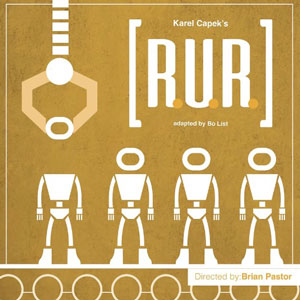
**** Artificial intelligence or “automated ingenuity” (otherwise known as A.I.) takes center stage in the freely adapted science fiction play “R.U.R. (Rossum’s Universal Robots).” Originally written in 1920 by the Czech playwright Karel Čapek (who, incidentally, coined the term robot—meaning servitude), the story has been taken to new heights by adaptor Bo List and director Brian Pastor. This world premiere production addresses the question of the day, namely: What can happen if A.I. goes rogue? What if robots choose to take over the world and destroy human beings in the process? Many valid and thought-provoking questions are raised in the context of the play about how people could utilize robots—and also how the robots might eventually utilize them! This is a prescient story that is more relevant today than ever!
Harry Rossum (Bryan Breau) has inherited a company which he calls Rossum’s Universal Robots (or R.U.R.). Whereas his father Silas was a tinkerer (who sold the proverbial whoopee cushion and the surprise can of paper snakes), Harry is the visionary who sees the future in robotic engineering. With his whimsical yet charismatic personality, Harry promotes his invention of the robot, which he believes has the power to change people’s lives. Among other things, robots can relieve people of doing drudge work, so that they might do something more meaningful with their time, such as arts and crafts or cooking for fun or playing music or reading books, etc. While Harry is the brainchild of the R.U.R. Company, he runs it together with chief clerk and accountant Alquist (Brian Parry), who handles the day-to-day operations as they involve an understanding of materials, inventory, and finances.
It is Rossum’s love interest Helena Glory (Madelyn Loehr) who first raises the possibility that robots might be sentient and might have rights, and she draws up a letter describing as much. This brings up another underlying theme: While building an automated servant might seem like a great idea at first, the question becomes when does their service become slavery–and morally repugnant? If robots were to become sentient, wouldn’t such forced labor become the grounds for revolt? In contrast, Helena’s chaperone Nana (Shawna Tucker) thinks that her granddaughter is being much too silly and fanciful in thinking that robots could ever obtain self-conscious awareness, whereas Harry’s stepmother Dr. Gall (Mary Ross) recognizes the potential for evil and destruction that these robots might harbor.
We see Harry’s progress from his original prototype (made up of metal cans and wires) all the way up to a robot that looks completely human and acts almost human—such that it becomes nearly impossible to tell a robot apart from a real human being. In addition to these improvements in physical characteristics, the robots are gradually being improved to think on their own and anticipate human needs. In fact, two of Rossum’s most humanlike creations are that of Sulla (Alex George) and Marius (Brendan Hutt). And without divulging any great secrets, they are the first to rebel…. Additional robots include Radius (Sean William Kelly) and Tibia (Claudia Sevilla) and several others with creative names like 5 and F.
Initially the robots do what people ask them to do and also what people don’t want to do—and this seems like a good and noble objective. But it soon appears to the audience that Harry has a certain naivete about his creation. While his optimistic view of social good intersects with his aim of using technology towards the greater perfection of humankind, we in the audience can see (almost from the beginning) how such a bright and rosy future might be doomed. When it becomes clear that robots start making decisions on their own initiative about what their masters should (or shouldn’t) do or don’t need to do, it’s only one small step away from their deciding whether people could (or should) be dispensed with entirely.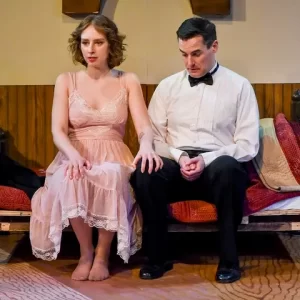
This is a clever script. I especially loved the first act, where the story piques the audience’s imagination with its exploration of all sorts of controversial issues related to what constitutes being human and what constitutes being a robot. Robots might be more efficient: better at making calculations and faster in making decisions and undertaking certain tasks. But what constitutes being human is much more complex—and is ultimately preferred. In addition to having self-consciousness and feeling emotions (such as joy and sadness), being human has to do with the exercise of free will and retaining one’s ability to make choices, especially over one’s own life. Above all, being empathetic is an important quality that robots supposedly don’t possess, that is, when they are built to act on automatic pilot. However, the second act (set two years later) did not excite me as much. Here Čapek posits a very specific dystopian universe once the robots take control. He postulates their collective decision-making and how people are disposed with as cavalierly as was earlier done with robots—who were incinerated should their programming appear to fail. While this is a very creative conjecture about robot autonomy, the story descends into becoming too deus ex machina as time goes on. Yet all this is overshadowed by the brilliant contemplation of what the future may bring, especially if we’re not careful.
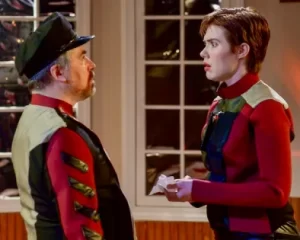
The first thing we notice when we walk into the theatre is the wonderful scenic design by Jeremiah Barr, particularly the floor that makes up the stage, with the letters “R.U.R.” in a green circle in the middle surrounded by a good number of wooden panels of differing textures, arranged in circular sectors like triangular pizza slices. We also see Meghan X. McGrath’s prop design: like the unusually shaped phantasmagoric displays on two walls and the portrait of Silas Rossum over the windows. Then too, there’s an old-fashioned (corded) phone from the 1920s, which creates the premise for one of the first gags in the show: the eighty-pound cordless phone. Robotic-sounding music greets us at the beginning of the first and second acts, and the sound effects of the robots’ ray guns and other mechanical devices are extremely well done, due to sound designer and composer Jonathan Guillen. Liz Cooper’s lighting design works nicely for this production, and costumes by Beth Laske-Miller are appropriate for the 20th century. Especially notable are the Star Trek-like uniforms for the characters of Sulla and Marius, and Alex George’s hairstyle for Sulla is perfect for the role. Fight director/intimacy director Maureen Yasko has done a superb job, particularly regarding close contact in the scene between Sulla and Helena, when Helena does not believe that Sulla could possibly be a robot because she looks much too human.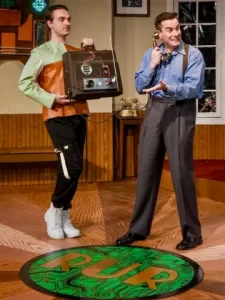
While the human characters in “R.U.R.” are not always the most compelling, Čapek’s prophetic view about the prospects and capabilities of A.I. is what makes the show. At the same time, it is adaptor Bo List who has made this play accessible to a modern audience and has contributed his own touches, such as his humor regarding the meaning behind the abbreviation LOL. So… in the last analysis, the audience is left to ponder whether Čapek was correct in his speculations about how modern autonomous technology can lead to a frightening dystopia. Now it’s your turn to see this production and speculate for yourself!
“R.U.R. (Rossum’s Universal Robots)” is playing through June 15, 2025, at City Lit, 1020 W. Bryn Mawr Avenue, in Chicago, on the second floor of the Edgewater Presbyterian Church.
 General admission tickets – $35
Seniors – $30
Students and Military – $12
Performance schedule:
Fridays and Saturdays – 7:30 p.m.
Sundays – 3:00
Plus two Mondays: June 2nd and 9th at 7:30 p.m.
For more information and to purchase tickets, please visit: https://www.citylit.org/.
To see what others are saying, visit www.theatreinchicago.com, go to Review Round-Up and click at ” R.U.R.(Rossum’s Universal Robots)”.





More Stories
“The Brief Wonderous Life of Oscar Wao” reviewed by Paul Lisnek, Curtain Call Chicago
“The Play That Goes Wrong”
“Carmen” reviewed by Frank Meccia