

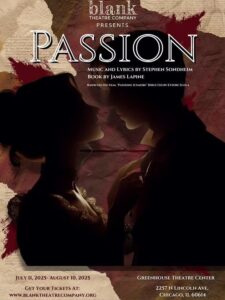
 **** This is not just another typical love story. Stephen Sondheim’s “Passion” , a memorable new production playing at the Greenhouse Theatre Center, has stunning music, intelligent lyrics, and complex, fascinating characters. The romantic score is emotive and lush, capturing the essence of this operatic story of unrequited longing, clandestine affairs and heartbreak. This is a dark and caustic masterpiece.
The year is 1863. Captain Giorgio Bachetti (Evan Bradford) and his lovely paramour Clara (Rachel Guth), express their desires essentially through letters, while he is stationed at a remote military outpost in Italy. Not willing to leave behind a normal life, and a husband and son to be with Giorgio, Clara dooms the relationship.
While Giorgio is at his remote military post, his life is irrevocably changed by the arrival of Fosca (Brittney Brown), the sickly and unattractive (so we are told) cousin of his superior officer, Colonel Ricci (Myles Mattsey). Fosca becomes obsessed with Giorgio and falls desperately and painfully in love with him. Giorgio refutes her advances, but yet cannot stay away from her. He realizes, he must make a choice and decide what kind of love he wants to have in his life. The story reveals how Fosca falls in love with Giorgio. But ultimately, the more important point is how and whether Giorgio is going to fall in love with Fosca. Her relentless stalking finally has its effect on Giorgio. There are duels and deaths and lots of letters.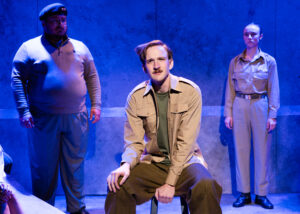
This 19th century Italian setting and story screamed out “opera.” Yet, Sondheim resisted this operatic notion as per in an annotation in his volume 2 of lyrics, “I chose to think of the show as one long rhapsodic love song…” And there are many lovely songs in this production, such as “Loving You” and “I Wish I Could Forget You,” where Fosca insists Giorgio write her a love letter that she dictates to him. Mr. Sondheim does not write generic set-pieces, but highly specific character pieces that delve beneath the surface to illuminate a specific individual’s dilemmas, desires and illusions. And with great emotional pull. This is the magic of Sondheim.
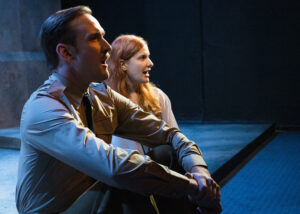
Passion is just plain encaptivating. Unabashedly emotional, and yes, passionate. Under the skilled direction of Danny Kapinos, this play comes across as a throbbing fever dream, out of which painful and startling clarity emerge. Brittney Brown, Evan Bradford and Rachel Guth, the three main characters, not only can sing very challenging material with notoriously complex lyrics, they had the acting skills to match. They show us opposing principles of light and dark, order and chaos. Each had the commanding ability to make smooth transitions over wide vocal ranges, while portraying the emotional complexities of their individual characters. We are drawn into their dark inner worlds, at times unsettling and even disturbing. Bradford makes the handsome Giorgio strong and vulnerable. We see him morph from a lovestruck innocent into a convincing world-weary sufferer. Brown is particularly impressive in her ability to physically embody her character, especially her facial expressions and body language. There is deep inner beauty to her as she makes her character relatable despite her extreme actions. By sheer force under the spell of these strong actors, we are reminded of those difficult moments in life, which we’ve all had, where we were obsessed, possessed, or out of control.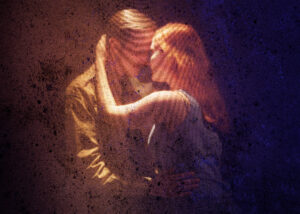
The supporting cast provided a rich backdrop of rather loud and boisterous soldiers, a conniving Austrian count, and the somewhat puzzling Doctor Tambourri (Kingsley Day), who urges Giorgio to acquiesce to Fosca’s demands and then tries to save him from her clutches.
The staging was simple (Hayley E. Wallenfeldt), beautifully lit (Seojung Jang), and quite effective. They addressed the lack of space for such an elaborate production with muted, translucent panels towering over a minimal set. The lighting behind the panels provides glimpses of the world beyond the set. In some cases, illuminated projections tell another story than the one we are watching. Finally, the chamber orchestrations by Evelyn Ryan plays an especially important role in lending the music (under the direction of Eric Kaplan) the richness and texture to bring forward Sondheim’s sweeping melodic lines.
The contemporary women’s costumes (Cindy Moon) lacked 19th century period exactness, perhaps suggesting the 21st century universality of the themes presented. The male ensemble’s military uniforms evoked the period and are regimented, fitted, sharp and handsome.
Every aspect of the show is beautifully realized in this 1 hour and 45-minute production with no intermission. It is easy to see this ambitious show as a series of big obstacles to overcome. The plot is a bit unlikely, and at moments creepy. The main character is overbearing and supposedly unattractive. The music (and story) is opera-like but lacking the easily remembered arias. Much of the action consists of reading or singing aloud the letters. Director Danny Kapinos has done right by Passion thanks to fine staging and talented actors who can sing.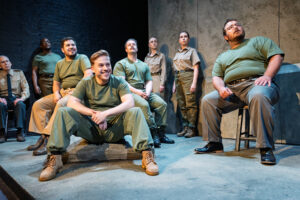
For any Sondheim fan, this production is a must; for anyone who has not seen Passion before, it can be a challenging and ultimately rewarding revelation.
Listing Information:
Blank Theatre, a 501 (c) non-profit organization, presents Passion, music and lyrics by Stephen Sondheim and book by James Lapine. This production made possible by Michael and Mona Heath.
 One hour, forty-five minutes without intermission.
Through August 10, 2025
Thursdays, Fridays and Saturdays at 7:30 pm, Sundays at 3:00 pm
Greenhouse Theatre Center
2257 N. Lincoln Avenue
Chicago, IL 60614
Tickets $41.00 general (includes facility and convenience fees), $26.00 students
Website: www.blanktheatrecompany.org
To see what others are saying, visit www.theatreinchicago.com, go to Review Round-Up and click at “Passion”.


More Stories
“The Jackie Wilson Story” 2026/505h Anniversary reviewed by Julia W. Rath
“The Drowsy Chaperone” reviewed by Al Bresloff and another by Paul Lisnek ( Curtain Call Chicago)
“White Rooster” Reviews by Al Bresloff and a second by Paul Lisnek Curtain Call Chicago