

***** Medea is a figure from classical mythology who has been the subject of endless fascination ever since the tragedian Euripides innovated the notion that she slew her children to get revenge on her husband for abandoning her. Luigi Cherubini’s opera, which debuted in 1797 and has a libretto by François-Benoît Hoffman that adapts a play by Pierre Corneille, was not the last word on her, but in terms of the dramatic power of its music, it might never be surpassed. The new co-production at the Lyric Opera, directed by Sir David McVicar and conducted by Lyric Music Director Enrique Mazzola, is a very straightforward telling of the story save for the end, but one that captures enormous emotions and a riveting performance by soprano Sondra Radvanovsky in the titular role.
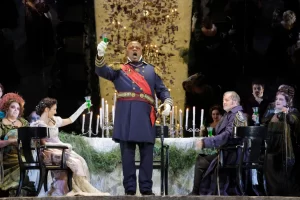
We open as Glauce (soprano Elena Villalón), the princess of Corinth, prepares for her wedding to the hero Giasone (tenor Matthew Polenzani), Medea’s ex. Glauce is under a great deal of stress. It seems that Giasone has convinced himself and the Corinthians that Medea, who gained universal scorn for using her magic to betray her father and brother for Giasone’s benefit, used her magic to seduce him, and now that he wishes to leave her and marry Glauce, that must mean her power has inexplicably broken. Glauce is unsure of this, both in the sense that she’s uncertain that Medea has really been defeated and that marrying Giasone is right, but she, too, possesses a great capacity for self-delusion, and over the course of her musings, she manages to force her fretful music into the happy mincing more typical of a wedding. Her father, King Creonte (bass-baritone Alfred Walker), proclaims with much fanfare that Giasone shall be welcomed into their family and the hated witch driven from their land, and he privately reassures Giasone that his children have been taken to a secret place, not to protect them from their mother, but from the Corinthian mob.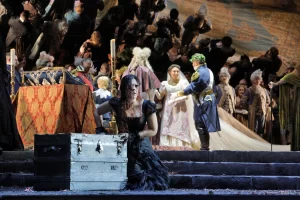
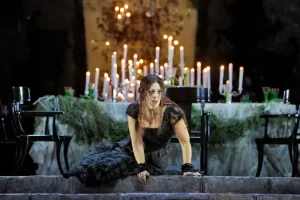
Of course, things aren’t that simple. During the feasting the night before the ceremony, Medea slithers in on her belly, lamenting that Giasone has forsaken her after she sacrificed everything for him and that her children will be taught to hate her. In a duet that is more like a duel, Giasone tells Medea that he is never taking her back no matter how much she complains. But recognizing that they’ve been unfair to her, Giasone and Creonte grant Medea one reprieve: that her exile will be delayed for twenty-four hours, and that she will be permitted to see her children one last time. This proves disastrous.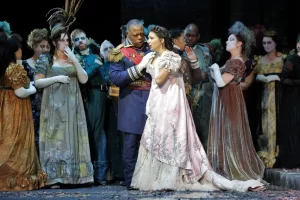
Radvanovsky not only has a powerful lyric voice that captures Medea’s anguish and vulnerability, but she’s also able to project it while spending much of the run-time planking or otherwise in odd positions. McVicar makes bold choices in his directing, and I’ve had mixed feelings about his other productions that made their way to Chicago, but personally, I enjoyed Medea’s physicality being so different from any other character in the play or what we would normally expect from a person. She’s strange and off-putting, she takes up space, and she rarely meets other people on their own levels. In stark contrast, Polenzani’s Giasone is a hard man with a sophisticated deportment and a commanding presence. We can see in him the man who managed all the other egotistical Greek heroes on the Argo and who Creonte would naturally choose as his successor. Another highlight is mezzo-soprano Zoie Reams in the role of Neris, Medea’s sole remaining friend and the person who seems to actually do most of the main couple’s child-rearing. Neris has a mournful but soothing voice when she invites Medea to share her sorrow, which has the effect of calming Medea down but also gets her scheming again. It’s not the moment we see Medea resolve to carry out her last act of desperation, but it’s the turning point in the opera when she re-awakens.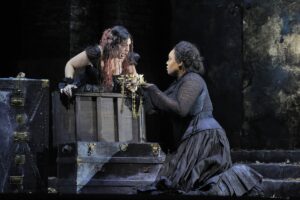
Cherubini’s overture is a whole drama in itself, and in this score, we can hear the dawning of the Age of Romanticism. To match the sound, McVicar, who doubled as the set designer, has placed the action within a massive palace with solid bronze doors that clearly shut Medea out of the ancient world’s civilization. When the doors are open, most of the stage is taken up by a steeply angled mirror that provides a top-down view of the stage, effectively allowing costume designer Doey Lüthi’s First French Republic-era finery to serve as the set. I interpreted this as a reference to Medea being descended from the sun god Helios, as it provides us with his view, but it also just looks cool and ensures none of the set dressing goes to waste. If you’re familiar with the subject matter, Cherubini’s take won’t necessarily cause you to see Medea completely differently, but for sheer grandeur, this is a quite filling production.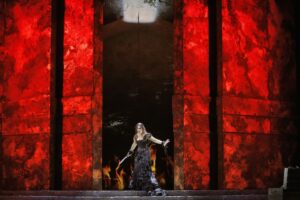
 Medea will continue at the Lyric Opera House, 20 N Upper Wacker Drive, Chicago, thru October 26, with the following showtimes:
October 17: 7:00 pm
October 20: 7:00 pm
 October 23: 2:00 pm
October 26: 2:00 pm
Running time is two hours and forty-five minutes with one intermission.
There is also a thirty-minute preview talk an hour before the show.
Performances are in Italian with English supertitles.
The Lyric offers parking deals with Poetry Garage at 201 W Madison St. if inquired about in advance. Tickets start at $47; to order, visit LyricOpera.org or call 321-827-5600.
To see what others are saying, visit www.theatreinchicago.com, go to Review Round-Up and click at “Medea.”



More Stories
“In Pursuit Of”
“The Brief Wonderous Life of Oscar Wao” reviewed by Paul Lisnek, Curtain Call Chicago
“The Play That Goes Wrong”