
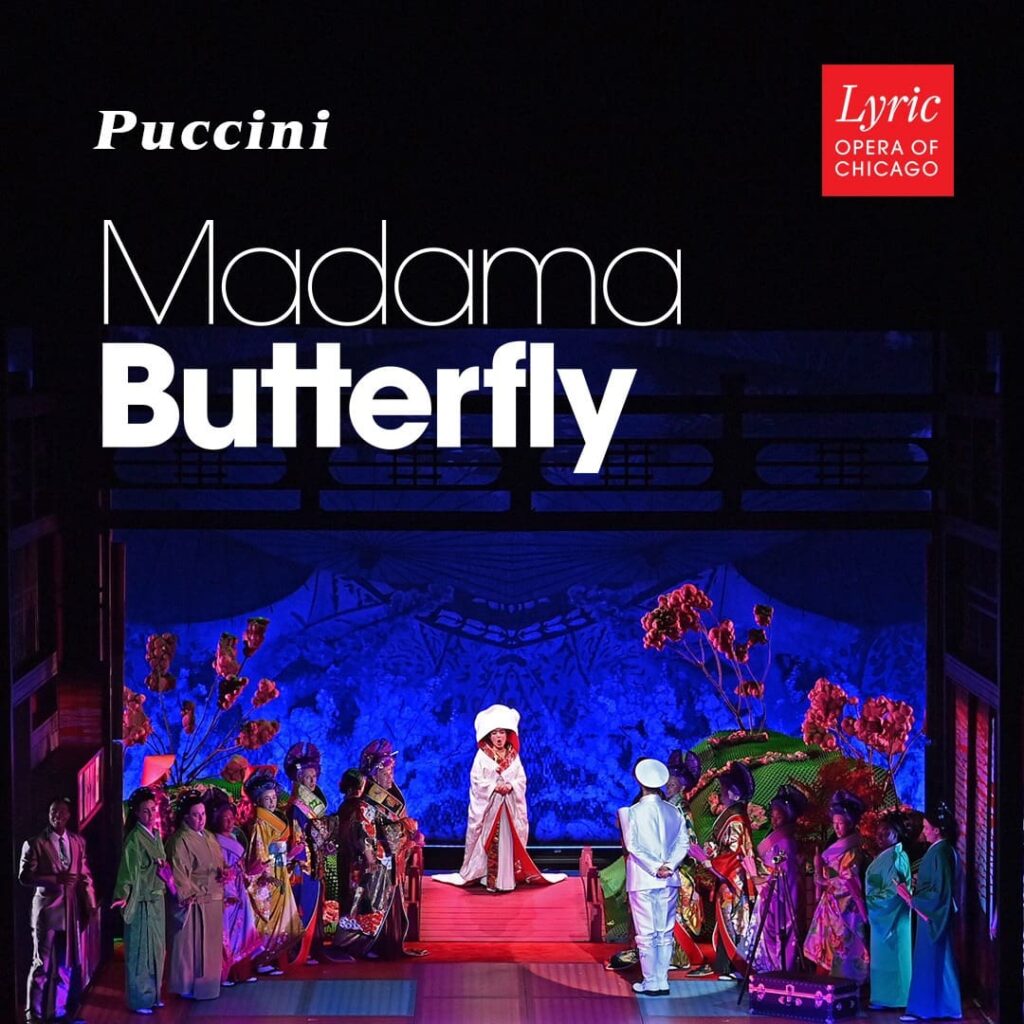
 **** An opera season that opens with Medea in the fall and features Madama Butterfly in the spring might be interpreted as setting up a certain narrative, but the Lyric Opera’s new-to-Chicago production of Madama Butterfly, directed by Chief Artistic Officer Matthew Ozawa, has plenty of meta-narrative of its own. A reimagining of the story that is meant to frame it more overtly as a Western fantasy, this production is comparable to David Henry Hwang’s 1988 M. Butterfly, which expressed dissatisfaction with the portrayal of Asian women as tragically trampled upon. But while Hwang’s reinterpretation emphasized that the Butterfly-character is a skilled manipulator who originally seduced a foreigner for pragmatic reasons regardless of what genuine feelings they developed later, Ozawa’s concept goes much further, presenting the titular Butterfly as not only a geisha’s persona, but as an entirely fictional character in an edgy video game. It’s a heavy layer to add for people who may be experiencing the story for the first time, particularly as it seems to veer into the territory of chatbot sentience in the last act, but it’s an excellent chance to hear Giacomo Puccini’s music conducted by Domingo Hindoyan and see a bold, beautiful design by women of Japanese heritage.
We first see the man who takes on the role of Benjamin Franklin Pinkerton (tenor Evan LeRoy Johnson) when he comes home to his apartment after what was apparently a draining day and just about collapses into his armchair, donning a VR headset and booting up a new save file of his favorite romance game, in which he plays the role of a nineteenth century American naval officer stationed in Japan. The marriage-broker Goro (tenor Rodell Rosel) gives a tutorial of the house, which Pinkerton thinks looks ephemeral, and the cleaning lady, Suzuki (mezzo Nozomi Kato), chimes in with some dialogue Pinkerton attempts to skip. However, he cheers up when his friend, Sharpless (baritone Zachary Nelson) declares the girl he’s arranged to marry, Cio-Cio-San (soprano Karah Son), is one her way with the wedding procession. And although the large and very ornately dressed chorus overloads the game’s memory, causing a rendering error in the lighting and character animations, and Cio-Cio-San suffers a pathing error when she walks too close to Pinkerton, he is very much smitten. She asks Pinkerton how old he wants her to be, he frantically pushes the up arrow when Goro suggests ten, she settles on fifteen, and after he dashingly saves her from her angry relatives, she acquaints him with her backstory and inventory. Goro prompts Pinkerton for a microtransaction to get the full version of this all at once, but he can spend what he wants and quit the relationship at any time.
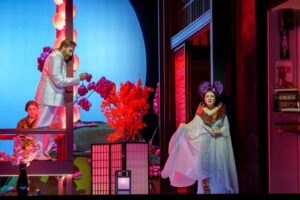
A game that casts the player as an adult seducing a teenager is certainly creepy and payment processors would likely demand that it be removed from e-stores, but an interesting aspect of Ozawa’s production is that, if Cio-Cio-San is not real, then Pinkerton really isn’t hurting anyone, and that Cio-Cio-San’s need for his coin and devotion is actually the game exploiting him. This is even present in the second act, when Pinkerton isn’t playing the game because his real-life girlfriend hates it. He can only stare yearningly at the set from outside it, causing Cio-Cio-San’s famous aria “Un bel dì, vedremo” to make her look like a purple-haired gacha game idol sending a whining notification to her player that he’s missed several of their son’s special events and she’s starving because he hasn’t opened the app recently. However, during most of the third act, Pinkerton isn’t present onstage at all, and his now-wife, Kate (mezzo Alexis Peart), enters the game to tell Cio-Cio-San it’s over and that she’s taking Pinkerton and Cio-Cio-San’s child. Is this suicide-baiting a chatbot? Pursuing one of the game’s storylines to its conclusion so her husband can have closure? Joining in his sadistic fantasy? The audience has to draw their own conclusions.
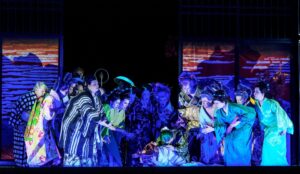
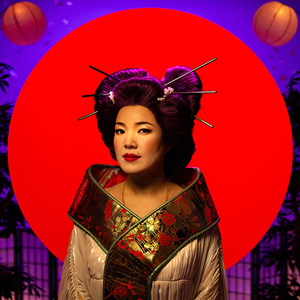
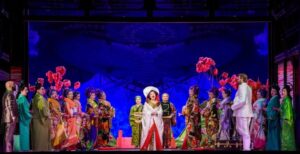
Son and Johnson are amazing performers, with Son’s power giving her character dynamism and Johnson’s sweetness playing up Pinkerton’s naivete. But the design team are also stars in Ozawa’s production. The collective dots designed the set, in which colored lights and collapsable slats comprise the pocket dimension of fantasy-Nagasaki within Pinkerton’s grey-toned apartment. A lot of assistance in this regard also comes from the boldly dramatic tones and dazzling special effects of lighting designer Yuki Nakase Link. Costume designer Maiko Matsushima decks out the chorus in designs that are accurate to the sort of games with huge casts of characters who all have extremely complicated clothing, hair, and make-up, with Pinkerton, Cio-Cio-San, and Mrs. Pinkerton’s costumes being especially heavy on symbolism and wish-fulfillment.
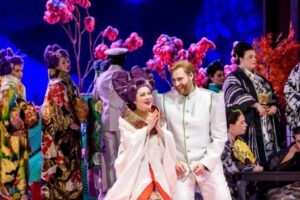
A production like this is taking a risk. People who enjoy a straight telling of Madama Butterfly may not like it or the artists’ angst over whether opera goers can tell the difference between reality and fiction, and attempts to challenge the text could be lost on people who don’t already know it or its history. However, I do think that there is a basis in the libretto for some of these choices, albeit not intentionally on Puccini’s part, and it’s obviously a project that aroused strong feelings and a lot of thought from creators who know what they’re doing. As music and spectacle, it’s excellent, and the framing device will allow it to stick around in the viewer’s head for a long time.
Madama Butterfly will continue at the Lyric Opera House, 20 N Upper Wacker Drive, Chicago, thru April 12th with the following showtimes:
 March 22: 2:00 pm
March 25: 2:00 pm
March 28: 7:30 pm
March 31: 7:00 pm
April 6: 7:00 pm
April 9: 2:00 pm
April 12: 2:00 pm
Running time is two hours and fifty-five minutes with one intermission. There is also a thirty-minute preview talk an hour before the show.
Performances are in Italian with English supertitles.
The Lyric offers parking deals with Poetry Garage at 201 W Madison St. if inquired about in advance. Tickets start at $60; to order, visit LyricOpera.org or call 321-827-5600.
To see what others are saying, visit www.theatreinchicago.com, go to Review Round-Up and click at “Madama Butterfly.”


More Stories
“Best Actress”
“The Jackie Wilson Story” 2026 edition (50th Anniversary) reviewed by Julia W. Rath
“The Drowsy Chaperone” reviewed by Al Bresloff and another by Paul Lisnek ( Curtain Call Chicago)