

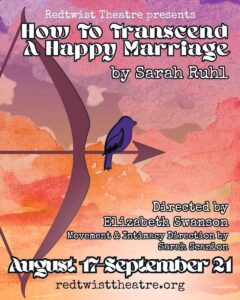
 *** Sarah Ruhl’s play “How to Transcend a Happy Marriage” is brilliant and thought-provoking, but basically bipolar. The comedy in the first act is hilarious, yet very genuine with its easy, sexually-tinged banter, and the actors’ timing is impeccable! In such an intimate theatre, like Redtwist (that holds a maximum of 29 people), you feel as if you’ve intruded on someone’s living room and invaded their personal space. And now you’re somehow a part of it all and could just walk in and add to their conversation. The first act is so raw, funny, and perceptive that it could have gotten six stars.* However, the second act is somewhat of a disappointment, that is, when impulsiveness dissolves into sober reflection and when the disconnect between fantasy and reality becomes distracting.
Directed by Elizabeth Swanson, the play begins when a young woman named Deborah, who calls herself Pip (Shaina Toledo), is sitting on a stoop. She plays with a young goat (I adored the excellent puppetry) but then kills it for food. In the next scene, we see two couples in the living room of a private home, where Jane (Monique Marshaun) and her husband Michael (Joe Zarrow) are hosting their best friends Georgette a/k/a George (Tatiana Pavela) and Paul (Carlos Treviño). Their conversation turns to Pip, a strange woman who was once a vegan but now eats meat, and the talk takes off in all sorts of directions. For example, they ask each other whether guilt about animal sacrifice would cause people to become vegan. And why would someone who was once vegan suddenly turn to eating animals? There is also some discussion about the fact that Pip has two male lovers. Considering that both couples have been raised with the ideal of monogamy, they ask each other if having a threesome could be a good thing or whether it’s just something unusual and different and possibly worthy of exploration. Speculation abounds! So in order to find out more about Pip (and especially more about her sex life), the couples decide to invite her and her lovers Freddie (William Delforge) and David (Joshua Servantez) to a New Year’s Eve party in their home. And the three of them accept the invitation.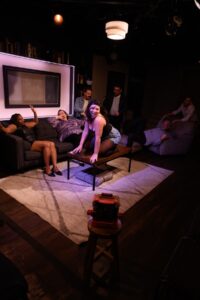
Next we see the party itself and the incredible interaction among the entire group, practically from the moment that the evening starts. Freddie, it seems, has provided a container of hash brownies to supplement the alcohol being served. David is enamored of the Greek mathematician Pythagoras, and not just because of his triangle, which the others heavily reference. Above all, Pip puts all of her ideas about love and sex on the table, literally and figuratively. The crowd is suddenly transfixed. This entire segment is so incredibly funny, and the sequence with the karaoke machine is unabashedly so! The final character in the show is Jenna (Elonie Quick), Michael and Jane’s teenage daughter, who unexpectedly returns home early from her own New Year’s Eve celebration and accidentally encroaches on her parents’ good time. The seeming role reversal creates an important tension in the plot, and this is done very well.
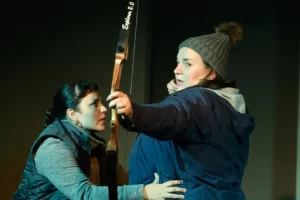
The second act, however, is the depressive counterpart of the first act’s mania. Pip and George go into the forest to hunt for deer. George has never gone hunting before, and Pip mentors her on how to shoot with a bow and arrow. At the same time, the two of them explore a lesbian relationship. Spoiler Alert: This is when George accidentally shoots a family dog instead of a deer–and the animal supposedly dies while their owners’ children are watching (or so we are told second-hand). I realize that the playwright was making the point that some animals are valued more than others in our culture (in this case, a dog versus a deer). So the questions become: When is an animal just an animal? Why does it matter if an animal is being loved and cared for? And does it make a difference if an animal is being eaten for food or not? Although this is a theme that carries over from the first act, the feel of the play has now shifted radically. Unlike the characters living in the moment, now everyone is busy trying to rationalize their behavior or figure out an explanation for the way they feel or the way that have chosen to live out their lives. They become preoccupied with the many varied meanings about what love is and what being in love might mean—and how this might relate to their sexuality.
Although the ebullience of the play fizzled out for me once the dog was killed (I couldn’t stop thinking about Kristi Noem and her dog), this was not the point at which the story starts to fall apart, and it never really makes a comeback. Double spoiler alert: This occurs when we are told that Pip has suddenly turned into a bird. No, we don’t see it actually happen on stage, but supposedly that’s how she escapes a prison cell. Now any sense of realism vaporizes entirely. Pip’s absence—and later her return as an invisible bird laying invisible eggs—cannot be any more insipid. In the face of several irrational situations and unnecessary plot twists, the noticably fresh and wonderful acting begins to fade, and we come to realize that it’s not the actors’ fault but that of the script! This turn of events made me reconsider what the play meant in its entirety, with certain aspects suddenly not so funny in hindsight. For example, although it’s amusing to see Freddie and David make their return to try to find the missing Pip, we begin to wonder if they knew from the beginning that she’s actually a bird who has taken on human form.
I loved the scenic design by Rose Johnson with the living room/multipurpose set, which works perfectly in the first act. The problem, however, is that in the second act, the audience has to imagine the forest and the outdoors, followed by imagining a jail cell, and the like. In other words, the set no longer depicted the locale. The lighting by Eric Watkins is great throughout, particularly in combination with the work of prop designer Paige Bosler. For instance, the LED light surrounding the picture frame changes color to represent a different day and time in the same room. Similarly, leaving one light fixture on (like a standing lamp) between scenes serves a similar purpose. Costumes by Marquecia Jordan are contemporary and fit the theme. I especially liked the clothing worn by Pip, in keeping with her feisty character. And Harper Justus’s sound design works well for this small theatre. Most of all, I’d like to credit Movement and Intimacy Director Sarah Scanlon, who has done a fantastic job with the cast. Since the show depicts love in all sorts of forms and variations, there is a lot of close contact among the actors, particularly a good deal of deep kissing and physicality.
In sum, the first half is a masterpiece in scriptwriting, acting, and stagecraft. But unfortunately, too many threads are brought up during the second half that are not sufficiently resolved. This is probably why Ruhl has George break down the fourth wall and address the audience directly with many of her reflections on life. George takes great pains to address the meaning of transcending a happy marriage and does so in a very pleasant and casual style. But the insertion of unreality only serves to dilute the larger message: that relationships may not be so simple and neither are our wants and desires. Does it matter whether these have to do with our animal nature? And if so, when and how should we act on them, or not? Basically, the second act is much like the proverbial hangover after a night of drinking. The aftereffects are painful for the characters and sometimes too painful for anyone to consider.
“How to Transcend a Happy Marriage” is playing through September 21, 2025, at Redtwist Theatre, 1044 W. Bryn Mawr Avenue, Chicago.
 Tickets: discounts available for seniors, students and industry professionals and pay-what-you-can for all Friday performances.
Performance Schedule:
Thursdays, Fridays, and Saturdays at 7:30 p.m.
Sundays at 3:30 p.m.
There will be two understudy performances on Sunday, Aug. 31 at 3:30 p.m. and Thursday, Sept. 11 at 7:30 p.m.
For more information, visit https://www.redtwisttheatre.org/how-to-transcend-a-happy-marriage.
To purchase tickets, visit https://redtwisttheatre.thundertix.com/events/249857 or call 773-728-7529 or email reserve@redtwist.org.
Total running time of two hours including a 15-minute intermission.
*There was one woman in the first row of the audience who was laughing so hard throughout the first act that she put her hand to her mouth to laugh into it so that she wouldn’t be a distraction to the actors. Her hand rarely moved!
To see what others are saying, visit www.theatreinchicago.com, go to Review Round-Up and click at “How To Transcend a Happy Marriage”.





More Stories
“The Brief Wonderous Life of Oscar Wao” reviewed by Paul Lisnek, Curtain Call Chicago
“The Play That Goes Wrong”
“Carmen” reviewed by Frank Meccia