
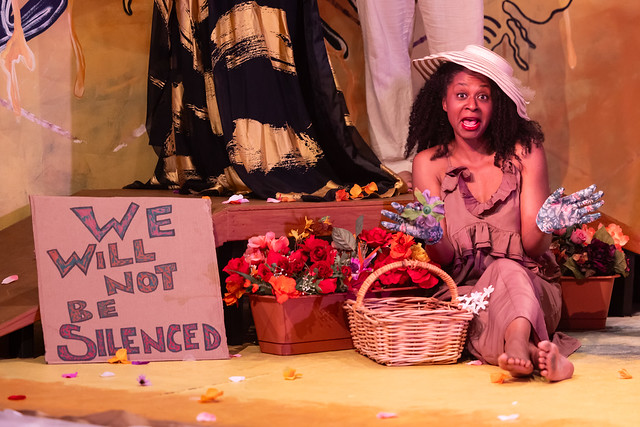
 **** This is not a good time for honey bees. As the country takes a sharp right turn and the MAGA GOP fuels their politically-expedient culture wars, this timely and brave new production, Honeypot: Black Southern Women Who Love Women — an adaption of the groundbreaking creative nonfiction work by Northwestern dean of the School of Communication, E. Patrick Johnson — emerges to exercise a moment of essential free speech.
This scholarly and artistic oral history, adapted for the stage by D. Soyini Madison, professor emerita at Northwestern and co-directed by Fleetwood-Jourdain Theatre artistic director Tim Rhoze and Madison, takes a unique approach to presenting and preserving the lives of Black queer women who were raised in the American South. We are thrust into a dazzling, unfamiliar world at the intersection of racial, gender, sexual and class oppression within the context of southern history. That’s more than enough to twist someone’s panties in Washington.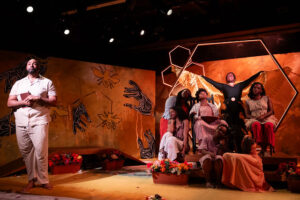
At a time when our government works to eliminate D.E.I. initiatives, to silence free speech on campuses, and to ban books and performances that address topics addressed in this production, Johnson cannot risk losing these voices and stories of a historically marginalized group. In a recent interview after the publication of his book of the same title and upon which this play is based, Johnson spoke up defiantly and stated, “The more these forces try to silence us, the more vocal we must become.”
Honeypot begins in contemporary reality, and its opening is set in present-day Chicago. Using a fictional framework to recount real-life oral histories, Johnson presents a world where he, as Dr. EPJ (Jelani Julyus), is awakened one morning by the trickster Miss B, the Queen Bee of the Hive (Tuesdai B. Perry), informing him that he has been chosen to collect and share stories of her sisters – all Black, Southern, same-gender-loving women.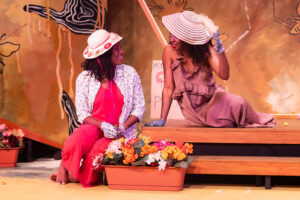
With little explanation, Miss B whisks the reluctant Dr. EPJ away from his home and husband to the world of Hymen (of course) where she serves as his tour guide. The production features a talented cast of six ensemble actors (Sadie Stickler, Angelena Browne, Jasmine Robertson, Kaitlyn Fields, Nehanda Julot, Santina Juma) performing multiple roles. The women whom they depict come from all walks of life and recount their experiences on topics ranging from coming out and falling in love to mother/daughter relationships, religion, and political activism. As Dr. EPJ hears these stories, he must grapple with his privilege as a man and as an academic.
Here, the women are reimagined as denizens of a beehive, each going about their lives as members of a huge, diverse community. The set design (Rhoze and Kotryna L. Hilko) is awash in honey-colored, sponge-painted walls with large bees and hands dripping and oozing thick honey from fingers and honeycomb crevasses (Sholo Beverly). There is a neon-lit wooden hexagon framing the center stage as if we are looking into and immersed in a beehive. The design of the sets, the expert lighting (Josiah Croegaert), the sound and musical selections, including Bob Marley’s “Get Up, Stand Up” (Ethan Korvne), and the wardrobe selections (Hilko) brought this play to life and transported the audience into a fictionalized world. As implausible as this may seem, it works. The metaphor of the hive, its bees, and the sweet honey they create refers to the life of bees, essentially female-dominated communities with an occasional “drone” (a man) on an as-need-be-basis only. In my mind, the hive draws a parallel with Black women who toiled, enslaved in the fields alongside men, and, too, tended to the domestic demands of family life.
Between each story, Miss B punctuates the narratives with her all-knowing, queenly bee-ing as Dr. EPJ must undergo, withstand and endure experiences he has not lived. This comedic relief displays artistic and literary skill, but the interviewed women are the real stars – women whose world Dr. EPJ can never be a part of. It is within those women’s testimonials, we must deal with racism, violence, piety, betrayal, abuse, incest, love, activism and aging. Their life stories get to the essential point more so than Dr. EPJ’s character development and his personal growth as he gains insights into patriarchy and the many challenges these women face.
All of these stories are powerful in their own way and for different reasons. Some of the stories are traumatic. Many stories are joyous, celebrating the people, the work, and the faiths that made the women who they are. The women are frank and sometimes explicit about their lives and loves. There is much to treasure in these stories. We see these women are made to face an infuriating paradox of blessings and shaming, grace and cruelty, provisionally opened arms and persistently closed doors. This production pushes back against the dominant narrative that queerness of all kinds is incompatible with Christianity and Blackness, instead showing that there is a rich history of stories about Black queer Christian people. Ultimately, Honeypot presents a powerful story of hope, resilience and love of all kinds in spite of the lack of understanding, rejection, abuse and ignorance these women endured. The fact that they came out on the other side of these experiences pretty much intact is a real testament to their fortitude.
Combining the vulnerable and intimate narratives with original music, vocal power, seductive choreography (Marsae Lynn Mitchell), prose, and poetry, this show is engaging throughout and is a moving experience. It reveals the complexity of personal identity, while offering a creative literary technique to represent these lives in a rich and dynamic way. At times devastating and always gripping, Honeypot is both innovative and educational as these hidden women have a moment of needed visibility. And it’s the warmth and honesty of these women that leave a lasting impression and endows this show with a whisper of something authentically new.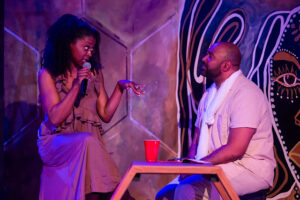
At long last, these breathtakingly rich life histories show how Black female sexuality is and always has been an integral part of the patchwork quilt that is Southern culture. These stories are worth documenting and studying, and we deserve to see this work done with exceptional care by Rhoze and Madison. We would do well to recall today, such acts of self-representation are nothing short of revolutionary.
This is a co-production of Fleetwood-Jourdain Theatre and Northwestern University’s Wirtz Center for the Performing Arts.
Performance Details:
Run Dates: Saturdays at 7 PM and Sundays at 3 PM, through June 1, 2025
Location: Fleetwood-Jourdain Theatre at the Noyes Cultural Arts Center, 927 Noyes Street, Evanston
Tickets: $32; Students $10 — On sale now at www.fjtheatre.com or call 847-866-5914
To see what others are saying, visit www.theatreinchicago.com, go to Review Round-Up and click at “Honeypot: Black Southern Women Who Love Women”.





More Stories
“The Brief Wonderous Life of Oscar Wao” reviewed by Paul Lisnek, Curtain Call Chicago
“The Play That Goes Wrong”
“Carmen” reviewed by Frank Meccia