

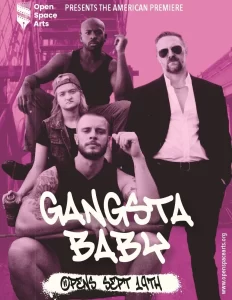
 ** “Gangsta Baby”, written by Cameron Raasdal-Munro and skillfully directed by Rikki Beadle-Blair, is in its first U.S. world premiere, having played previously at the Hope Theatre, in London. The story centers on an abusive relationship between a working-class father and son, where Raasdal-Munro plays the lead in the character of Junior, a queer sex worker who has been making his own living in the working-class city of Hastings. Life goes on as usual until his father Senior (Josh Odor) returns to Britain from a job in Dubai and reintroduces himself to his son. Senior is a gangster, who would like others to think that he’s reformed from his criminal activity and is merely in the debt collection business. But now Senior wants to impose his will on his son and turn him into a person he’s not, that is, he wants Junior to go to college and become more successful than his father by rising into the middle class. Senior is a closeted gay man, and not only is he very upset that Junior has become a sex worker, but he is repulsed by Junior’s flaunting his sexual openness. The father uses the word queer to describe his son using the most negative nuance possible, for he doesn’t want Junior to appear effeminate in any way. Basically, the two men are of different generations: The father has to prove to himself that he’s being macho (in the sense of being a tough guy and beating up on people) so that he can use this as a veil to hide his gayness. His son, however, just wants to live his life authentically and express his sexual orientation openly.
There is a double-meaning to the title “Gangsta Baby.” On one level, Junior is the son of a gangster, who treats him as a child and wants to mold him into something he is not. But on another level, Junior’s close friend and half-brother or stepbrother Pete (Jensen Knudsen, who is a marvelous actor) is a transman who goes by the name Gangsta Baby. A street artist with a spray can often in hand, Pete constantly provides some measure of comfort and support when Junior shares his troubles with him. But it’s never clear whether Pete calls himself Gangsta Baby because of any possible family connection with Senior. Pete is in love with Junior in terms of real affection, but Junior is too busy with his sex work to notice. Yet this reality does not escape Senior, who wants to destroy Pete both because he is trans but also because he desperately craves Junior’s attention but doesn’t want to share this with anyone. Another person on Senior’s radar screen is Mitch (Bryan Nicholas Carter), Junior’s landlord. The show starts out with Junior providing sexual favors to Mitch in lieu of money he doesn’t have. And in the “Oh, what a tangled web we weave” scenario, Senior is Mitch’s debt collector. So you can guess the outcome when Mitch is not forthcoming with paying up his money to the mob—and Senior doesn’t get his cut.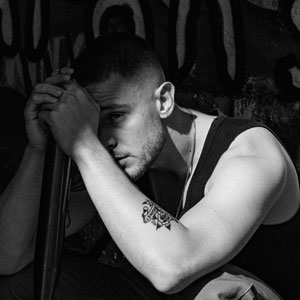
This is a sexually explicit and violent show about crime, drugs, homophobia, and queerness that’s close-up and personal in a 31-seat theatre. Get ready to hear heavy Cockney accents, all sorts of sexual and scatological terms, and a barrage of obscenities. I will also claim ignorance about some of the uniquely British words being batted about in the mix. Moreover, be prepared for a story that’s not entirely linear, and this is where the choppiness sets in. Sometimes we see characters who were supposed to be dead (like Pete) suddenly come alive in a future scene and, in Mitch’s case, he comes alive only to become dead again. I couldn’t figure out if the intervening was a dream sequence or in someone’s imagination—or perhaps this person was meant to be a different character entirely. I also wondered whether the hanging towards the end of the show was meant to be some sort of retribution on a higher plane of existence. There is a lot for the audience to take in and to imagine, and too many portions are unclear.
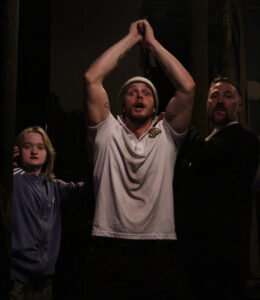
I liked Phoebe Hugget’s set design with David Flores’ graffiti on the walls, with one wall having the name Gangsta Baby written in pink on blue as a reference to Pete being transgender. The back of the front door is painted with a city scene, featuring a man sitting on a curb. I liked the inclusion of the functioning restroom into the play as well as real spray cans of paint, thanks to prop designer Alex Tuscanes, who also supplied the guns, knives, liquor bottles, and drags. Lighting design by Lex Newman is perfect for this show! Dialect coach Jason A. Fleece has done a nice job imparting the appropriate accents to all of the characters. Costume design by Jade Andrews works well throughout: The blood-soaked garments tell their own story when we don’t see the result of gunshots or stabbings as they happen in real time. Sound design by Zach Stinnett is accomplished well, especially in coordination with the lights whenever there is some sort of killing. I definitely want to make a shoutout to intimacy coordinator Christa Retka, considering all the close sexual contact in this production. Plus R&D Choreography did a bang-up job with the violence design, which occurs often and is plausibly well done particularly in the final fight between father and son. Finally, I really enjoyed the exercise segment just before the performance starts when we see Raasdal-Munro flex his strong muscles and practice his boxing jabs: We observe him pounding on a tall floor-to-ceiling post in the middle of the room, while seeing his finely crafted tattoos when he does his pushups. What great “eye candy” for all!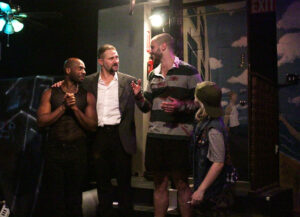
While the directing and acting are excellent and the role of Junior is so incredibly well played by Raasdal-Munro in this semi-autobiographical story, the show is nevertheless a very difficult one to watch. It’s hard to witness people being tormented in all sorts of ways, which include threats of death and physical harm, not to mention actual harm, including suicide pacts and shootings. The first half hour seemed like a full hour (when I looked at my watch), and after that I found myself looking down at it every ten minutes. While the performance held my interest (if not also my astonishment from time to time), some amount of streamlining is in order. A good amount of verbiage could be easily cut out (much of which might not have been all that comprehensible to an American audience in the first place). Plus the simulated sex scenes need not be so graphic. Perhaps most importantly, the additional characters seemed superfluous. Sticking to the basic four (Junior, Senior, Pete, and Mitch) would have shortened and sharpened the script.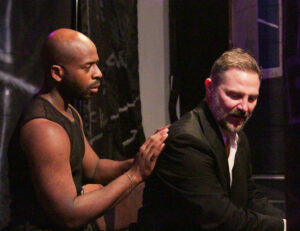
Now a small comment about the venue: A sturdy railing would be helpful when ascending or descending the three steps between ground level and the theatre. Grabbing someone else’s sturdy arm (when necessary) should not have to be an option.
“Gangsta Baby” runs through October 19th , at Open Space Arts, 1411 W. Wilson Avenue, in Chicago.
 General admission tickets: $30.00
Students and seniors: $25.00
Performance schedule:
Fridays and Saturdays at 7:30 p.m.
Sundays at 3:00 p.m.
Exteded
For more information and to purchase tickets, visit https://openspacearts.org/.
Note: The program contains an advisory. “This production includes sexual content, non-consensual acts, physical violence, flashing lights, and non-toxic theatrical haze.”
To see what others are saying, visit www.theatreinchicago.com, go to Review Round-Up and click at “Gangsta Baby”.




More Stories
“In Pursuit Of”
“The Brief Wonderous Life of Oscar Wao” reviewed by Paul Lisnek, Curtain Call Chicago
“The Play That Goes Wrong”