
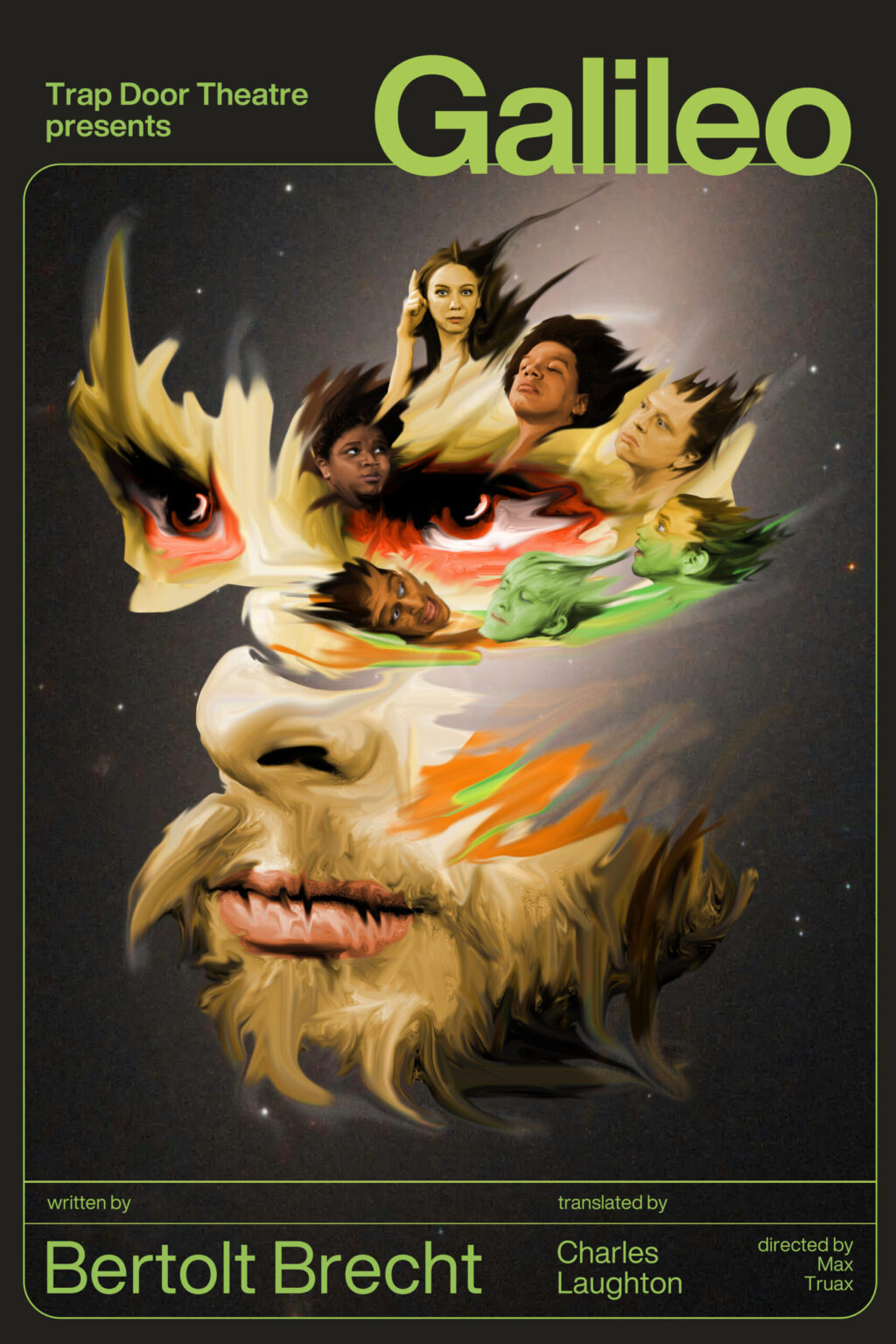
 ***** You might think that if you know who Galileo Galilei was, you know how any dramatic representation of him will go. Galileo discovered heliocentrism and was persecuted for it by the Church, but ultimately vindicated by history. However, Bertolt Brecht’s 1938 biographical play recontextualized science’s protomartyr within very contemporary concerns about how research doesn’t get funded unless it promises to serve someone’s interest, that stating a fact you can observe with your own eyes is taking a political side, and that believing in progress of any kind is a leap of faith. As the new production at Trap Door Theater directed by Max Truax and based on a 1947 adaptation by Charles Laughton demonstrates, all those things are still true. Brecht famously did not intend for his works to be escapist, but instead to help his audience make sense of their immediate concerns, and this Galileo is a prime example of even over eighty years later, his plays seem to be ripped from the headlines.
At the story’s start, Galileo (David Lovejoy) is so poor, he doesn’t even have a stitch on his back. Working as a math professor in the Republic of Venice, he is expected to produce results for the navy, and since it’s been a while since he has, he must either devote his time to pursuing his passion for astronomy or making money by taking on private students, but not both. He would be better paid in the Republic of Florence, but that would make him subject to the Inquisition, and the astronomy community has recently become unsure of where they stand with that. However, one day, a foreign student brings news of an interesting new tool in the Netherlands, the telescope, that could open up new avenues of research. Galileo steals the invention and is briefly able to afford clothes, but what he finds when he points the telescope upward discredits thousands of years of knowledge essentially overnight, with massive implications for every aspect of society.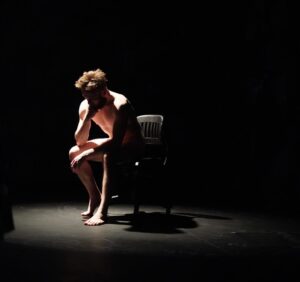
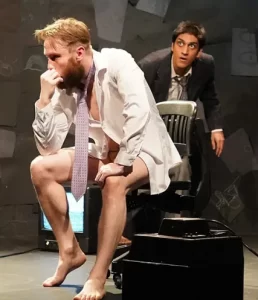
Brecht and Laughton’s script and Trap Door’s production aren’t just the story of how the visionary was oppressed by the ignorant at the behest of their exploiters. That’s part of it, of course, but Lovejoy’s Galileo is a man whose fear is nearly as strong as his pride. His apprentice who is basically like a son, Andrea (Shail Modi), is an idealist; his daughter, Virginia (Genevieve Corkery) wishes he could be normal so he could give her a dowry and stop getting in trouble, but Galileo is somewhere in between. Very early on, he tells his wife (Joan Nahid, who doubles as the Inquisitor), that he won’t be burnt at the stake like Giordano Bruno was ten years earlier because he has incontrovertible proof, and she immediately disabuses him of the notion that these decisions get made out of genuine regard for evidence. After a few disappointing incidents and close calls, Galileo takes this to heart and self-censors for eight years.
One of the devices that Truax uses throughout the play is to have the characters orbit around each other, both physically and by repeating their lines with slight changes in emphasis. It’s a neat way to show Galileo getting worn down, not only by the same objections, but by the trap between different gravitational pulls he has found himself in. Joan Nahid is a sinister Inquisitor and Gus Thomas plays the regal but unreliable members of the ruling class, but Dan Cobbler is a third antagonistic force as the personification of the up-and-coming businessmen who exploit Galileo and science in general. He’s funny and even charming, but equally dangerous. Another device is that many of the characters carry box TVs to indicate who currently has sway with public opinion, a smooth way of broadening the elitist world of a play in which the mood of the common people is often remarked on but mostly known second-hand.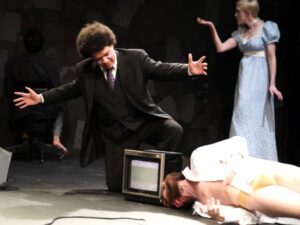
Before the vocabulary to describe the universe as we currently understand it existed, the moon and planets were described as stars, and both classical pagans and the medieval Abrahamic religions often equated them with Heaven as holiness and the afterlife. A point that is made throughout the play is that Galileo proved that Heaven is really just other Earths even less hospitable than our own, and this is treated as even more devastating to the common people’s faith than learning the truth about our physical location. However, Galileo’s initial hope that reason will provide a path to paradise is also steadily eroded, and his submission is driven in large part by coming to suspect that the Age of Industry he is ushering in won’t be a good one for humanity. I found it remarkable that Brecht could take a historical conflict in which one side was totally, objectively wrong and still make it a tragedy about a hero being torn between two contradictory moral imperatives. Galileo might be too timely to provide catharsis, but I was fascinated by the production and its way of framing science’s struggles.
 Galileo will continue at Trap Door Theatre, 1655 W Cortland Ave, Chicago, thru June 14, at the following times:
Thursdays: 8:00 pm
Fridays: 8:00 pm
Saturdays: 8:00 pm
Running time is ninety minutes with no intermission.
Tickets are $31 with 2 for 1 admission on Thursdays. Special group rates are available. Visit Trap Door Theatre or call 773-384-0494 or email boxofficetrapdoor@gmail.com
To see what others are saying, go to Theatre in Chicago and click “Galileo.”




More Stories
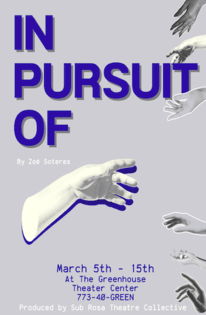
“In Pursuit Of”
“The Brief Wonderous Life of Oscar Wao” reviewed by Paul Lisnek, Curtain Call Chicago
“The Play That Goes Wrong”