
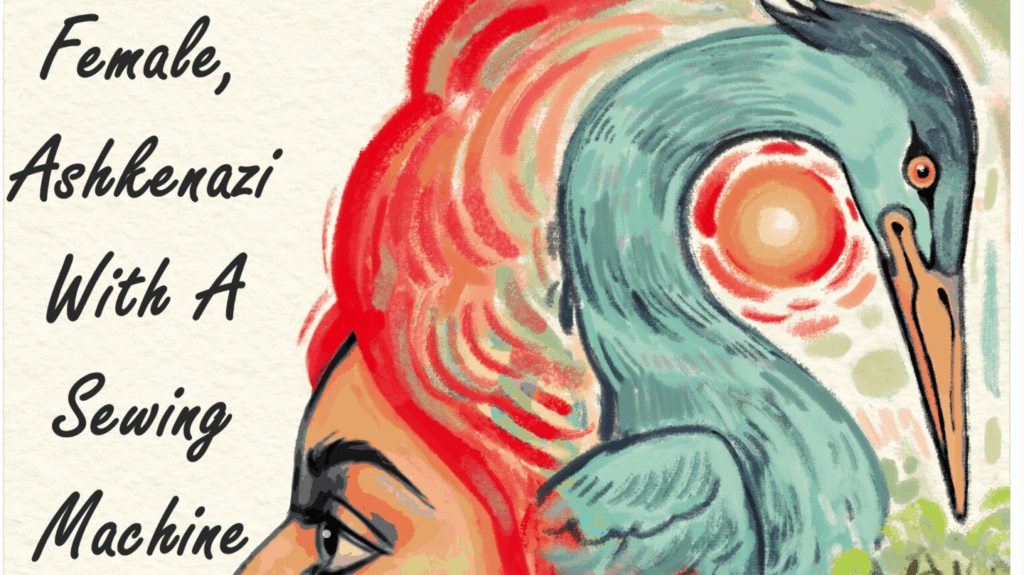
 *** “Female, Ashkenazi with a Sewing Machine” by Jamie Greenblatt tells a personal (though fictionalized) story about the playwright’s bout with cancer. Part cathartic, part educational, the play lays the groundwork for an audience to learn something about a serious genetic mutation that affects 1 out of 40 Ashkenazi Jewish women. Having the BRCA gene increases the risk that these women will get ovarian or breast cancer sometime during their lifetime.
Directed by Izadorius Tortuga, the play takes place in the contemporary era. It depicts a loving relationship between Anna (Haley Basil, who does a phenomenal job acting) and Benjamin (Keith Surney) and how their affection for each other grows into marriage. This is supposedly a “mixed marriage”, as Benjamin is a fully practicing Jew (with a good knowledge of Hebrew and the Jewish traditions) and Anna is a non-Jew. Yet at the beginning, Benjamin says that his radar tells him that she is really Ashkenazi. While Anna highly doubts that, she also knows that she was adopted as a child and has never learned who her birth mother was. The only legacy from her unknown past is inheriting a Singer 301 sewing machine, built in 1951. Anna has always cherished this machine, which serves as her constant companion, and she really enjoys sewing, especially making quilts. She is, in fact, a member of a quilting society.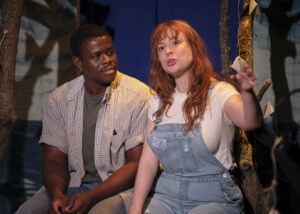
We watch how Anna and Benjamin really want to have children, but she has an issue with miscarriages. The last time that she believes she has gotten pregnant, she learns instead that she has developed a tumor, diagnosed as ovarian cancer. After undergoing genetic testing, Anna finds out that she has the BRCA gene mutation and is asked if she’s an Ashkenazi Jew. Now she not only undergoes medical treatment for her deadly disease but starts out on a journey to discover her heritage.
All throughout the play, there is a spirit-guide (Margo Chervony) who takes on different forms as she leads Anna through her life’s transitions: having to do with family matters as well as with her cancer diagnosis and treatment. This spirit-guide (with her exaggerated movements and expressions), often seems to exist in Anna’s imagination. But at other times, she is a real person, like a medical doctor or a social worker. At one point, Chervony, in the role of the Foundress, presents herself as Anna’s Ashkenazi ancestor, who informs her about the increased prevalence of the BRCA gene mutation among Eastern European Jews, going back to the Black Death of 1347. When only 350 Jews survived and subsequently married among themselves, this caused the BRCA gene mutation to become more predominant among this small population than it otherwise might have been.*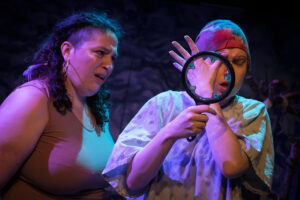
The quilting theme represents the tie that binds people together from one generation to the next. The color indigo is important here, because it is considered to be the strongest color of all. It is the holy color, associated with Abrahamic traditions. God (in the Bible) has commanded the Jews to decorate each of four corners of their garments (and subsequently the fringes of the tallit, or ritual shawl) with a blue thread. Another theme having to do with strong roots to one’s culture and tradition is represented by the tree, which stands before us on stage. It’s a clever twist when its paper leaves carry important, if not prophetic, messages.
My guest and I did have some issue with the ending (which I won’t ruin for you). I liked the idea of the unknowingness of the future, and I was good with the symbolism of the blue heron, which represents the ability to navigate life’s challenges with serenity and wisdom. Yet my guest thought that everything should have been wrapped up more tightly in a bow. Was the ending meant to be real or fantastical? Was it meant to take place on the earthly plane or the heavenly plane or the astral plane—or all of the above?
Thanks to set designer Viscaya Wilson, there is a multipurpose set, largely consisting of a painted backdrop of furious clouds and some type of sea or lake below. This works well in portraying the angst of going through life seemingly rudderless. It also could indicate the boundary between this world and that of the unknown: whether it’s called the void, the afterlife, the Great Beyond, or what you will.
The musical score by Richard Jennings has its sad and compelling notes, and Venus Fu, the violinist, performs it very well. During opening night, several people arrived late to the Berger Park Coach House to take their seats, even after Fu was given the go-ahead to start the opening music (already more than ten minutes after the official start time). Considering that this is such an intimate venue, it was an excellent decision on her part to pause until everyone was seated. However, the violinist and her equipment should not have been stationed directly in front of the emergency exit door (which should have been marked with the obligatory EXIT sign).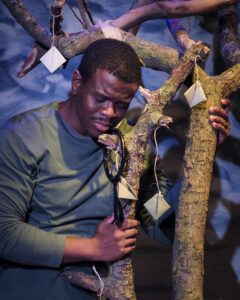
Costume design by Ashley E. Benson is very good. I liked the hospital gowns with their zippers and hidden compartments and especially liked the segment where the surgery is being simulated: where we see a string of internal organs being pulled from Anna’s body. Tristin M. Hall, the intimacy designer, has a big role in this play, considering the close contact among the actors in various romantic scenes plus those involving medical procedures. Julie Adams, the lighting designer, has done a fine job in demarcating scenes and characters.
By watching this production, we see the tragic experience of a young woman diagnosed with ovarian cancer and going through surgery, chemotherapy, and other forms of treatment. Anna’s trusty sewing machine turns out not just to be a family heirloom but a means for keeping body and soul together. We can’t help but notice the deep love that Benjamin has for his wife and how this adds to her resilience, with his willingness to help her out in the best way that he possibly can. With her spirit-guide constantly at her beck and call, Anna is never alone in her existential journey, all the while her cancer diagnosis becomes the added impetus for finding her biological roots. Then there’s the role of modern science: While early genetic testing can be useful for discovering the predilection for developing malignancies, there are additional reasons for studying DNA, that is, to find out more about one’s ancestry.
“Female, Ashkenazi with a Sewing Machine” is playing through August 23, 2025, at the Berger Park Coach House, 6205 N. Sheridan Road, in Chicago.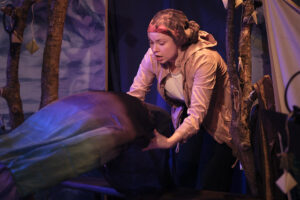
 General Admission Tickets: $25.00 plus an applicable service fee
Seniors: $20.00 plus an applicable service fee
Students: $20.00 plus an applicable service fee
Performance schedule:
Thursdays and Fridays at 7:30 p.m.
Saturdays at 3:00 p.m.
To purchase tickets, visit https://www.zeffy.com/en-US/ticketing/female-ashkenazi-with-a-sewing-machine.
For more information about this show and about Arts Judaica’s other offerings, please go to: https://www.artsjudaica.com/.
*According to the internet, “BRCA gene mutations occur in all races and ethnicities. Individuals of Ashkenazi Jewish descent have a 1 in 40 chance of having a BRCA1 or BRCA2 gene mutation as compared to about 1 in 200 individuals in the general population.” Also note that men and women are equally likely to possess the gene mutation, which can also cause pancreatic cancer and prostate cancer, but not as frequently as breast and ovarian cancer. Also note that not having this particular gene mutation doesn’t mean that you won’t be at risk to develop cancer, because random mutations are always possible and could happen to any individual, in any generation, at any time.
To see what others are saying, visit www.theatreinchicago.com, go to Review Round-Up and click at “Female, Askenazi With a Sewing Machine”.




More Stories
“The Brief Wonderous Life of Oscar Wao” reviewed by Paul Lisnek, Curtain Call Chicago
“The Play That Goes Wrong”
“Carmen” reviewed by Frank Meccia